The Unity of Shamor and Zachor

Parshat VaEtchanan is read immediately after Tisha B’Av, on Shabbat Nachamu—the Shabbat of consolation. It also begins the seven-week journey toward Rosh Hashanah, a period of renewed energy and preparation, especially within Breslov.
Among the major events reviewed in the Parshah is the giving of the Ten Commandments. The original account appears in Parshat Yitro, when Am Yisrael stood at Har Sinai. Here, as Moshe Rabbeinu prepares to leave the world, he repeats the commandments for the generation about to enter Eretz Yisrael.
One might expect the wording to be identical. Yet there are significant differences, each of which reveals an additional dimension of the Torah.
The best-known example concerns Shabbat.
In Parshat Yitro, the Torah says:
“Zachor et Yom HaShabbat lekadsho” — “Remember the day of Shabbat to sanctify it.”
In Parshat VaEtchanan, it says:
“Shamor et Yom HaShabbat lekadsho” — “Guard the day of Shabbat to sanctify it.”
Zachor (remember) and shamor (guard) appear to describe two opposite aspects of Shabbat.
Zachor teaches the positive mitzvot through which we actively sanctify the day: Kiddush, Havdalah, the three meals and the other expressions of the holiness of Shabbat.
Shamor teaches restraint. We guard Shabbat by refraining from the thirty-nine categories of melachah (creative labor), together with the rabbinic restrictions and protections established by Chazal.
Zachor tells us what to do.
Shamor tells us what not to do.
Why does the Torah use one expression in Parshat Yitro and another in Parshat VaEtchanan?
Two Words Spoken as One
Rashi explains that zachor and shamor were not delivered as two separate commands.
“Shamor v’zachor b’dibbur echad ne’emru” — “Shamor and zachor were said in a single utterance.”
Hashem expressed both words simultaneously, something no human mouth can do and no ordinary ear can hear.
At Har Sinai, the Jewish people experienced the two commands as one. They heard shamor and zachor together. The letters themselves were also revealed together, despite their being entirely different words.
This was a supernatural revelation in speech, hearing and sight.
The question is why such a miracle was necessary. The Torah could have stated one command in the Ten Commandments and developed the other laws of Shabbat elsewhere, just as it expands upon the other mitzvot throughout the Torah.
Why did Hashem insist that shamor and zachor be revealed as one inseparable statement?
To understand this, we must first understand the apparent contradiction within Shabbat itself.
Shabbat Means Stopping
The word Shabbat is related to shevitah (cessation) and menuchah (rest).
For one day, Hashem tells us to stop.
We put aside work, business, travel, phones, messages, purchases and the constant activity of the week. We do not perform melachah. We step out of the world of production and control.
Shamor represents this side of Shabbat.
Guard the day. Refrain. Accept the boundaries. Do not act as though everything depends on your efforts.
Yet Shabbat is not spiritual inactivity.
It is the time when a Jewish neshamah (soul) can reach its highest levels of perception.
Torah learned on Shabbat has a unique power. The prayers and three meals elevate a person beyond what he can ordinarily reach during the week. The Arizal said that the spiritual perceptions he received during his sleep on Shabbat afternoon were equivalent to many hours of Torah study.
Reb Noson explains that when Rosh Hashanah falls on Shabbat, we do not blow the shofar because the three Shabbat meals themselves correspond to tekiah, shevarim and teruah. Eating a meal on Shabbat can accomplish what the sounding of the shofar accomplishes.
This is zachor—the active sanctification and elevation of the day.
So what is Shabbat?
Is it stopping or advancing?
Is it restraint or spiritual movement?
The Torah’s answer is that it is both, and not merely at different times. Shamor and zachor were spoken together because their unity is the secret of Shabbat and of spiritual life itself.
Running and Returning
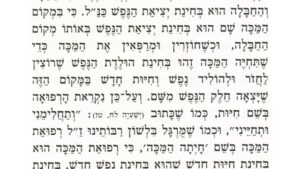
Rebbe Nachman explains in Likutey Moharan Lesson 24 that true spiritual growth requires two movements: advancing and being pushed back.
A person begins by running toward Hashem. He learns, davens, performs mitzvot and seeks greater levels of holiness. This movement is necessary. One cannot simply sit back and expect spiritual light to arrive without effort.
Young people often embody this energy. A teenager or newly married man may approach avodat Hashem (service of Hashem) with tremendous urgency: get up earlier, learn more, daven better, accomplish more.
This drive is precious.
The story is told that Reb Zusha of Anipoli would be urged to rise at midnight with the reminder that there would be enough time to sleep in the grave. There is too much to accomplish to waste life in sleep.
But Rebbe Nachman warns that forward movement alone can produce “too much light.”
A person needs to know when to stop. After running forward, he will inevitably be pushed back. His energy weakens, his inspiration disappears or circumstances prevent him from continuing at the same pace.
The pushback is not the failure of the process. It is part of the process.
A person is built not only by advancing, but by how he responds when advancement is no longer possible.
The Setback Completes the Advance
This is the unity of zachor and shamor.
Zachor is the movement forward—the desire to accomplish, sanctify and elevate.
Shamor is the restraint—the moment when Hashem says, “Stop. You cannot continue in the same way. Accept the boundary.”
They are not two unrelated stages.
Whenever a person advances, he must understand that the later setback will complete that advance. When he is pushed back, he must remember that the setback came because he previously moved forward and that another advance will follow.
The two movements belong to one spiritual structure.
A person often divides his life into periods of success and periods of failure. He thinks, “Then I was growing. Now I am going backward.”
Rebbe Nachman teaches that the movement backward may be the very thing transforming the earlier inspiration into something real and lasting.
The challenge is to receive the setback with simcha (joy) and emunah (faith), rather than with despair.
Shabbat Contains Both Movements
Shabbat is the clearest weekly expression of this truth.
Externally, Shabbat appears to be a day of retreat. We refrain from work, disengage from ordinary activity and accept strict limitations.
Yet precisely through that stopping, the greatest spiritual advancement becomes possible.
The Jew is not producing, traveling or controlling. Nevertheless, through Kiddush, the meals, prayer, Torah and menuchah, his neshamah rises to levels beyond what weekday exertion could accomplish.
Shamor is not preventing zachor.
Shamor creates zachor.
The restraint becomes the vessel for the elevation.
That is why Hashem did not present them as two separate instructions. If shamor and zachor had been spoken separately, a person might conclude that spiritual life alternates between unrelated modes: sometimes action and sometimes rest.
By speaking them simultaneously, Hashem revealed that the stopping and the advancing are one process.
Rebbe Nachman teaches that simcha can emerge from a broken heart, as it exposes your overlooked good points, and those points become the foundation of joy.
The Young Man and the Older Man
This perspective changes how we evaluate people at different stages of life.
A young man may look at an older person moving slowly and assume that he is spiritually inactive. The younger person is energetic, learning intensely and rushing to accomplish. The older man may need more time to walk, read or complete ordinary tasks.
The young person may think, “What does he know? I am moving forward while he can barely move.”
But the older person may possess a much deeper perception of life and Hashem.
He has already experienced both the running and the pushback. He has been tested, disappointed and forced to rebuild. He knows that life cannot be sustained by youthful energy alone.
The younger person may not yet have encountered the setback that will test whether his enthusiasm is rooted deeply enough to endure.
When that setback comes, the question will not be how quickly he once ran, but whether he can remain connected to Hashem when he can no longer run.
The older person’s slowness may therefore conceal a wisdom the younger person has not yet acquired.
Speech, Sight and Hearing
Rashi emphasizes that the unity of shamor and zachor appeared in three ways.
They emerged from Hashem in one utterance.
They were revealed together as one written word.
They were heard simultaneously.
These three faculties—speech, sight and hearing—correspond to Chochmah, Binah and Da’at, the three primary faculties of the mind.
Sight corresponds to Chochmah (wisdom). When Adam and Chavah ate from the Tree of Knowledge, the Torah says that their eyes were opened. Rashi explains that this refers not simply to physical vision, but to awareness and perception.
Hearing corresponds to Binah (understanding). The Zohar associates listening with the heart, the place where understanding develops. Hearing means receiving something, considering it and grasping its implications.
Speech corresponds to Da’at (integrated knowledge and connection). The verse in Mishlei says, “From His mouth comes knowledge and understanding.” Speech takes internal perception and connects it to expression.
Hashem revealed shamor and zachor together through all three faculties because the union of advancement and restraint must penetrate the entire mind.
A person must see it, understand it and live with it as integrated knowledge.
The Nine Chambers
Rebbe Nachman teaches that when Chochmah, Binah and Da’at encounter the pushback of the Keter, they become intermingled and multiplied.
Three faculties interact with three, creating nine chambers.
These nine chambers become vessels through which a person can receive a perception of the Infinite Light—something beyond his previous capacity.
The details of this teaching are profound, but its practical meaning is clear: the setback does not merely slow a person down. It rearranges and deepens his understanding.
When the faculties of the mind are challenged, they begin working together in new ways. The person’s wisdom, understanding and lived awareness become more mature.
This can produce breakthroughs that were impossible through forward movement alone.
Shamor and Zachor therefore do not merely coexist. Their interaction creates the vessels for an entirely new level of perception.
The Mastery of the Tzaddikim
Reb Noson explains in Likutey Halachot that the great Tzaddikim mastered this movement of advancing and returning.
Their greatness was not that they experienced constant uninterrupted ascent. They also encountered boundaries, concealment and pushback, each according to his level.
Their distinction was that they knew how to work with both movements.
They advanced with tremendous strength when it was time to advance, and they accepted the setback when Hashem required restraint. They understood that neither movement stood alone.
Through this mastery, they reached the extraordinary perceptions that earned them the title of Tzaddikim.
A regular Jew must apply the same principle on his own level.
One need not be a Tzaddik to recognize that both shamor and zachor are part of life. Even an ordinary Jew must learn to move forward without being destroyed when the forward movement stops.
Shabbat Nachamu
This teaching is especially appropriate for Shabbat Nachamu.
We have just completed the mourning of Tisha B’Av. We confronted the destruction of the Beit HaMikdash and the enormous losses of exile.
Now comes consolation.
But consolation does not mean pretending that the loss never happened. Shabbat Nachamu contains both mourning and renewed joy.
We remember what was destroyed, but we also look at what remains. We accept the setback and begin moving forward again.
That too is shamor and zachor.
Shamor preserves the memory of the loss and the boundaries imposed by exile.
Zachor calls us to sanctify what remains, rebuild and advance with simcha.
True consolation is not forgetting the destruction. It is discovering that the destruction does not eliminate the possibility of rebuilding.
Searching Through the Ashes
Reb Noson once walked with his followers through Breslov after a devastating fire.
They saw a homeowner whose house had been completely destroyed. The man stood among the rubble, weeping over everything he had lost. Yet while he cried, he searched through the debris for anything that might still be usable.
Reb Noson pointed to him and explained: even when a person has been completely burned, he must search for what can still be salvaged. From those remaining pieces, he can begin again.
The man did not deny the destruction. He cried.
But he also searched.
That is the correct union of brokenheartedness and hope, shamor and zachor.
A person may lose plans, opportunities, relationships or spiritual achievements. He may look at his life and feel that everything has burned.
The question is whether he will search through the ashes for the good that remains.
One mitzvah remains. One good desire remains. One point of emunah remains. One relationship can still be repaired. One new beginning is still possible.
That remaining point can become the foundation for rebuilding.
Rebuilding After the Holocaust
This capacity was demonstrated on an almost unimaginable level after the Holocaust.
Many survivors lost their spouses, children, homes and communities. Some found it impossible to begin again. Their suffering had been overwhelming.
Yet others remarried, established new homes and raised children and grandchildren.
A man who had lost his wife and children could have concluded that his life was over. Instead, some were able to say, “I must begin again.”
That did not erase the first family or diminish the loss. It meant that the setback, however devastating, would not be allowed to become the final word.
Their new families became living evidence that Am Yisrael could survive destruction and produce new fruit.
They embodied the unity of shamor and zachor: guarding the memory of what was lost while actively building the future.
The Key for All of Life
Shabbat is not only one day of the week. It teaches the pattern through which a Jew must approach the week, the year and his entire life.
There will be times of zachor—times of energy, action, learning and visible advancement.
There will also be times of shamor—times of limitation, waiting, restraint and apparent retreat.
Both come from Hashem.
The setback should not cause a person to dismiss his earlier growth, and the period of growth should not make him believe that setbacks will never come.
He must know in advance that they work together.
When he can run, he should run.
When Hashem tells him to stop, he should use the stopping to receive a deeper light.
When something is destroyed, he should mourn honestly and then search the rubble for what remains.
That is how a person reaches his tikkun (rectification).
May we be zocheh to internalize the unity of shamor and zachor, to advance with simcha when the path is open and to hold onto emunah when Hashem pushes us back. May Shabbat Nachamu bring true consolation, helping us preserve what remains, rebuild what was lost and move forward toward redemption.
Shabbat Shalom u’Mevorach.
Meir Elkabas
- 0 comment