- Israel ⬦ Read ⬦ Shabbat ⬦ Tzaddik ⬦ Weekly Torah Portion
Running After the Best
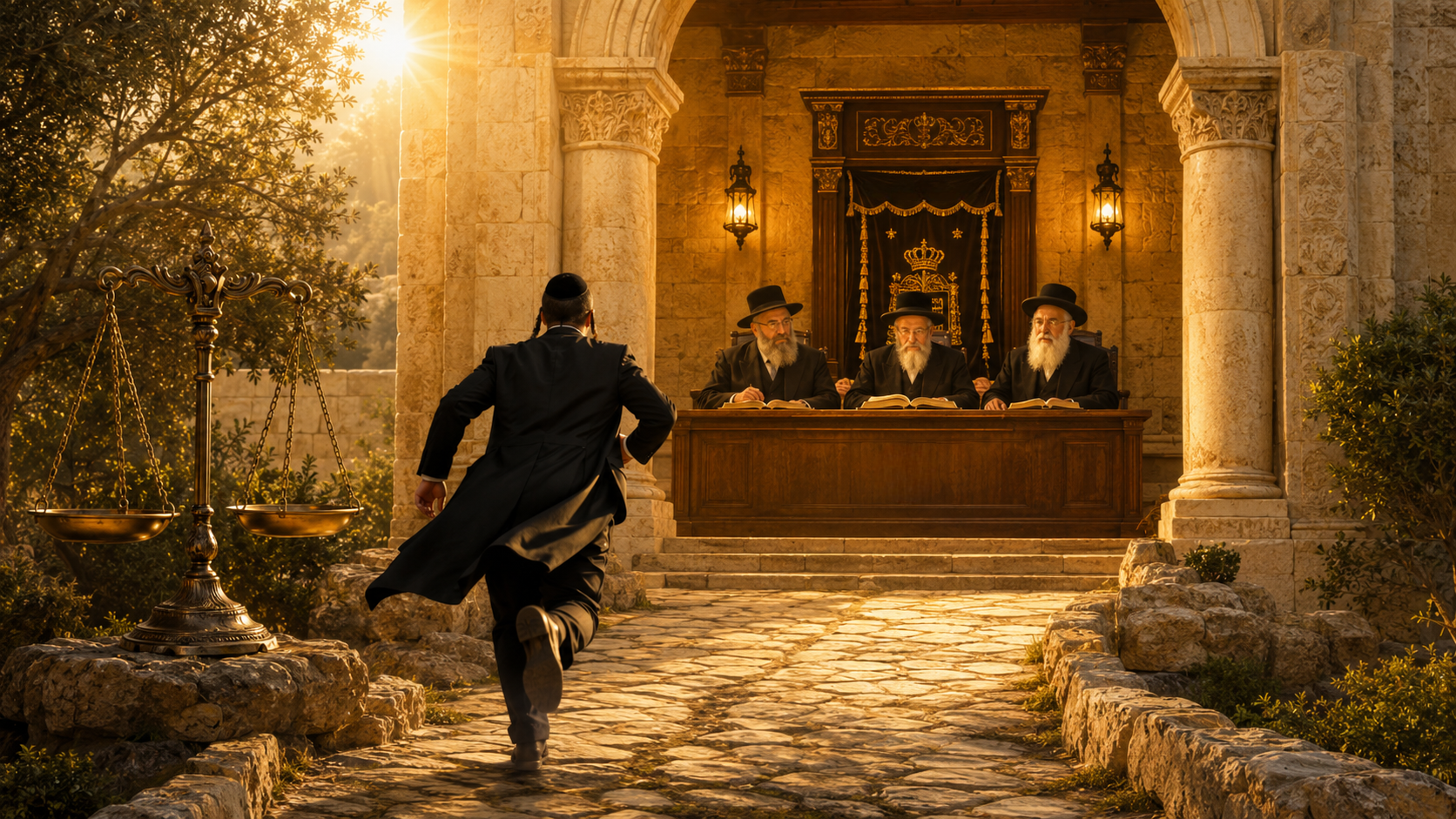
Parshat Shoftim opens with the command to establish a proper system of justice:
“Shoftim v’shotrim titen lecha” – “You shall appoint judges and officers.”
Every city and tribe must have judges who rule according to Torah and officers who ensure that their rulings are carried out. The Torah then warns:
“Lo tateh mishpat, lo takir panim, v’lo tikach shochad” – “Do not pervert justice, do not show favoritism and do not take a bribe.”
Then comes the famous command:
“Tzedek tzedek tirdof” – “Justice, justice shall you pursue.”
Why does the Torah repeat the word tzedek?
Rashi explains:
“Halech achar Beit Din yafeh” – “Go after an excellent court.”
It is not enough merely to have judges. A person should seek out the best judges and the finest Torah authorities he can find.
And the Torah immediately connects this pursuit with Eretz Yisrael:
“Lema’an tichyeh v’yarashta et ha’aretz” – “So that you may live and inherit the Land that Hashem your God is giving you.”
This raises a question. Why is pursuing the finest Beit Din linked specifically to the ability to remain in Eretz Yisrael?
The answer touches the very nature of the Holy Land.
The Center of the Infinite Light
Kabbalah teaches that when Hashem created the universe, He first formed what is called the Chalal HaPanui, the “vacated space.”
Hashem’s Infinite Light was everywhere. In order for finite creation to exist, there had to be, so to speak, an empty space within which the universe could emerge.
Into that space Hashem sent a ray of the Infinite Light toward its central point. From that point, creation unfolded.
What is the center?
The Kabbalists identify it progressively.
The center of creation is the earth.
The center of the earth is Eretz Yisrael.
The center of Eretz Yisrael is Yerushalayim.
The center of Yerushalayim is the Beit HaMikdash.
The center of the Beit HaMikdash is the Holy of Holies.
And at the center of the Holy of Holies is the Even Shetiyah, the Foundation Stone, from which the world was established.
That ray of Divine vitality did not disappear when the Beit HaMikdash was destroyed. Hashem continues to sustain creation at every moment, and the spiritual point through which that life enters the world remains connected to Yerushalayim and the place of the Holy of Holies.
For this reason, Eretz Yisrael has a unique capacity to expose a person to Hashem’s Infinite Light.
The closer one is spiritually to that source, the greater the potential revelation.
But potential is not enough.
The Infinite Light can only be received through the proper vessels.
The Expertise of Going Forward and Back
Rebbe Nachman explains in Likutey Moharan Lesson 24 that a person cannot receive the Infinite Light simply by moving forward continuously.
Spiritual life requires two movements.
There is advancement: a person learns, davens, changes, grows and comes closer to Hashem.
Then comes the pushback.
Something stops him. His inspiration disappears. His plans fall apart. He experiences frustration, confusion or circumstances that seem to drive him backward.
The person who interprets every setback as failure will eventually collapse.
He may begin with tremendous aspirations but, after enough disappointment, conclude that there is no point in continuing. This is one of the reasons people give up on improving themselves spiritually and morally: they do not understand that setbacks are built into the process of growth.
Rebbe Nachman teaches that one must become an expert in both movements.
When Hashem allows him to advance, he advances.
When Hashem pushes him back, he knows how to hold on.
He does not surrender in either state.
This expertise is essential everywhere, but it becomes especially important in Eretz Yisrael because the spiritual light available here is so intense.
To live close to greater light requires greater vessels.
The Tzaddik Who Knows Both Directions
For this reason, a person needs guidance from the highest caliber of Tzaddikim.
There are Tzaddikim who reveal beautiful Torah insights. Their teachings may be deep, powerful and true.
But there is another level of Tzaddik: one whose concern is to bring godly light to every Jew, including the person who has fallen very far.
Such a Tzaddik knows how to strengthen someone while he is advancing and how to keep him alive spiritually when he is being pushed backward.
He can speak to the knowledgeable Jew and the uneducated Jew.
He can guide the person filled with inspiration and the person who has almost given up.
His Torah does not merely explain lofty ideas. It gives life.
This is the deeper meaning of “Tzedek tzedek tirdof.”
The Torah tells us not to settle for ordinary spiritual guidance. We must pursue the Tzaddikim who can guide a person through both tzedek and tzedek – the forward movement and the inevitable pushback that follows it.
Why “Tzedek” Twice?
The Ohr HaChaim notes the significance of the double expression “tzedek tzedek.”
The word tzedek shares its root with Tzaddik. The judges of Eretz Yisrael must themselves possess righteousness.
But the repetition points beyond ordinary righteousness.
A person needs a Tzaddik who understands both aspects of spiritual life.
There is the tzedek of advancement.
And there is the tzedek of the setback.
In Kabbalah, tzedek is also associated with Malchut and din (judgment). A setback can feel harsh. After a person advances, he may suddenly encounter difficulty, resistance or spiritual constriction.
That too is tzedek.
It is part of the just and necessary order through which Hashem allows a person to grow.
The real test is not only whether a person knows how to run forward. It is whether he knows how to survive the moment after the running stops.
The greatest Tzaddikim have mastered both states and can therefore teach others how to navigate them.
“Tzedek tzedek tirdof” means: pursue those Tzaddikim.
Do not assume they will come to you.
“Tirdof” means run after them.
Seek them out.
Seek the highest-quality spiritual leadership
Why Aliyah Can Be So Difficult
This helps explain a painful reality.
Many Jews make Aliyah filled with idealism. Some first connect to Israel through Birthright or similar programs. Others make the jump and come through Nefesh B’Nefesh. They arrive hoping for greater spirituality, a better environment for their children and a more meaningful Jewish life.
Then they are hit with setbacks.
Parnassah becomes difficult. Bureaucracy becomes exhausting. Education becomes complicated. Family pressures emerge. What seemed like the obvious spiritual move suddenly feels unbearable.
Some eventually say, “I cannot do this,” and leave.
The question is understandable.
“I came back to my roots. I came to the Land of the Jewish people. I was trying to do something holy. Why is everything becoming harder?”
The answer is that living in Eretz Yisrael is not necessarily easy.
The Gemara teaches that Eretz Yisrael is acquired through difficulties.
A person is coming closer to a place of tremendous spiritual light. That itself creates tests.
The problem is not that the person made a mistake by coming.
The question is whether he has the tools to handle the pushback that follows the advance.
This is precisely why the Torah says:
“Tzedek tzedek tirdof… lema’an tichyeh v’yarashta et ha’aretz.”
If you want to live in and truly inherit the Land, seek Tzaddikim who know how to guide you through thick and thin.
They can help you understand that the setback is not proof that you do not belong.
It may be part of what belonging here requires.
Yerushah and Rash
There is another hint in the Torah’s language.
The word yerushah (inheritance) contains the root rash, meaning poor or impoverished.
To inherit Eretz Yisrael, a person must be capable of becoming “poor” before Hashem.
This does not mean depression, worthlessness or self-hatred.
It means humility.
A person recognizes:
“Hashem, without You, I am rash (רש). I have nothing independently. Everything I possess and everything I accomplish comes from You.”
Only someone willing to relinquish the illusion of self-sufficiency can truly receive the Land as an inheritance from Hashem.
Eretz Yisrael is not conquered spiritually through ego.
It is received through dependence upon Hashem.
Tzaddikim Who Give Life
The Tzaddikim we must pursue are therefore not merely brilliant Torah scholars.
They are compassionate guides whose Torah can reach a Jew wherever he is.
A person may know very little Torah.
He may have fallen spiritually.
He may be discouraged, confused or ashamed.
The true Tzaddik can still speak to him.
He can give him one point of light, one reason to begin again and one piece of advice that makes continued avodat Hashem possible.
That quality is indispensable in Eretz Yisrael.
The intensity of the Land can elevate a person tremendously, but without the proper guidance, the same intensity can overwhelm him.
The greatest Tzaddikim teach a person how to receive the light without being broken by the setbacks that accompany it.
Who Is Really Standing on the Land?
There is a striking Midrash concerning the soil of Eretz Yisrael.
A person may physically live in the Holy Land yet be unworthy of its holiness. The Midrash describes angels placing the earth of the Diaspora beneath such a person’s feet, so that although he appears to be walking in Eretz Yisrael, spiritually he is not truly standing upon its soil.
This lends itself to a humorous observation: perhaps that explains why some secular Israelis are so fond of imported Italian floor tiles – they can say, “I am not standing in Israel; I am standing in Italy.”
But the Midrash has a much more serious second half.
There are Jews living in the Diaspora who desperately want to be in Eretz Yisrael but face obstacles they genuinely cannot overcome.
Their hearts are here even though their bodies are elsewhere.
For such worthy Jews, the angels take the holy earth that has, so to speak, been displaced from beneath the undeserving resident of Israel and place it beneath the feet of the Jew in the Diaspora who longs for the Land.
Spiritually, he is walking upon Eretz Yisrael.
The teaching shows that connection to the Land is not merely geographical.
Desire, worthiness and spiritual orientation matter.
Walking Four Amot in Eretz Yisrael
Chazal attach enormous significance to walking even four amot (cubits) in Eretz Yisrael.
Why is physically walking upon its soil so important?
Because the earth of the Land is the point of contact with the spiritual channel through which the Infinite Light enters creation.
Due to its being connected to humility, the earth itself connects a person to the holiness of the Land.
This is why being physically present in Eretz Yisrael—and even walking upon things connected to its soil—has such spiritual significance.
The Holy Land can transmit extraordinary gifts: simcha, length of days, Torah, emunah, deeper perception, a good life and nachat.
But those gifts require vessels.
The vessel is “Tzedek tzedek tirdof.”
You Have to Run After It
One word in the verse deserves particular emphasis:
“Tirdof” – “You shall pursue.”
The Torah does not say simply to admire righteousness or agree that great Tzaddikim exist.
You must run after them.
Finding the right spiritual guidance requires effort.
A person must search for Torah that gives him life.
He must identify Tzaddikim whose teachings strengthen him both when he is rising and when he is falling.
He must pursue the wisdom that teaches him not only how to become inspired, but how to remain connected when inspiration disappears.
That pursuit is itself part of acquiring Eretz Yisrael.
The Land exposes a person to an extraordinary light. The true Tzaddik teaches him how to receive it.
Running After the Best
Rashi’s interpretation of “Tzedek tzedek tirdof” is therefore more than advice for establishing an excellent court.
“Go after the best Beit Din.”
Seek the highest-quality spiritual leadership.
Do not settle for Torah that speaks only to the successful moments.
Find Torah that can reach a Jew when he is down, rebuild him and send him forward again.
Those are the Tzaddikim connected to the light of Eretz Yisrael.
Through their guidance, a person learns to master the movement described by Rebbe Nachman in Lesson 24: advancing without arrogance and retreating without despair.
Then he can become a vessel for the Infinite Light that shines through the Holy Land.
May we be zocheh to fulfill “Tzedek tzedek tirdof,” to seek out the true Tzaddikim who can guide us through both advancement and setback and, through their light, merit a genuine connection to Eretz Yisrael and the Infinite Light that shines within it.
Shabbat Shalom u’Mevorach and Chodesh Tov.
Meir Elkabas
- 0 comment