The Shekhinah calls to join in her crying
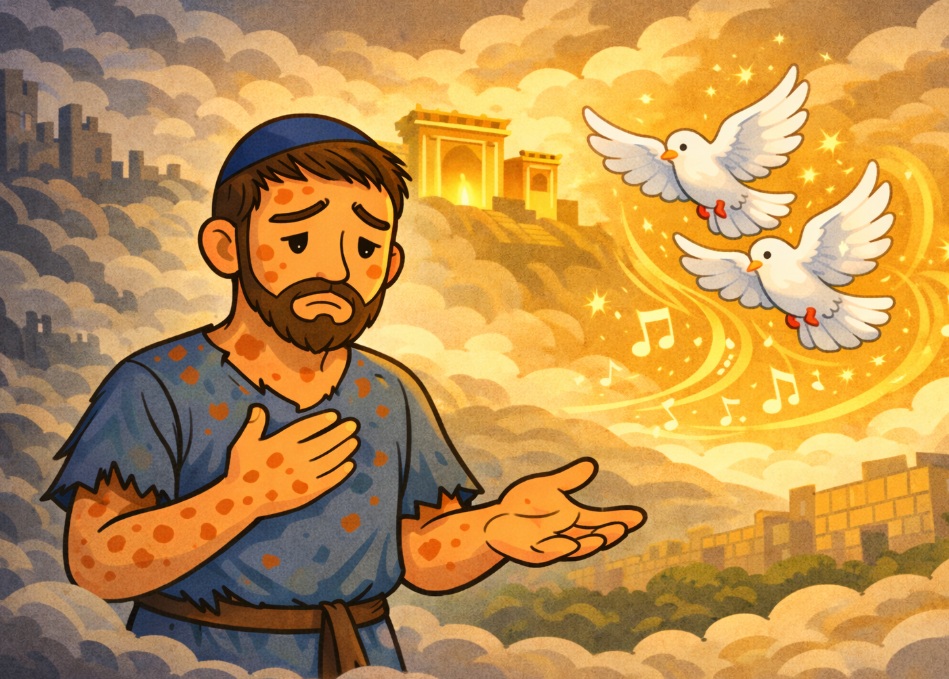
Parshas Tazria–Metzora teaches us the power of the human voice and how speech can distance a person from holiness or become the path back. A metzora, one afflicted with leprosy (tzara’as) for sins such as lashon hara, remains spiritually impure while the affliction is upon him. But once healed, he begins his return to purity by bringing two birds.
Reb Noson zal says that the two birds refer to the “shtei tzipporim chayos tehoros,” the two live pure birds that a metzora, a leper, must bring when he becomes cured (Likutey Halakhos, Nedarim 4:36). A leper is tamei. In order to become tahor, he has to bring a special korban of two birds. The Gemara says that the word MeTzORA (מצורע) means MOTzI RA (מוציא רע); i.e., he was punished with leprosy because he spoke lashon hara. He desecrated the kedushah of the kol, the voice, that was given to him from Heaven. Therefore, he must bring as a korban a symbol of that which is pure. The chirping of a bird is the sound of the special tefillah that the bird davens to HaShem in purity. The Gemara says, “Let these two birds, whose kolos are pure, come and bring forgiveness for the metzora whose kol has become tamei” (Arakhin 16b). These two birds represent purity of voice.
The Voice Between the Two Kruvim
The birds also represent the sefiros of Netzach and Hod, from which the power of nevuah emanates (Zohar Chadash, Sifra Tinyana). Every navi received his nevuah from these two sefiros. By the same token, the birds symbolize the keruvim, the two angelic figures on either side of the Aron HaKodesh (Likutey Halakhos, Nedarim 4:36). Whenever Moshe Rabbeinu had to receive a nevuah from Heaven, it says that the voice came “mibein shnei hakeruvim ” (Shemos 25:22, Bemidbar 7:89), from between the two keruvim in the Ohel Mo’ed, the Mishkan. Later, in the Beis HaMikdash, all nevuah also came forth from there. At the time of the Churban, the Shekhinah went into galus and the two birds were separated. This is why we no longer have the power of nevuah.
Joining the Shekhinah at Chatzos
The Shekhinah is also called Rachel (Zohar Bereishis). “Rachel mevakah al baneha” (Yirmiyahu 31:14). Rachel cries about her children, the Jews who are in galus. It does not say Rachel bokhah but rather, mevakah, meaning that she also causes others to cry along with her. Therefore, there is a mitzvah of getting up at midnight, as it says, “Kumi roni balailah” (Eikhah 2:19), Arise to say the Tikkun Chatzos and join in the wailing and crying over the churban Beis HaMikdash (Shulchan Arukh, Orach Chaim 1:2). Those who do so merit to have a chut shel chesed, great simchah and consolation, during the day. We say to them, “You cried over the Churban, the galus haShekhinah. Now, ‘Min’i kolekh mibekhi,’ you may stop crying because ‘yeish sakhar lifulasekh,’ there is a reward for your deeds ‘veshavu banim ligvulam’ (Yirmiyahu 31:15-16). The children will return to the boundaries of Eretz Yisrael, for the geulah is forthcoming.” The consolation to the birds is, “You will find your mate, you will be reunited, and the Shekhinah will return to its place in the Beis HaMikdash.”
The birds’ crying is the crying of the Shekhinah over her children. Those who are close to the Shekhinah cry with her during Tikkun Chatzos, the mourning over the Churban. That is why the site of the Churban is called the Wailing Wall. Those who are zokheh to cry there over the Churban will be zokheh to the simchah of its rebuilding le’asid lavo, in the future (Ta’anis 30b).