Everyone Needs a Rebbe!
ADAPTED FROM HIS AUDIO SHIUR ON EIN YAAKOV LESSON 12A – SHABBAT 127-147
Parshas Bo: The First Mitzvah and a Hidden Warning
Parshas Bo is the moment when the Jewish people receive their very first mitzvah – HaChodesh HaZeh Lachem (החודש הזה לכם). In his Ein Yaakov shiur, Rabbi Zvi Aryeh Rosenfeld Z”L explains that hidden in this mitzvah is a simple but powerful warning: when Torah is disconnected from proper learning, guidance, and a rebbi, even the greatest spiritual light can be dimmed.
When Physical Pleasure Overpowers Spiritual Life
The Gemara (Mesechta Shabbos 147b) says that there are two cities. In one city, the wine of that city is very good—excellent, superior to any other wine. In another city, the waters are like mountain waters. They draw a person to them. They are of excellent quality, far superior to any other place.
The Gemara says that the Ten Lost Tribes were destroyed by the wine of that city of Prugisa (פרוגיסא), a place that produces wine of exceptional quality, and by the water of Diomses (דיומסית). This wine and these waters draw a person to them, and this brings out physical desires, which automatically take a person away from spiritual values. They stop the study of Torah and go after physical pleasures. This brings them down to a point where they lose their religion, chas v’shalom. And that is what happened to the Ten Lost Tribes.
The Greatest Student Who Forgot His Torah
The Mishnah in Pirkei Avot says that Rabbi Yochanan ben Zakai had five students. The first student was Rabbi Eliezer HaGadol, the rebbi of Rabbi Akiva. So great was he—he was actually superior to all the rabbis of his time, despite the fact that he was not the Nasi. The chief rabbi was Rabban Gamliel.
Then there was Rabbi Yehoshua ben Chananya. He was called the Chachima d’Yehudai—the wisest of all the Jews, the cleverest. The fifth one was Rabbi Elazar ben Arach. The Mishnah in Pirkei Avot quotes Rabbi Yochanan ben Zakai who said: put all the students and all the rabbis of the Jewish people-on one side of the scale, and place Rabbi Elazar ben Arach alone on the other side. He would outweigh all of them in knowledge. So superior was he.
Now the Gemara says that this great Rabbi Elazar ben Arach—who was also known by a pseudonym, Rabbi Nehorai (רבי נהוראי)—traveled to a city that had this special, superior type of water. Nehorai (נהוראי) means “great light,” tremendous light, because he brought this great light to the Jewish people through his Torah. While staying there, he was drawn to the water.
As great as he was, he was drawn into it to the point where he stopped studying Torah, and he forgot his learning—he completely forgot what he had learned.
When he returned from that place—after being there for quite a while—he came back to the yeshivah. He went to read, not Gemara, but Chumash, just to read the words. The first mitzvah in the Torah is HaChodesh HaZeh Lachem (החודש הזה לכם). This is the first mitzvah that Hashem gave the Jewish people when they left Egypt—the month of Nissan, the month of Pesach, the laws of Pesach.
The first words are HaChodesh HaZeh Lachem (החודש הזה לכם)—“this month is for you.” When reading these three words, he said HaChiresh Haya Libam (החרש היה לבם).
In other words, he made a mistake in every one of the three words. Instead of HaChodesh (החודש), “this month,” he said HaChiresh (החרש), which means “deaf.” Instead of HaZeh (הזה), “this,” he read Haya (היה), “was.” Instead of Lachem (לכם), “for you,” he said Libam (לבם), “their heart.”
The entire sentence was changed to HaChiresh Haya Libam (החרש היה לבם)—“the heart was made deaf; it could not hear.” When we say that the heart hears, it means the heart understands. The heart became deafened to the point that he lost his learning. The Gemara says that the rabbis had pity on him. They prayed for him, and his knowledge returned to him.
Therefore, it says in Pirkei Avot, using his pseudonym, that Rabbi Nehorai (רבי נהוראי) says: leave your home and go to a place to study Torah, and never be sure of yourself. Always continue to study Torah. Never say that you can rely on others for it. He stressed afterward how dangerous it is for a person to stop the study of Torah. This is what the Gemara says, but it pays to examine these words carefully.
Three Altered Words That Reveal the Danger
There is, naturally, a deeper message here. Why did he pick specifically these three words? Why did he change the words in such a precise way? Missing a letter could produce a meaningless word, yet here each word still had meaning—and the three together formed an exact message. And why only these three letters?
If we examine this carefully, the Ari HaKadosh explains that in HaChodesh (החודש), if you change the dalet (ד) to a reish (ר), it becomes HaChiresh (החרש). In HaZeh (הזה), he changed it to Haya (היה), introducing a reish (ר) and a yud (י). In Lachem (לכם), he changed it to Libam (לבם), introducing a reish (ר), yud (י), and bet (ב).
Reish–Yud–Bet spells Riv (ריב), meaning machloket (מחלוקת), dispute, and safek (ספק), doubt. Additionally, the Arizal explains that the numerical value of Reish–Yud–Bet is 212, corresponding to 212 groups of destructive forces that operate under the Satan.
This teaches that when a person leaves Torah, he becomes vulnerable to these 212 destructive forces.
Without a Rebbi, the Heart Cannot Hear
What we have learned many times is the importance of learning Torah—how to learn Torah and where to study Torah. But there is another message here as well. The difference between a heart that hears, accepts, and absorbs, and one that does not, is whether one learns alone.
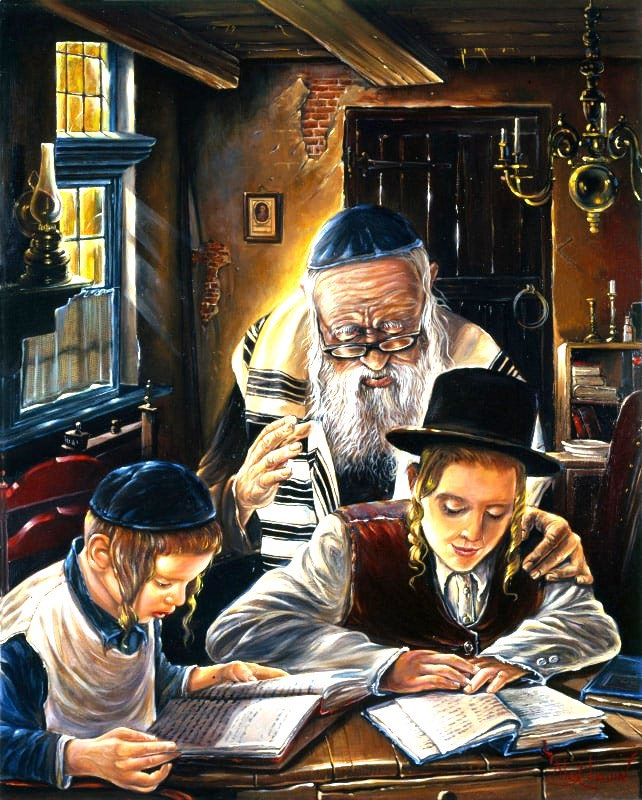
The Gemara says that one who learns by himself is subject to Cherev al HaBadim (חרב על הבדים)-the sword upon the loners. His learning is considered flawed and dangerous. One who learns with another—especially one who learns from a rebbi (רבי)—is successful in Torah.
When Rabbi Elazar ben Arach warned about leaving Torah—and above all, leaving one’s rebbi—the three letters hidden in these words are Reish–Bet–Yud, spelling Rebbi (רבי).
When the rebbi is missing, instead of Torah shining forth—HaChodesh HaZeh Lachem (החודש הזה לכם), celebrating together the mitzvah of Pesach—the result is HaChiresh Haya Libam (החרש היה לבם). The source of Torah has been damaged. Without the rebbi, the heart becomes hardened, unable to absorb, and no true knowledge can enter. This was the hidden message that Rabbi Elazar ben Arach conveyed.
- 0 comment