The Fire Was Too Strong!
ADAPTED FROM HIS AUDIO SHIUR ON SHOFTIM – LESSON 4
From Nadav and Avihu to Shimshon HaGibbor
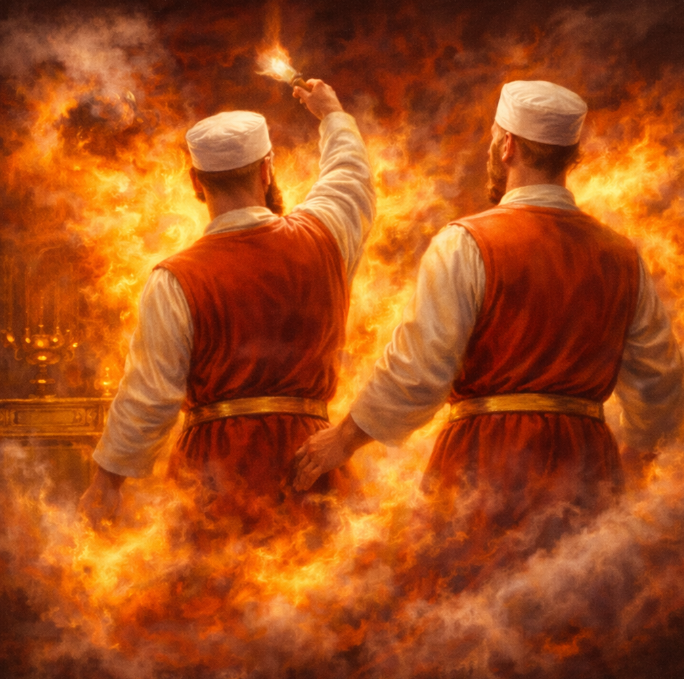
Parshas Shemini opens with one of the most powerful and mysterious moments in the Torah – a moment of incredible closeness to Hashem, and at the same time, a moment of פחד and awe. On one side, we have the highest revelation: “וַתֵּצֵא אֵשׁ מִלִּפְנֵי ה׳” – a fire comes down from Heaven. The Shechinah is revealed. The Mishkan is complete. Everything is exactly as it should be. And then, almost immediately, the Torah tells us something shocking: “וַיַּקְרִיבוּ… אֵשׁ זָרָה אֲשֶׁר לֹא צִוָּה אֹתָם.” Nadav and Avihu—the greatest, holiest of people—bring their own fire… and everything changes. The Zohar HaKadosh as well as the Arizal reveal something even deeper and more surprising: That the soul of Shimshon HaGibbor, one of the most powerful and unique figures in Tanach, was actually a gilgul—a reincarnation—of Nadav and Avihu. Shimshon Hagibbor was one of the greatest and most unique heroes of Bnei Yisrael, a Nazir from birth blessed with extraordinary strength, who spent twenty years fighting and weakening the Pelishtim. His strength, however, was tied to his spiritual mission, and when he became involved with Delilah, he was ultimately deceived into revealing the secret of his strength. Once his hair was cut, the Shechinah departed from him, and he was captured, blinded, and imprisoned in Azza. In his blindness and isolation, he entered deep hisbodedus, crying out to Hashem in sincere repentance for his mistakes. As a sign that his teshuvah was being accepted, his hair began to grow back and the spirit of Hashem slowly returned. Later, during a massive celebration honoring their god Dagon, the Pelishtim brought Shimshon to mock him in a stadium filled with thousands. Standing between the two central pillars, he davened for one final surge of strength, and with Hashem’s help, he pushed them apart, collapsing the entire structure and killing himself along with his enemies. Despite the devastation, his body was found intact, and he was buried with honor – remembered as a hero who gave his life in the ultimate act of sacrifice for Am Yisrael. The Navi here notes that “the number of those whom he killed in death was far greater than the number of those whom he killed in his lifetime” (Rashi and Radak, Shoftim 16:28). Rav Noson zal teaches us (Likutey Halakhos, Basar beChalav 5:29) that this is more than just a posthumous tribute to his final act of courage. The Navi tells us this for a deliberate reason. But first one must understand the importance of attaching oneself to a tzaddik. The Gemara teaches us that attaching oneself to a tzaddik allows one’s spiritual imperfections to be cleansed in this world. Otherwise, one must undergo a cleansing process after death that involves the indescribable suffering of Gehinnom.
Tzaddikim are greater in death than in life
As we said earlier, one who attaches himself to a living tzaddik can have his spiritual imperfections purged without having to undergo either of the two Gehinnoms. Should the tzaddik pass away, maintaining that closeness by studying his writings and continuing to firmly believe in him will assure that the cleansing powers of the tzaddik in his lifetime will be multiplied manifold upon his passing. Indeed, the Gemara (Chullin 7b) tells us that “tzaddikim are much greater in death than in life.” In his lifetime, a tzaddik may entreat HaShem for something and not be answered simply because HaShem treasures the tzaddik’s prayers and wishes for them to continue. This is why our ancestors Yitzchak and Rivkah had to pray for twenty years before being blessed with children. But once the tzaddik passes away, the strength of his prayers is greatly magnified and that is what the Gemara is hinting at in stating that tzaddikim are much greater in death than in life. Their ability to overpower evil is greater in death than in life. This brings us back to our pasuk which states in regard to Shimshon that “the number of those whom he killed in death was far greater than the number of those whom he killed in his lifetime.” A tzaddik can destroy more evil after his passing than he can during his lifetime. Consequently, his power to purify those who cling to him in faith after his passing is greater as well.
Shimshon’s path to Gan Eden
We said earlier that the reason Shimshon prayed to avenge the loss of only one of his eyes was so that he could be compensated for the loss of the other in the World to Come. One may wonder why he would be concerned about getting his due reward in the next world, being as he was a tzaddik. Could it be that he was afraid of being punished for having had relations with non-Jewish women? The Zohar HaKadosh as well as the Arizal address this question. According to the Arizal (Shaar Hagilgulim, Hakdamah 36), Shimshon was a combined reincarnation of Nadav and Avihu, the two sons of Aharon HaKohen who brought an unauthorized incense offering at the inauguration of the Mishkan and were consequently consumed by a heavenly fire. These two sons of Aharon were very great tzaddikim, as the Torah itself testifies (Shemos 10:3). Yet as a result of their offering a “strange fire,” their neshamos were consumed by fire while their bodies remained intact. Aside from the sin of initiating an unauthorized offering, various other reasons are offered for why they were so severely punished (Vayikra Rabbah 20:6-10). One of these is that they were culpable on account of not being married. Another ascribes it to their having been drunk with wine upon entering the Mishkan, which the Torah prohibits in an ensuing passage. In order that these sins be rectified, they had to be reincarnated in the person of Shimshon. As a consequence of their not having married, they were forced in their reincarnation to consort with Pelishti women, whereas their getting drunk on wine necessitated their forswearing wine for the duration of Shimshon’s life. The main question, though, is what happened to Shimshon afterwards? Were all his sins atoned for? According to the Gemara (Yoma 82a), death together with teshuvah, repentance, atones for all one’ sins. For the sin of having looked desirously upon Pelishti women, he was already punished by having his eyes gouged out (Sotah 9b). Was his suffering at the hands of the Pelishtim and his dying a horrible death enough to completely prepare him for the World to Come? The Zohar HaKadosh tells us not. He still had to be reincarnated so as to complete his rectification. He came back again as King Tzidkiyahu, the last king of Yehudah who rebelled against the Babylonians and upon being captured was punished by having his eyes gouged out. Hence Shimshon had to suffer that same punishment again and again in order to get his sin erased. The Arizal goes on to list a number of blind figures in our history who were reincarnations of Shimshon. Why did Shimshon have to undergo so many reincarnations so as to enter Gan Eden? Did he in fact enter Gan Eden? The answer is that undoubtedly Shimshon was a great tzaddik. But the greater the tzaddik, the more exacting HaShem is in calling him to account for his sins. That is why so many generations had to pass before Shimshon’s sins could be completely rectified. The last reincarnation he had to undergo was in the person of Rav Yosef, a great Talmudic Sage who, despite being blind, headed a key Babylonian yeshivah. So in the end Shimshon merited great honor in this world and then went on to enjoy honor in the next.
The lesson for us is that Shimshon was a tzaddik, and we must be very careful not to diminish him through a superficial reading of the story. His willingness to sacrifice his life for Bnei Yisrael places him among our greatest heroes. And in truth, his story is deeply connected to Parshas Shemini. The Arizal teaches that Shimshon was a gilgul of Nadav and Avihu – souls of tremendous closeness to Hashem, whose fire once burned too intensely, “אֵשׁ זָרָה אֲשֶׁר לֹא צִוָּה אֹתָם.” What they began in Shemini—a yearning for closeness that lacked proper boundaries—Shimshon came to rectify through a life of struggle, restraint, and ultimately mesirus nefesh. It was precisely because he was such a high soul that he had to endure such suffering, until his final act—calling out to Hashem and giving his life—transformed that same fire into true kedushah, securing for him a place in the highest levels of Gan Eden.
- 0 comment