Extracting Ruth from the Chamber of Exchanges
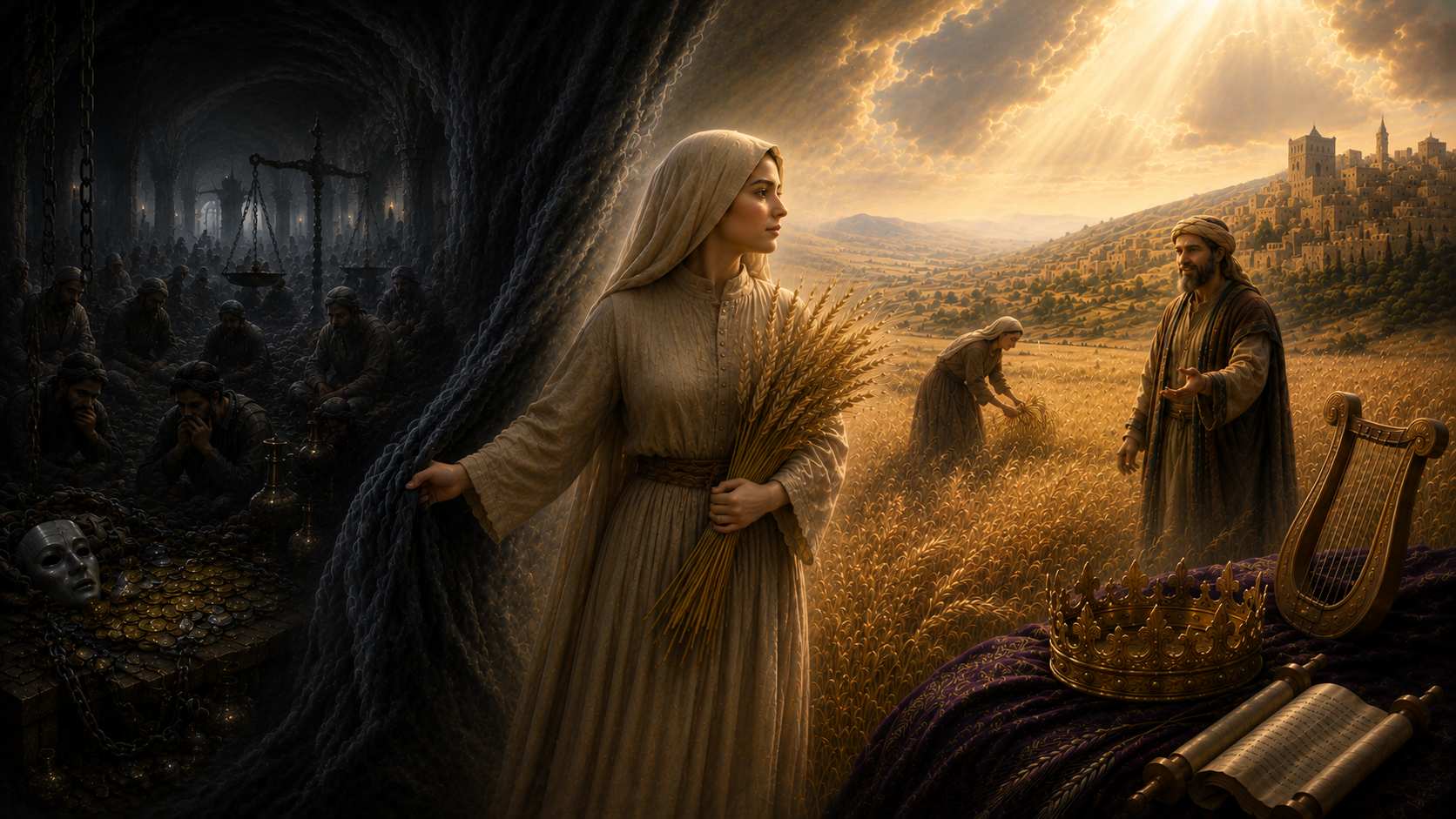
Shavuot is uniquely connected to Megillat Ruth. On the simple level, the connection is obvious: King David’s yahrtzeit falls on Shavuot, and Ruth is the ancestor of David HaMelech. But Chazal reveal that Megillat Ruth contains much deeper themes directly tied to the essence of Shavuot and receiving the Torah.
The final chapter of Megillat Ruth focuses on Boaz’s efforts to redeem the field of Machlon and marry Ruth. Although Ruth originally came from Moav, Boaz recognized extraordinary holiness hidden within her. He saw her modesty, kindness, loyalty to Naomi, and willingness to abandon everything in order to attach herself to Am Yisrael and to Hashem.
At the same time, there was major confusion surrounding her status. The closer redeemer, Ploni Almoni, refused to marry Ruth because he misunderstood the halachah regarding Moavites entering the Jewish people. He believed the prohibition applied equally to men and women, while the true halachah is “Moavi v’lo Moavit”—a Moabite male is forbidden, but not a Moabite woman.
This confusion surrounding Ruth reflects one of the deepest realities of creation itself.
The Chamber of Exchanges
Rebbe Nachman, based on the Zohar, teaches that after the sin of Adam HaRishon, the world entered a state called the “Chamber of Exchanges” (“Heichal HaTemurot”). In this state, good and evil became mixed together. Truth and falsehood appear intertwined. Light becomes hidden in the darkness, and holiness can appear outwardly distant or impure.
The soul originally existed in closeness to Hashem before descending into this world. Yet Hashem specifically sends the soul into physical existence so it can reconnect through challenge, confusion, and free choice.
This means that a Jew’s mission in life is not merely to avoid darkness, but to enter the confusion of the world and extract holiness trapped there.
Ruth herself embodied this process. Externally she came from Moav, a nation associated with spiritual impurity and rejection. But internally she contained the future light of David HaMelech and Mashiach.
Why Great Souls Face Greater Confusion
Reb Noson explains that the greater a person’s spiritual potential, the more intense the confusion and challenges he may face. The Yetzer Hara invests enormous effort specifically against souls capable of extracting great holiness from the Chamber of Exchanges.
This explains why truly good people sometimes experience bewildering difficulties. Their struggles are not signs of abandonment. Rather, they indicate that hidden holiness is waiting to be elevated through them.
Ruth’s entire journey reflected this reality. She experienced widowhood, poverty, exile, uncertainty, and rejection. Yet hidden within all of those difficulties was the future redemption of Am Yisrael.
Simcha and the Extraction of Holiness
In Likutey Moharan lesson 24 Rebbe Nachman teaches that the primary tool for extracting holiness from darkness is simcha. Through performing mitzvot with joy, a person can elevate sparks trapped within confusion and impurity.
This process eventually leads a person toward the Keter, the spiritual crown associated with the Infinite Light. Through the Keter, Divine vitality, clarity, hope, and spiritual breakthroughs shine into a person’s life.
However, Reb Noson explains that entering the Chamber of Exchanges is extremely dangerous. Many people become overwhelmed by confusion or despair. Therefore, attachment to true Tzaddikim becomes essential.
The Power of the Tzaddikim
The Tzaddikim are called masters of simcha because they know how to remain connected to Hashem even while surrounded by darkness and confusion. Their joy allows them to descend into difficult places spiritually and elevate holiness trapped there.
Boaz represented this quality. Others saw only a Moabite convert. Boaz saw the hidden light destined to bring Mashiach into the world.
This is also the secret of David HaMelech himself. David’s life was filled with concealment, opposition, rejection, and suffering, yet from within those struggles emerged eternal kingship and redemption.
Shavuot and Receiving the Torah
Shavuot celebrates not only receiving the Torah, but the revelation that holiness can emerge specifically from concealment. The Torah was given to human beings living inside a confusing world—not to angels removed from struggle.
Megillat Ruth teaches that redemption itself grows from hidden places. Through faith, simcha, patience, and attachment to the Tzaddikim, a Jew can extract holiness from even the darkest situations and reconnect to Hashem.
This is the deeper connection between Shavuot and Megillat Ruth: the revelation that even within the Chamber of Exchanges, hidden sparks of holiness are waiting to be redeemed.
There are battles a Jew cannot overcome through his own strength alone
The Power of Tehillim and the Help of the Tzaddikim
Reb Noson explains that an average Jew often finds it extremely difficult to maintain simcha while struggling within the “Chamber of Exchanges” (“Heichal HaTemurot”), where holiness and impurity appear mixed together. A person can feel trapped in darkness, confusion, and spiritual exhaustion, unable to find clarity or joy on his own.
What can such a person do?
The answer is attachment to the Tzaddikim.
The Tzaddikim of the caliber of Moshe Rabbeinu possess the ability to shine light even into the darkest situations. Through their teachings, prayers, advice, merit, and spiritual strength, they help lift a person out of despair and reconnect him to Hashem.
Ruth herself represents the ultimate example of holiness trapped within impurity. She came from Moav—a nation born through spiritual corruption and immorality—yet from her emerged King David and eventually Mashiach. Chazal even see the greatness of David HaMelech hinted within her very name. The Gemara explains that she was called Ruth because she would have a descendant (King David) who would “saturate” (rivah) to Hashem through praises and song in Sefer Tehillim.
The Simplicity of Tehillim
Rebbe Nachman teaches that one of the greatest pathways to redemption is the simple recitation of Tehillim. Sometimes a person imagines that spiritual greatness depends only on intellectual achievement or deep scholarship. Yet Rebbe Nachman explains that even the greatest Torah scholars must eventually put everything aside and speak simply to Hashem through Tehillim.
This simplicity possesses enormous power.
Mashiach himself is connected to this path of simplicity, sincerity, and heartfelt prayer. Through Tehillim, a person activates the light of David HaMelech and the holiness rooted within Ruth herself.
“V’Zot Lefanim B’Yisrael”
The verses describing Boaz’s redemption of Ruth contain profound allusions to this entire process:
“V’zot lefanim b’Yisrael…” — “And this was formerly done in Israel…”
The Midrash explains that “zeh” refers to holiness and revelation of Hashem, while “zot” can refer to the side of impurity and idol worship. The process of redemption involves elevating holiness trapped within “zot” back toward the Divine countenance.
The verse continues:
“Al hageulah v’al hatemurah” — “Regarding redemption and exchange.”
This directly hints to redeeming holiness from the Chamber of Exchanges itself.
But how is such a redemption accomplished?
The verse answers:
“Shalaf ish na’alo v’natan l’re’ehu” — “A man removed his shoe and gave it to his friend.”
Reb Noson explains that the shoe symbolizes a person’s connection to physicality and the difficult tests encountered in the lowest places of life. The feet stand closest to impurity, and therefore require protection. Sometimes the struggle becomes too overwhelming for a person to handle alone.
At that point, he “gives over his shoe” to the Tzaddikim (“to his friend” – רעהו – in the verse is referring to Moshe Rabbeinu who is called the Faithful Shepherd – רעיה מהימנא – etymologically similar to “friend”).
In other words, he admits: “Hashem, I cannot overcome this battle alone. I need the help of the Tzaddikim.”
The Example of Yehoshua and Calev
This concept appears throughout Tanach. Before entering Eretz Yisrael, Yehoshua required Moshe Rabbeinu’s blessing to withstand the influence of the spies. Calev traveled to Chevron specifically to pray at the graves of the Avot and ask for their assistance.
Both recognized the same truth: there are battles a Jew cannot overcome through his own strength alone.
Attachment to the Tzaddikim becomes the bridge that allows a person to survive confusion, withstand the Chamber of Exchanges, and eventually extract the holiness hidden there.
Shavuot and the Light of Redemption
This is one of the great gifts of Shavuot.
Shavuot is not only the anniversary of receiving the Torah. It is also the revelation that Hashem provides faithful shepherds—Moshe Rabbeinu and the true Tzaddikim of every generation—to help Am Yisrael navigate the darkness and confusion of the world.
The yahrtzeit of David HaMelech falls on Shavuot precisely because David represents the power of Tehillim, simplicity, yearning, and redemption. Through Tehillim and attachment to the Tzaddikim, a Jew can break through the walls blocking his path and arrive at his true spiritual destination.
May we merit on Shavuot to receive the light of the Torah with joy, attach ourselves to the true Tzaddikim, and strengthen ourselves through heartfelt Tehillim. Through this, may we succeed in extracting holiness from every darkness and draw closer to the final redemption with the coming of Mashiach, speedily in our days. Amen.
Chag Sameach!
Meir Elkabas
- 0 comment