The Diminishment of Five
Parshat Pinchas comes each year near the beginning of the Three Weeks, the period between the Seventeenth of Tammuz and Tisha B’Av. These weeks are a time of mourning, but they are also a powerful opportunity to come closer to Hashem.
The verse in Eichah says:
“Kol rodfeha hisiguha bein hametzarim” — “All her pursuers overtook her between the straits.”
On the simple level, Rashi explains that “bein hametzarim” refers to the narrow period between the Seventeenth of Tammuz and Tisha B’Av. During these days, the enemies of Am Yisrael overtook us and brought destruction.
But the Maggid of Mezritch reveals a deeper meaning. The word “rodfeha” can be read as “rodef Yud-Kei” — one who pursues Yud-Kei, the first two letters of Hashem’s Name. A person is running after a higher perception of Hashem, but that level is too lofty to grasp directly. Yet “hisiguha” can be read as “hisig Vav-Kei” — he can attain Vav-Kei, the second half of the Name, specifically “bein hametzarim,” within the constricted days of the Three Weeks.
In other words, precisely in these narrow places, a person can reach something. The highest light may be beyond him, but through the constriction itself, he can receive a vessel for perceiving Hashem.
That is the background to one of the striking details in Parshat Pinchas: the number of families counted as Am Yisrael prepares to enter Eretz Yisrael.
The Census After the Plague
At the beginning of Parshat Pinchas, Hashem commands Moshe Rabbeinu to count Am Yisrael again after the devastating plague that followed the sin with the daughters of Midian and Moav.
Many Jews had fallen through immorality and idolatry as a result of Bilaam’s advice. Yet Hashem does not give up on Am Yisrael. After the plague, He commands a new census. The people are counted again, tribe by tribe and family by family, as they prepare to enter and inherit the Land.
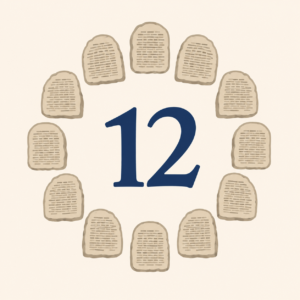
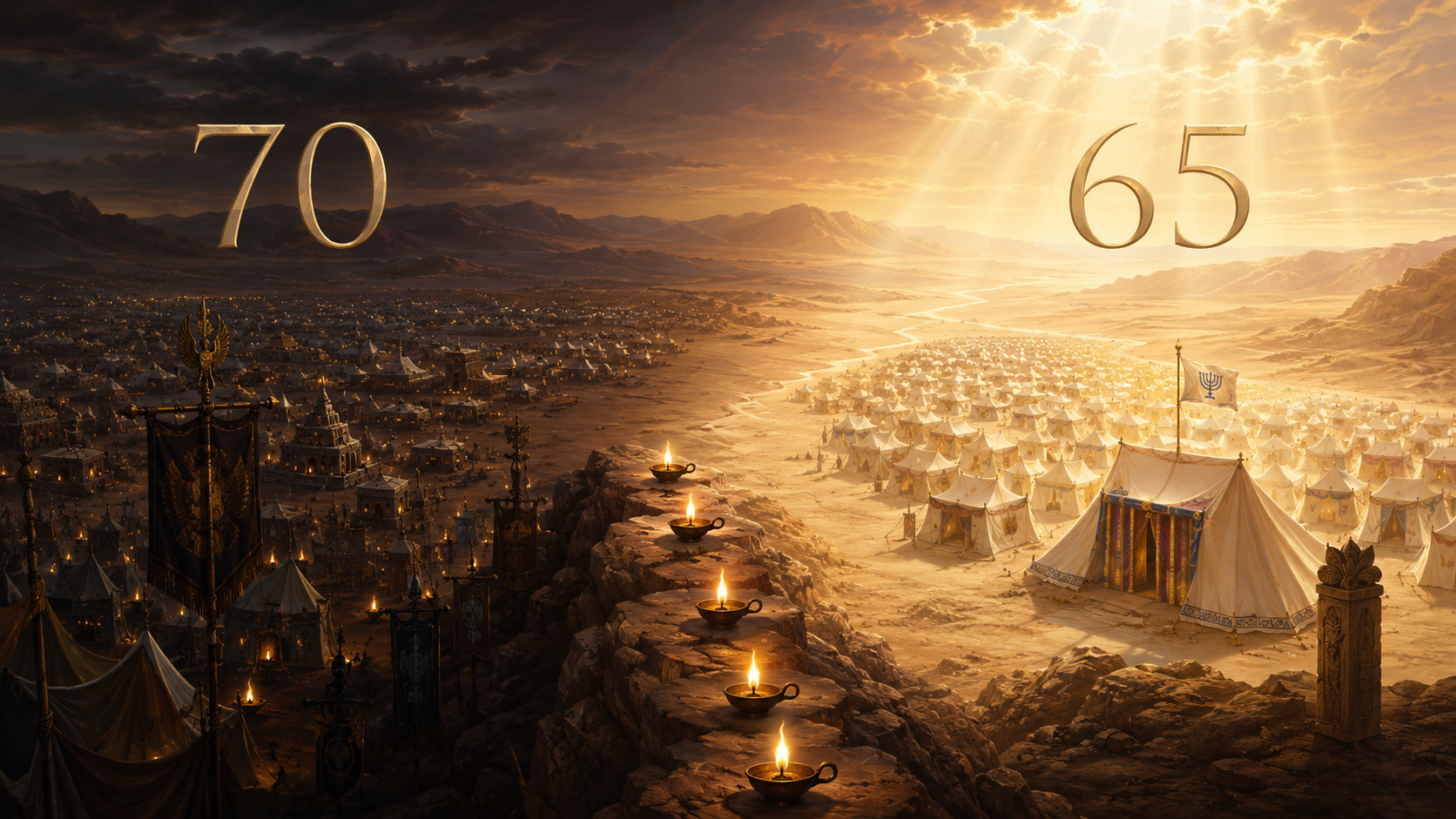
Rashi points out that the total number of families listed in this census, together with the Levi’im, is sixty-five.
This number is not incidental.
The nations of the world descend from the seventy nations listed after Noach. Humanity branches into seventy nations and seventy languages. Yet here, as Am Yisrael prepares to enter Eretz Yisrael, the Jewish families number only sixty-five.
Seventy minus five.
Rashi connects this to a verse in Parshat Va’etchanan:
“Ki atem hame’at mikol ha’amim” — “For you are the smallest of all the nations.”
On the simple level, the verse means that Hashem did not choose Am Yisrael because we are large or powerful. Just the opposite. We are the smallest of the nations.
But Rashi in Parshat Pinchas reads the word “hame’at” as two parts: “hei me’at.” The letter hei has the numerical value of five. “Hei me’at” means five less. Am Yisrael is five less than the seventy nations. Instead of seventy, we are sixty-five.
The question is: why does this matter?
What is the meaning of being diminished by five?
The Greatness of Being Small
In Parshat Va’etchanan, Rashi explains the same verse in another way.
“Ki atem hame’at” means not only that Am Yisrael is numerically small, but that we know how to make ourselves small. Hashem chose us because we diminish ourselves. When Hashem gives us greatness, blessing and spiritual light, we do not become inflated by it. We know how to step back, humble ourselves and say, “This is not mine. I am not worthy of this.”
Rashi gives examples. Avraham Avinu said, “I am dust and ashes.” Moshe Rabbeinu and Aharon said, “What are we?” David HaMelech said, “I am a worm.”
The greatness of Am Yisrael is that when Hashem bestows abundance, we do not allow that light to make us arrogant. We know how to be me’at — small, reduced, diminished.
This is the key to receiving more.
The nations of the world want greatness without diminishment. They want wisdom, power, culture, science, creativity and success, but without the humility needed to receive the light properly. When too much light comes without a vessel, it overwhelms and corrupts.
Am Yisrael’s path is different. We receive by becoming smaller.
Seventy and the Search for Secrets
The number seventy is associated with sod (secret). Samech is sixty, vav is six, and dalet is four, totaling seventy.
The Torah has seventy facets. These seventy faces of Torah are the gateway to the secrets of creation. They open the path toward deeper perception of Hashem’s wisdom in the world.
The seventy nations also seek secrets. They try to probe the depth of life and creation through worldly means: culture, philosophy, science, art, literature, entertainment and human wisdom. They keep producing new books, new theories, new systems and new visions of life because they are searching for the secret of existence.
But the secret is not found there.
The true sod is found in the Torah.
The nations are seventy, but they cannot reach the inner secret through their own greatness. Am Yisrael, by contrast, can access the seventy facets of Torah precisely because we are not seventy. We are sixty-five.
We reach the secret by accepting diminishment.
Lesson 24 and the Secret of the Setback
This is exactly what Rebbe Nachman teaches in Likutey Moharan Lesson 24.
A person wants to reach the Infinite Light. He wants clarity, closeness to Hashem, blessing and deep perception. But the Infinite Light cannot be received directly. If it were to shine into a person without a vessel, he would be overwhelmed.
Therefore, Hashem gives a pushback.
A person comes close, then feels pushed away. He receives light, then experiences darkness. He advances, then feels diminished. That setback is not a rejection. It is the creation of a vessel.
Reb Noson develops this idea at length in Likutey Halachot, especially in the laws of giving thanks and in the laws of Nefilat Apayim (falling on one’s face). The secret of receiving the Infinite Light is to know how to accept the setback with simcha (joy) and emunah (faith).
The pushback is the me’at. It is the diminishment.
A person thinks, “I was close, and now I am far. I had light, and now I feel small. I was growing, and now I have fallen back.”
But in truth, this very diminishment is the key to growth. If a person accepts it properly, with humility, joy and faith, it becomes the vessel through which he can receive even greater light.
That is the greatness of Am Yisrael. We are hei me’at — diminished by five. We know that the path to the highest levels is through constriction.
Sixty-Five and the Hidden Name
The number sixty-five has another deep meaning.
When we see Hashem’s Name written as Yud-Kei Vav-Kei, we do not pronounce it as written. Instead, we read it as Alef-Dalet-Nun-Yud, the Name of Adnut. Alef is one, dalet is four, nun is fifty and yud is ten, totaling sixty-five.
In other words, sixty-five is the Name we pronounce in place of Yud-Kei Vav-Kei.
This itself is the secret of diminishment.
We know there is a higher Name written before us, but we do not pronounce it. We cover it. We read a lower expression, Alef-Dalet-Nun-Yud, and through that cover-up, we connect to the higher Name.
At first, this may seem strange. If the higher Name is written, why not say it directly? Why not access the light openly?
The answer is that we cannot receive that light directly. We need a garment, a cover, a vessel.
Alef-Dalet-Nun-Yud is that vessel. It is the sixty-five that allows us to connect to the seventy and beyond.
This is the same message as Rebbe Nachman’s teaching. A person reaches the highest levels not by refusing limitation, but by accepting it. The cover-up is not a block. It is the way in.
When a person feels reduced, limited, pushed back or covered over, that very diminishment may be the vessel being formed for a greater light
Accepting the Cover-Up
This is one of the deepest messages for life.
A person wants to see Hashem clearly. He wants open light, obvious answers, visible progress and direct connection. But Hashem often gives him life in a covered form.
He gives him setbacks. He gives him waiting. He gives him limitations. He gives him situations where the light is hidden inside a lower vessel.
The person can become frustrated and say, “This is not what I wanted. This is not the real thing. I want the light itself.”
But Am Yisrael knows the secret: the cover-up is the path.
We pronounce Alef-Dalet-Nun-Yud and through that connect to Yud-Kei Vav-Kei. We accept sixty-five and through that reach what is beyond seventy. We accept the me’at, the smallness, and through that receive the Infinite Light.
That is why the Jewish families entering the Land are counted as sixty-five. They are entering Eretz Yisrael not as the seventy nations, who try to seize the secrets of creation through their own power, but as Am Yisrael, who receive the secret through humility, diminishment and faith.
The Five Voices of Joy
There is another layer to the number five.
Reb Noson explains that the letter hei, which equals five, is connected to the five voices of joy mentioned in the blessing recited at a wedding based on a verse in Isaiah:
“Kol sason v’kol simcha, kol chatan v’kol kallah, kol omrim hodu laHashem ki tov” — “The voice of joy and the voice of happiness, the voice of the groom and the voice of the bride, the voice of those saying: Give thanks to Hashem, for He is good.”
These are the five voices of happiness.
Even physically, laughter is expressed through the sound of the letter hei: “ha, ha, ha.” The hei itself hints to joy.
In Breslov, we can connect this to the five practical pathways of simcha that Rebbe Nachman teaches. These are the “fabulous five,” the five ways to awaken joy even when a person is not naturally feeling it.
They may begin as small, even diminished, forms of joy, but they are powerful because they lead to true simcha.
The Five Ways to Joy
The first way is mili d’shtuta — lighthearted silliness. A person tells a joke, acts a little silly, or uses humor to break through sadness. It may feel fake at first, but Rebbe Nachman teaches that even an external act of joy can awaken genuine joy inside.
The second way is music, dancing and clapping. A person puts on a nigun, moves his body, claps his hands and enters an atmosphere of simcha. The music may begin from the outside, but it can open something real within him.
The third way is finding the good points. Instead of staring at what is broken, a person searches for the nekudot tovot, the good points within himself. He looks for the mitzvot he has done, the good desires he still has, the moments where he did try, and he allows himself to feel joy in that good.
The fourth way is hoda’ah — giving thanks. A person thanks Hashem for everything, beginning with the smallest details. He thanks Hashem that he woke up, that his soul returned to his body, that his eyes opened, that he can hear, breathe, speak, eat, walk and move. Even if things are not perfect, he looks for what does exist and gives thanks for every tiny detail.
The fifth way is simchat ha’atid — joy from the future. A person believes that in the end, everything will be repaired. There will be a time of true joy. Even now, while he is still struggling, he borrows joy from the future redemption and brings it into the present.
These five pathways are also a form of me’at. They can seem small, simple, even artificial. But they are the tools that allow a person to receive the great light.
Five Less Than the Nations
Now the phrase “hei me’at” becomes even deeper.
Am Yisrael is five less than the seventy nations. We are diminished by five, but that very five is our secret.
The nations try to reach the secrets of creation through greatness, expansion and haughtiness. Am Yisrael reaches the secrets through the five voices of joy, the five pathways of simcha, and the willingness to accept diminishment.
A Jew learns to be happy even with small things. He learns to be happy with a joke, a nigun, a good point, a word of thanks, or the hope of the future. These may look insignificant, but they train him to accept the me’at. They teach him how to become a vessel.
Because he can be happy with smallness, he can receive greatness.
This is why the diminishment of five is not a loss. It is the key.
The Secret of Jewish Greatness
Parshat Pinchas teaches that after a great fall, Hashem counts Am Yisrael again. Even after the plague, even after failure, Hashem shows that the Jewish people are still preparing to enter Eretz Yisrael.
But they enter with the number sixty-five.
They enter with Alef-Dalet-Nun-Yud, the Name that covers the higher Name. They enter with the willingness to accept concealment. They enter with the power of hei me’at, the diminishment of five.
This is how Am Yisrael accesses the secrets of Torah. Not by demanding direct revelation, not by imitating the seventy nations, and not by rejecting the setbacks of life. We access the secret by becoming vessels.
We accept the pushback. We accept the cover-up. We accept the smallness. We strengthen ourselves with the five pathways of simcha and keep moving forward.
Through sixty-five, we reach beyond seventy.
Receiving the Light Through Diminishment
The lesson is practical for every person.
When life becomes constricted, when a person feels reduced, limited, pushed back or covered over, he should not assume that Hashem has abandoned him. That very diminishment may be the vessel being formed for a greater light.
The work is to accept it with simcha and emunah. To say: “Hashem, I do not see the full Name. I cannot pronounce the higher light directly. But I accept the vessel You have given me. I accept the cover-up. Through this, I believe I can come closer to You.”
A person who lives this way can turn even the Three Weeks into a time of closeness. The bein hametzarim, the narrow straits, become the place where he can attain a new perception of Hashem.
May we be zocheh to understand the secret of hei me’at, the diminishment of five. May we strengthen ourselves with the five pathways of simcha, accept the setbacks of life with emunah, and through that become true vessels for Hashem’s Infinite Light.
Shabbat Shalom, and may we all receive true consolement with the coming of Mashiach, the gathering of the exiles and the building of our Holy Temple, Amen.
Meir Elkabas
- 0 comment