- Israel ⬦ Joy ⬦ Read ⬦ Shabbat ⬦ Weekly Torah Portion
The 70 Translations of the Torah
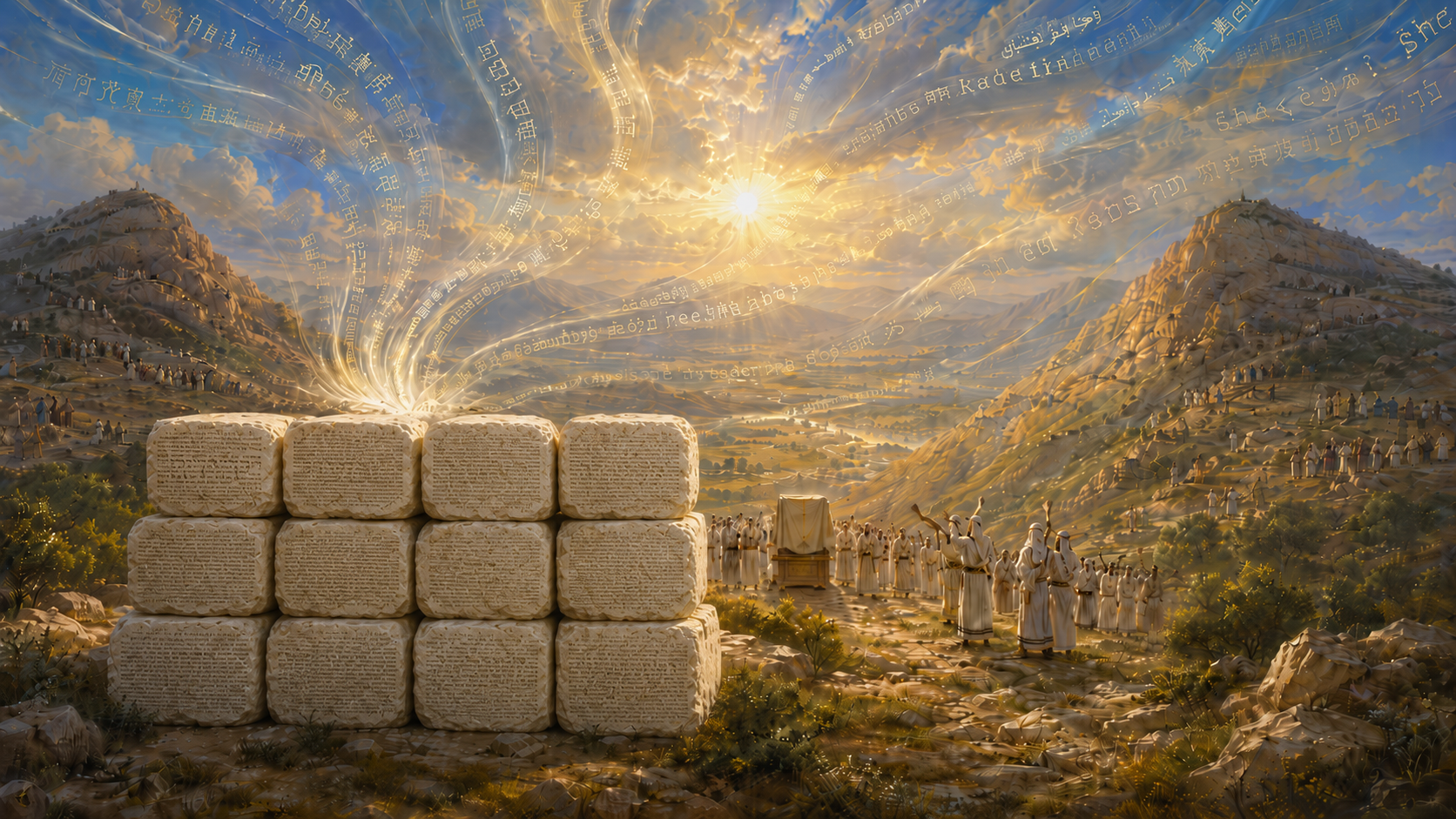
Parshat Ki Tavo describes what Am Yisrael was commanded to do upon crossing the Jordan River and entering Eretz Yisrael. Twelve stones were to be erected in the Jordan, while another twelve were taken from the river and ultimately brought to Har Eival. There, opposite Har Gerizim, the tribes would be divided between the two mountains, with the Kohanim, Levi’im and the Ark between them as the blessings and curses of the covenant were proclaimed.
The stones on Har Eival were also used to construct an altar. The Torah commands that they be coated with sid (lime) and used to build “mizbach avanim, lo tanif aleihem barzel” – an altar of stones upon which iron had not been raised. The stones had to remain whole, “avanim shleimot,” and a special worm was used for the necessary cutting rather than metal.
Burnt offerings and peace offerings were then brought upon the altar:
“V’achalta sham v’samachta lifnei Hashem Elokecha” – “You shall eat there and rejoice before Hashem your God.”
Immediately afterward, the Torah commands:
“V’chatavta al ha’avanim et kol divrei haTorah hazot ba’er heitev” – “You shall write upon the stones all the words of this Torah, clearly explained.”
Rashi explains the words “ba’er heitev” as “b’shiv’im lashon” – in seventy languages.
The Torah in Seventy Languages
The Gemara in Sotah 32a discusses these stones, and the commentaries emphasize the miraculous nature of what happened. Some understand that the 613 mitzvot were written upon them, while the Ramban maintains that the entire Torah was written. According to this understanding, the Torah was rendered into seventy languages in a single day, each language written in its own form and style.
The commentaries explain that these translations made the Torah accessible to the nations.
That itself raises a striking question. Torah is the inheritance of Am Yisrael, and there are limitations on teaching Torah openly to non-Jews. Why, then, was such an extraordinary effort made to translate it into all seventy languages?
The answer begins with the verse immediately before the command to write the Torah:
“V’samachta lifnei Hashem Elokecha.”
First comes simcha.
Am Yisrael had tremendous reason to rejoice. They had entered the Holy Land after forty years in the desert, and they were entering into a covenant with Hashem, expressed through the blessings and curses proclaimed at Har Gerizim and Har Eival.
Only after reaching that simcha were they commanded to write the Torah in seventy languages.
Torah Can Reach Every Place
The seventy languages correspond to the seventy nations and to the particular middot, attitudes and forms of expression associated with them.
The Torah being written in all seventy languages teaches that no matter where a Jew falls, and no matter where a holy spark becomes trapped, Torah can reach that place.
When Torah is translated, its external expression necessarily adapts to the language into which it enters. English, Spanish, French and every other language have their own vocabulary, style and way of expressing ideas.
Nevertheless, the truth of Torah remains intact.
This is the deeper meaning of the seventy translations. Torah can enter the language and expression of a nation without losing the truth contained within it. It can penetrate even a distant place, awaken the holiness trapped there and bring it back.
A mitzvah performed with simcha can extract holiness from the deepest darkness
The Truth of Torah
This connects to Rebbe Nachman’s teaching in Likutey Moharan Lesson 2, Part 2.
Rebbe Nachman teaches about emet, truth. When a person is genuinely connected to truth, that truth begins to express itself through his speech, prayer, davening and Torah learning.
Words that come from a point of truth have a unique power. They are not distorted by illusion or falseness, and because they emerge from such a pure place, they can reach another person.
The same is true of Torah itself.
Its truth cannot ultimately be manipulated or disrupted by the language through which it is expressed. Even when Torah enters one of the seventy languages and takes on that language’s external form, its inner truth can still shine through.
This is why it can travel to the farthest places and still awaken what has fallen there.
Seventy Nations, Seventy Facets
The number seventy carries additional significance.
There are seventy nations, but there are also seventy facets of Torah. The word sod, meaning secret, also has the numerical value of seventy.
The holy sparks trapped within the attitudes and qualities of the seventy nations therefore contain dimensions connected to the secrets of Torah.
When those sparks are brought back, they add something to the vitality and radiance of Torah precisely because of how far they had fallen.
The descent is distant, but the return reveals an additional dimension of holiness.
This gives another meaning to the Torah being written in seventy languages: the truth of Torah reaches into all seventy domains, retrieves what is trapped there and brings it back to its source.
Simcha, Gratitude and Truth
But the Torah first emphasizes simcha.
Rebbe Nachman teaches that a person comes to truth through giving thanks to Hashem. Hoda’ah creates a positive, joyful attitude, and through that simcha Hashem gives a person access to truth as a gift.
His Torah becomes connected to truth.
His speech becomes connected to truth.
His prayer becomes connected to truth.
And that truth can shine wherever he is.
This is the order found at Har Eival. First:
“V’samachta lifnei Hashem Elokecha” – rejoice before Hashem.
Then:
“V’chatavta… ba’er heitev” – write the Torah clearly in seventy languages.
Through simcha, the truth of Torah can reach outward without being altered by the place it enters.
May we be zocheh to learn Torah with genuine emet and to reach that truth through gratitude and simcha. May that truth shine through our Torah, our speech and our prayer, reaching even the most distant places and releasing the holy sparks trapped there so that they can return to Hashem.
Shabbat Shalom u’Mevorach.
Meir Elkabas
- 0 comment