Lech Lecha – Going Without Conditions
ADAPTED FROM HIS AUDIO SHIUR ON EIN YAAKOV LESSON 175B AND SHEVACHEY HARAN 7A
A test that strengthens generations
There were ten tests to which Avraham Avinu was subjected, and he passed all of them. What were those ten tests? Pirkei Avos tells us that he was tested ten times, without listing the details. Here the Gemara discusses these tests, pointing to events recorded in different places in the Chumash. The main test was when HaShem said to him: “Lech Lecha.”
You are living in your father’s house, surrounded by all the comforts of a wealthy home. Now leave that familiar life. Go into exile. Go to a strange land. Go to Eretz Yisrael, the land of HaShem, and there you should settle. Leave the comforts of home and go into what appears to be exile. But this will be your home. Eretz Yisrael is your home, the home of the Jewish people. This was a test.
We find something similar in our own time. Boys from wealthy homes give up those comforts to go to a strange city, even overseas, to a yeshivah of modest means. They live in simple dormitories, with uncomfortable beds and meager meals, far removed from the comforts and delicacies to which they were accustomed. Yet they are happy to make this sacrifice in order to live a religious life, a life of Torah.
This echoes the first nisayon of Avraham Avinu. It is important to recognize that every person subjected to such a test receives assistance from the zechus of Avraham Avinu. Perhaps today a person could not pass such a test if it had not already been accomplished before him. When a tzaddik passes a test, his zechus remains for all those who must undergo a similar test in later generations. They draw strength and encouragement from the accomplishment of the tzaddik.
No conditions
We find a story about a wealthy man who approached Rabbeinu zal before his trip to Eretz Yisrael. The man said, “You are going to Eretz Yisrael. Please take me along with you. If you take me, I will go. If not, I will not go. Now it is up to you.” Rabbeinu zal asked him, “Why must I take you with me? Why can you not go yourself?” The man replied, “That is the way I want to go. By myself I will not go. If you take me, I will go.”
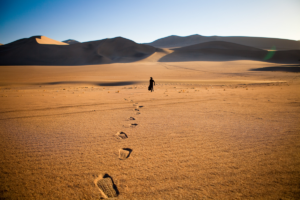
Rabbeinu zal turned to his talmidim and cried out: “This is not the way to get to Eretz Yisrael!” You do not make conditions. You do not make stipulations: “I will go if you do this, if I get that.” The way to go is the way HaShem said to Avraham Avinu: “Lech Lecha.” Lech Lecha means go. How should a person go? Even on foot. A person should be willing to walk and to crawl to Eretz Yisrael. If transportation is unavailable, he should be willing to make the journey on foot.
How could a person walk from America to Eretz Yisrael? We could ask the same question about a person setting out from Russia. In those days, the trip could take close to a year by boat, or more than a year overland by mule. How, then, could a person walk to Eretz Yisrael? The point is that if a person feels the value of the land, he would be willing to walk when he cannot obtain transportation.
This may sound impossible. A person might say, “That was thousands of years ago. People were different then.” Yet we have the same 248 organs, the same mind and the same heart. It depends on how we employ the faculties with which we have been blessed.
Nine years of determination
Consider Reb Tzvi Aryeh Lipel, ר׳ צבי אריה ליפל, a Breslover in Yerushalayim known to many who have been there. He was one of the closest talmidim of Rabbi Kochav Lev zal and had spent years in Uman. Every night, for hours, he would pour out his heart at Rabbeinu zal’s tziyun, begging to be zocheh to reach Eretz Yisrael. That was his cherished hope. Rabbeinu zal had taught the importance of getting there, and he begged, “Help me to get there.”
Finally, he decided that he would have to overcome the obstacles the hard way. For him, Lech Lecha meant setting out on foot.
This is not a tale from thousands of years ago, but an account from our own time. Reb Tzvi Aryeh’s journey took him through unfamiliar territory, including Mongolia and Manchuria. He did not speak Chinese and could barely speak the languages of the countries through which he passed. He traveled alone on treacherous roads, among dangerous people, through places where a person could become lost forever. He decided that reaching Eretz Yisrael was worth the effort, and he undertook the journey.
It took him nine years. He walked from Uman to Eretz Yisrael, practically the entire way on foot. He passed through many countries and faced grave dangers, including threats of execution and encounters with people described as cannibals. Some of his experiences were so extraordinary that even publishers of fiction might have dismissed them as too far-fetched. Yet he endured these difficulties and reached Eretz Yisrael.
This was not merely an account of the distant past. Here was an example from our own time of what Rabbeinu zal taught: a person who truly wants to reach Eretz Yisrael should be willing, if necessary, to walk there.
The courage to go forward
The wealthy man did not succeed in persuading Rabbeinu zal to take him. But Reb Noson zal found tremendous consolation in the account of Rabbeinu’s response. It gave him new strength, new desire and new courage to break through every possible obstacle and fulfill his own yearning to reach Eretz Yisrael.
When Reb Noson wanted to inquire further about leaving immediately, he visited another wealthy man who knew a great deal about conditions there. He came hoping to hear something encouraging about Eretz Yisrael. The man was reclining as he began to speak words of discouragement—not against Eretz Yisrael itself, but against the idea of traveling there.
He described the power of the Greeks and the danger of the war, insisting that anyone who attempted to cross the sea would surely be destroyed. He stressed that it was impossible to make the crossing at that time and that even in Eretz Yisrael itself there was danger.
Reb Noson saw that it was the Satan speaking through this man, trying to dissuade him from going. The Satan knew that Reb Noson’s journey to Eretz Yisrael was among the greatest matters of kedushah in that generation. Reb Noson left the man’s house at once. He refused to dwell on those words of discouragement.
A place on the ship
Reb Noson went directly to the port, to the agent, and paid for two places in a cabin aboard a ship bound for Istanbul, the first leg of the journey. There might have been no other Jews aboard. Traveling as isolated Jews among non-Jewish passengers brought additional dangers in those days.
Even these dangers did not deter Reb Noson. He felt that the journey was worth every sacrifice necessary to reach Eretz Yisrael.
The holiness of the land
The purpose of this story is to teach us that if these great tzaddikim made such sacrifices to reach Eretz Yisrael, surely we should bend every effort and not allow ourselves to miss the opportunity to be zocheh to get there. This brings us back to the first nisayon of Avraham Avinu. HaShem said, “Lech Lecha.” Leave your home, leave your comforts, leave your country, and go to Eretz Yisrael. Avraham Avinu passed the test, and his zechus remains for every Jew who must undergo a similar nisayon and make sacrifices in order to serve HaShem.
We have to recognize the tremendous value of Eretz Yisrael. We should be willing to make every effort to get there—to drink of its waters, to breathe its air, to walk on its soil, and to receive the kedushah that a person can attain there. May we all be zocheh to reach Eretz Yisrael soon, together with the entire Klal Yisrael, with kibbutz galuyos and the coming of Mashiach, and to see with our own eyes the rebuilding of the Beis HaMikdash, במהרה, אמן ואמן.
- 0 comment