The Jewelry of Rivka

Parshat Chayey Sarah describes how Eliezer, the servant of Avraham Avinu, was sent to find a suitable wife for Yitzchak. Through a remarkable series of events, he discovered Rivka, whose kindness and extraordinary spiritual qualities revealed that she was destined to become Yitzchak’s true marriage partner.
But why was Eliezer so certain that Rivka was the right person? Why did he give her a nose ring and two bracelets before even asking who she was? And what is the significance of the particular weights of these ornaments, which the Torah carefully records?
These details can be understood through Rebbe Nachman’s teaching in Likutey Moharan, Part 2, Lesson 2, Yemei Chanukah Hem Yemei Hoda’ah—the days of Chanukah are days of thanksgiving.
Thanksgiving, Halachah and the Three Aspects of Truth
Rebbe Nachman teaches that two practices have an extraordinary spiritual connection: giving thanks to Hashem and learning Halachah every day.
Both enable a person to connect to the delight of the World to Come while still living in this world. This closeness to Hashem opens the way for miracles, blessings and a higher level of truth.
When a person experiences the many changes and difficulties of life, he can easily become confused. Circumstances may appear contradictory or beyond his understanding. Yet if he can recognize Hashem’s presence and kindness within what he is experiencing and sincerely say, “Thank You, Hashem,” he draws closer to the truth.
Learning Halachah accomplishes something similar.
The Torah contains numerous discussions and differing opinions among the Tannaim, Amoraim, Rishonim, Acharonim and later Poskim. A person studying Halachah must work through these differing perspectives until he arrives at a clear ruling concerning what Hashem wants him to do.
In both practices, a person brings clarity out of confusion. Through thanksgiving, he recognizes Hashem’s kindness amid the complexity of life. Through Halachah, he discovers Hashem’s will amid the many opinions and distinctions of Torah law.
Rebbe Nachman calls this combination Todah-Halachah.
The resulting closeness to Hashem grants a person a higher degree of truth, which manifests in three essential areas of life.
The first is truth in prayer.
A person may daven regularly while feeling disconnected from the words, reciting them without sufficient concentration or sincerity. Through thanksgiving and Halachah, his perspective becomes more truthful, enabling him to pray with greater honesty and connection.
The second is truth in Torah study.
People study Torah at different levels of understanding. A person may read the words without fully appreciating their depth, while another sees profound truths in familiar passages of Chumash or Gemara.
Rebbe Nachman emphasizes the importance of learning from true Tzaddikim and accepting their guidance concerning what and how to study.
Without proper guidance, Torah study may fail to provide the spiritual vitality it should. Chazal even describe Torah as capable of becoming an elixir of death when approached incorrectly.
But when a person follows the direction of a true teacher, his Torah learning becomes more meaningful, clear and connected to truth.
The third is truth in marriage partners.
A genuine zivug is fundamental to a person’s life and to the continuity of the Jewish people. Marriage enables the establishment of families, the raising of children and the transmission of Torah and mitzvot to future generations.
The pain caused by unsuccessful marriages and divorce demonstrates how essential it is to find one’s true partner.
Reb Noson expresses this concern in his prayer on this lesson, pleading with Hashem that marriage partners should not become exchanged and that people should merit their true zivugim.
These three aspects of truth—prayer, Torah and marriage—form the foundation for understanding Eliezer’s discovery of Rivka.
Eliezer’s Mission
Avraham Avinu wanted to find a suitable wife for Yitzchak, but he did not want him to marry among the Canaanites.
The descendants of Canaan had been cursed by Noach, and Avraham did not consider them suitable for his son. Yitzchak, who had been born into Avraham’s holy household in Eretz Yisrael, was also not to leave the Land in search of a wife.
Instead, Avraham sent Eliezer to his family in Aram Naharayim, where he hoped a worthy marriage partner could be found among the descendants of his relatives, including Betuel’s family.
Eliezer traveled with camels, servants and a document signed by Avraham declaring that everything he possessed would belong to Yitzchak. This would demonstrate to the prospective bride’s family that Yitzchak was financially established and that she would be joining a wealthy household.
The journey itself was miraculous.
Eliezer experienced kefitzat haderech, a supernatural shortening of the journey, enabling him to travel the enormous distance from Eretz Yisrael to Aram Naharayim in a single day.
Upon arriving, he went to the well where the local girls would come to draw water in the evening.
There he prayed that Hashem should reveal the right marriage partner.
His test was based on Chesed. He would ask a young woman for some water, and if she responded by offering water not only to him but also to his camels, this would be the indication that she was suitable for Yitzchak.
Why did Eliezer choose kindness as the determining factor?
Avraham’s Chesed and the Power of Halachah
Rebbe Nachman teaches that Halachah is itself an expression of Chesed, kindness.
The greatest kindness a person can perform for creation is to fulfill Hashem’s will.
Hashem created the world so that mankind could serve Him through Torah and mitzvot. Every aspect of creation exists to make that service possible.
When a person learns Halachah and follows its requirements, he is fulfilling the purpose for which the world was created.
Whether he recites a brachah before eating, wears Tzitzit, observes Shabbat, keeps kosher or performs acts of kindness, he is using creation according to Hashem’s will.
The Gemara teaches that Hashem has only the four cubits of Halachah in His world. Amid the vastness of creation, the place most precious to Hashem is where His will is studied and clarified.
Chazal also teach that a teacher who does not teach his students Halachah is withholding Chesed from them.
Why? Because knowing how to live according to Hashem’s will is the greatest kindness a person can receive.
Avraham Avinu personified Chesed.
He established the Eshel Avraham in Be’er Sheva, providing travelers with food, drink and lodging—achilah, shetiyah and linah.
When his guests thanked him, Avraham redirected their gratitude toward Hashem.
He explained that the food and hospitality ultimately came from Hashem, not from himself, and encouraged them to bless and thank their true Benefactor.
Through his kindness, Avraham introduced people to the recognition of Hashem.
But Avraham was also deeply connected to Torah and Halachah. Chazal teach that he observed the mitzvot, including laws such as Eruvei Tavshilin and Eruvei Techumin, long before the Torah was formally given at Har Sinai.
His Chesed and his observance of Halachah were therefore interconnected.
Eliezer understood that a woman entering the household of Avraham and Yitzchak had to possess this same quality.
When Rivka willingly gave water to him and all his camels, she demonstrated that she belonged in a household founded upon Chesed.
This was the first indication that she was Yitzchak’s true marriage partner.
But Eliezer witnessed another remarkable sign.
The Rising Water and Yitzchak’s Thanksgiving
The Torah describes Rivka approaching the well with her water vessel.
Rashi brings down that Eliezer saw the water rise toward her—a miraculous indication of her righteousness.
Rising water carries an additional meaning connected to shirah, song and thanksgiving.
The Torah describes a miracle that occurred when the Jewish people were approaching Eretz Yisrael during their journey through the desert.
Amorite enemies hid between the mountains, preparing to attack the Jews. Hashem caused the mountains to come together, crushing the attackers, and then separated them again.
But the Jewish people were unaware of the danger from which they had been saved.
The water of the miraculous well rose, carrying the blood and remains of the enemies, revealing what had occurred.
When the Jews saw the miracle, they began to sing and praise Hashem.
Rising water was therefore associated with the revelation of Divine kindness and the thanksgiving that followed it.
When Eliezer saw the water rise toward Rivka, he recognized not only that she was a Tzaddeket, but also that she possessed a quality connected to praise and thanksgiving.
This was particularly significant because thanksgiving was central to Yitzchak’s spiritual service.
Yitzchak and the Prayer of Minchah
Later in the Parshah, when Rivka approaches Eretz Yisrael with Eliezer, she sees Yitzchak in the field.
The Torah states:
“Vayetzei Yitzchak lasuach basadeh”—Yitzchak went out to converse in the field.
Chazal teach that Yitzchak instituted the Minchah prayer.
When Rivka saw him, she asked Eliezer who he was. Upon learning that he was Yitzchak, she covered herself out of modesty and awe.
What is the special connection between Yitzchak, Minchah and thanksgiving?
Rebbe Nachman teaches that thanking Hashem while experiencing difficulties is an even greater spiritual accomplishment than thanking Him after salvation.
Shacharit is associated with the transition from night to day. Just as darkness gives way to light, a person who has emerged from danger naturally feels gratitude for his deliverance.
Minchah, however, takes place during the heat of the afternoon, when a person may still be struggling under the pressures of the day.
Reb Noson compares this to the difficulties of middle age, when a person may be overwhelmed by responsibilities involving family, children, livelihood marriage, and the daily struggle with one’s evil desires and bad traits.
At precisely such a time, when life feels difficult and constricted, a person must find something for which to thank Hashem.
The word Minchah also refers to a meal offering.
A poor person who cannot afford an animal or bird offering may bring a simple offering of flour. Even from his limited resources, he gives something to Hashem.
Similarly, a person suffering through difficult circumstances may feel spiritually impoverished. Yet if he can still find even a small kindness for which to express gratitude, that thanksgiving is especially precious.
Yitzchak, who instituted Minchah, therefore represents the power of prayer and thanksgiving during difficulty.
Avraham represents Chesed and Halachah.
Yitzchak represents prayer and hoda’ah.
Together, they express the two foundations of Rebbe Nachman’s teaching – Todah and Halachah.
The remaining aspect of truth is the true marriage partner.
And this is what Eliezer was seeking to establish.
The story of Eliezer and Rivka reveals the tremendous spiritual power of learning Halachah and giving thanks to Hashem
Why Eliezer Gave the Jewelry Before Asking Her Name
The Torah describes Eliezer watching Rivka as she draws water for his camels.
“Veha’ish mishta’eh lah, macharish, lada’at hahitzliach Hashem darko im lo”—The man watched her in astonished silence, waiting to know whether Hashem had made his journey successful.
He had already witnessed the water rising toward her, indicating the quality of praise and thanksgiving associated with Yitzchak.
Now he watched as she fulfilled her promise to give water to all the camels, demonstrating the Chesed associated with Avraham.
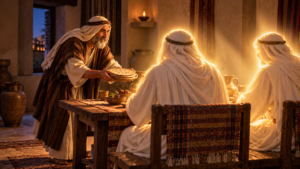
The moment she finished, Eliezer gave her a gold nose ring and two golden bracelets.
Only afterward did he ask who she was.
This is unusual. Would it not have been more sensible to establish her identity before presenting her with valuable jewelry?
Eliezer was so confident in the two signs that he did not want to delay.
The rising water represented thanksgiving and true prayer. Her extraordinary kindness represented Chesed and Halachah.
These two qualities corresponded to the first two aspects of truth taught by Rebbe Nachman.
Eliezer now wanted to establish the third: a true marriage partnership.
He therefore immediately presented the ornaments that would signify Rivka’s connection to Yitzchak.
(The commentaries explain that this was done modestly, without Eliezer touching her directly, using a cloth or other separation when placing the jewelry.)
But the significance of the jewelry goes much deeper.
The Two Bracelets and the Nose Ring
The Torah specifies the ornaments and their weights:
“Nezem zahav beka mishkalo, ushnei tzemidim al yadeha, asarah zahav mishkalam”—A gold nose ring weighing a beka and two bracelets for her hands, weighing ten measures of gold.
Rashi explains that these details allude to future events in Jewish history.
The nose ring weighed a beka, corresponding to the half-shekel that the Jewish people would contribute toward the service of the Beit HaMikdash.
The two bracelets, shnei tzemidim, represent the two Tablets of the Covenant.
The word tzemidim suggests something closely attached or joined together, hinting at the two Luchot.
Their weight of ten measures of gold represents the Ten Commandments inscribed upon those Tablets.
These symbols correspond precisely to the two foundations of Rebbe Nachman’s teaching.
The bracelets represent Halachah.
The Ten Commandments encompass the entire Torah, with the remaining mitzvot contained within them.
The purpose of learning Torah is to understand Hashem’s instructions and bring them into practical fulfillment through Halachah.
The bracelets therefore hint to the Chesed and Halachah associated with Avraham Avinu.
The nose ring represents prayer and thanksgiving.
The half-shekel contributions supported the korbanot offered in the Beit HaMikdash.
The Temple service included atonement, praise and thanksgiving. Even when a person brought a sin offering, he confessed his wrongdoing and could thank Hashem for providing a means of atonement.
Today, without the Beit HaMikdash, our prayers take the place of the sacrificial service.
The nose ring, through its connection to the half-shekel, therefore hints to the avodah of prayer and thanksgiving associated with Yitzchak.
Eliezer had witnessed both qualities in Rivka, and he now presented ornaments symbolizing them.
The bracelets corresponded to Chesed/halachah, while the nose ring corresponded to the rising water and the power of thanksgiving.
With these two qualities established, Eliezer recognized that Rivka possessed what was necessary to become Yitzchak’s true zivug.
Why Eliezer Changed the Order of His Story
Afterward, Eliezer met Rivka’s family and recounted what had happened.
However, when speaking to Lavan and Betuel, he changed the order of events.
He told them that he had first asked Rivka about her family and only afterward given her the jewelry.
Why did he alter the sequence?
Eliezer’s original certainty was based on the spiritual signs he had witnessed. He recognized the combination of Chesed/halachah and thanksgiving before needing confirmation of her family background.
But when presenting his story to Rivka’s relatives, he described the events in a more conventional sequence, placing the inquiry about her identity before the gifts.
His original actions demonstrated how powerfully he recognized the signs of truth.
He did not want to interrupt the moment by asking questions before securing the third aspect of truth—the marriage partnership.
The Attempt to Delay Rivka’s Departure
Once Rivka’s family agreed to the match, Eliezer wanted to return immediately to Eretz Yisrael.
But the Midrash describes further events surrounding the negotiations.
According to this account, Betuel attempted to poison Eliezer in order to take possession of the wealth he had brought.
An angel intervened by exchanging the food, causing Betuel to eat the poisoned portion himself and die.
Afterward, Lavan and Rivka’s mother sought to delay her departure.
The Torah states:
“Teshev hana’arah itanu yamim o asor”—Let the young woman remain with us for a year or ten months.
Rashi explains that yamim, literally meaning days, refers here to a year.
The straightforward explanation for the requested delay concerns the preparations traditionally made for a bride.
The commentaries describe a custom of allowing twelve months to prepare twenty-four ornaments, approximately two each month.
Since Eliezer had already provided ornaments and garments, Rivka’s family suggested reducing the delay to ten months.
Eliezer rejected the proposal. Yitzchak possessed ample wealth, and there was no need to delay the marriage for the sake of jewelry.
But the family’s request also hints to a deeper spiritual struggle.
One Day of Halachah Is Worth a Year
Rebbe Nachman teaches that learning Halachah connects a person to sha’ashua Olam HaBa, the delight of the World to Come, which transcends ordinary time and space.
Because of this connection, a single day of learning Halachah can possess the spiritual value of an entire year of Torah study.
This provides another meaning to the family’s choice of the word yamim, days, when requesting a year.
Rivka was about to leave with the spiritual qualities of Chesed/Halachah and thanksgiving. Her family wanted to retain that power for themselves.
By asking her to remain for yamim, they were seeking to hold on to the spiritual benefit associated with Halachah, in which one day can correspond to an entire year.
Their alternative request, asor, ten, also carries spiritual significance.
Rebbe Nachman teaches about asarah minei neginah, the ten types of melody, associated with song, praise and thanksgiving.
The request for ten months therefore hints to an attempt to retain the power of thanksgiving.
Rivka’s family was seeking to hold back one or both of the spiritual qualities she was bringing into her marriage: Halachah and hoda’ah.
Eliezer refused to allow this delay.
Finally, the family asked Rivka herself whether she wished to go.
She answered:
“Elech”—I will go.
Rivka was determined to leave immediately, even without her family’s further agreement.
She would take these qualities with her to Eretz Yisrael and establish the home she was destined to build with Yitzchak.
The Three Blessings Restored to Sarah’s Tent
When Rivka finally arrived and married Yitzchak, something extraordinary happened.
Rashi explains that three blessings that had disappeared after Sarah’s death returned when Rivka married and entered the tent of Yitzchak.
There had been a cloud resting over Sarah’s tent, a special blessing in the dough and a candle that remained lit from one Shabbat until the next.
After Sarah passed away, these blessings ceased.
When Rivka entered Yitzchak’s home, all three returned.
These represent the three aspects of truth described by Rebbe Nachman.
The candle represents truth in Torah.
The verse “Ki ner mitzvah v’Torah or” connects mitzvot and Torah with light. The candle therefore hints to Torah illuminated by truth.
The blessing in the dough represents truth in prayer and thanksgiving.
The challah and its blessing express recognition of Hashem as the source of sustenance. They therefore correspond to the hoda’ah that brings truth into a person’s prayer.
The cloud over the tent represents truth in marriage.
The tent is the home in which a marriage is established, while the cloud signifies the modesty and holiness surrounding that home.
The return of these three blessings demonstrated that Yitzchak and Rivka had attained the three aspects of truth: Torah, prayer and a true marriage partnership.
The foundations established by Avraham and Yitzchak—Halachah and thanksgiving—had now come together through Rivka.
Finding Truth Through Thanksgiving and Halachah
The story of Eliezer and Rivka reveals the tremendous spiritual power of two practices that are available to every Jew.
Rebbe Nachman teaches that learning Halachah and giving thanks to Hashem draw a person closer to the delight of the World to Come.
Through that closeness, a person gains a more truthful perspective on his life.
He can pray with greater sincerity, study Torah with greater clarity and merit a true marriage partner.
These teachings also change how a person approaches difficulties.
Instead of interpreting every challenge as a sign that Hashem is pushing him away, he can recognize that even painful circumstances can become opportunities to draw closer to Hashem.
The task is to search for what he can thank Hashem for, even amid uncertainty, while continuing to clarify and fulfill His will through Halachah.
Through these practices, a person can merit new openings, greater truth and the blessings that come from a deeper connection to Hashem.
May we be zocheh to learn Halachah every day, give thanks to Hashem in every circumstance and attain genuine truth in our Torah, our prayers and our marriages. May we merit to draw the delight of the World to Come into this world and experience Hashem’s kindness throughout our lives.
Shabbat Shalom u’Mevorach.
Meir Elkabas
- 0 comment