The Todah and Halakhah of Leah and Rachel
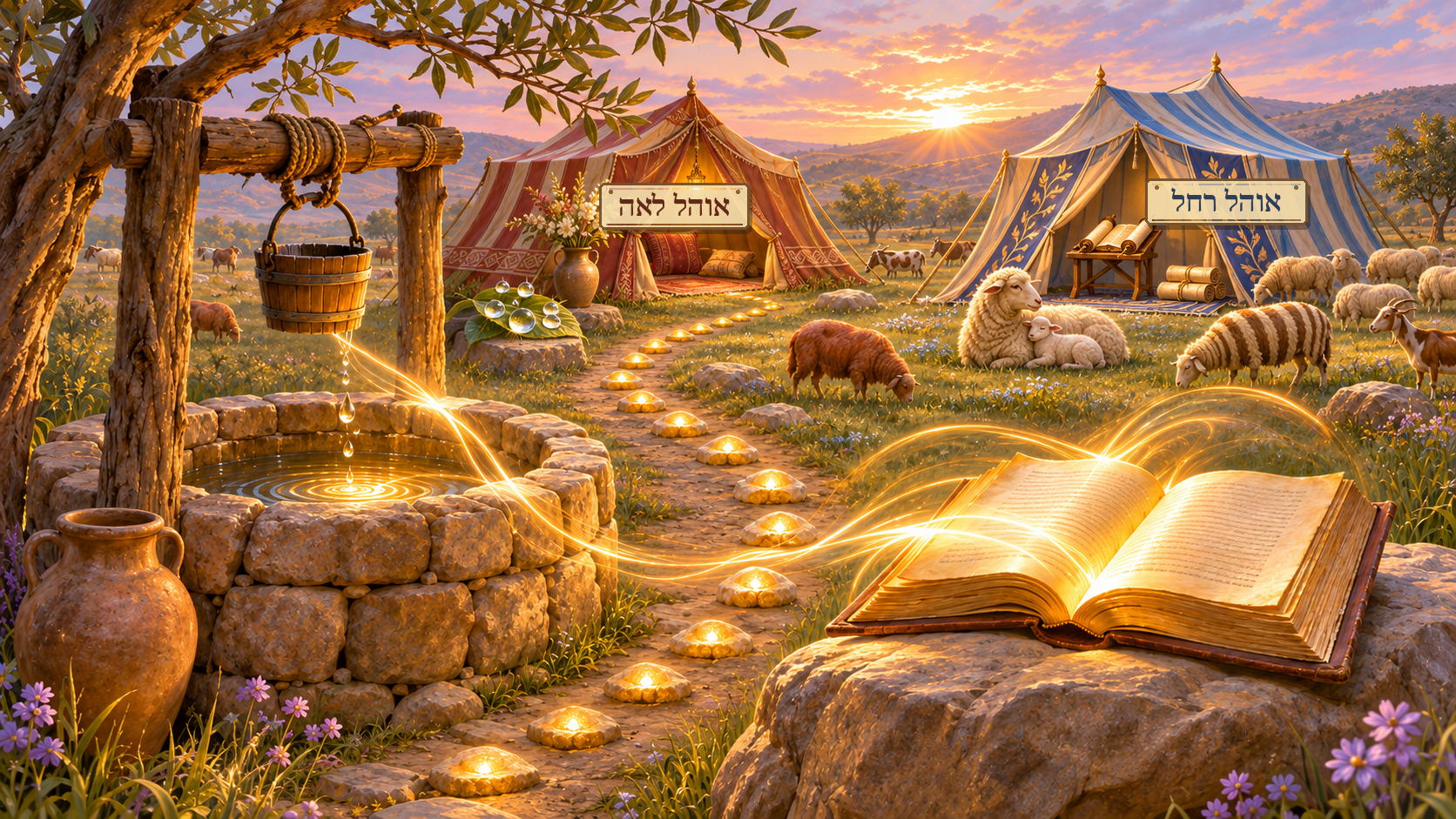
In Parshat VaYetze, Yaakov Avinu sets out to marry Rachel, only to discover that Lavan has deceived him and given him Leah instead. He eventually marries Rachel as well, and through Leah, Rachel, Bilhah and Zilpah, the twelve tribes of Israel are born.
Toward the end of the Parshah, Yaakov receives his wages from Lavan in the form of sheep and goats with unusual markings, including spotted, striped and reddish animals.
These events contain a remarkable connection to Rebbe Nachman’s teaching in Likutey Moharan II, Lesson 2, concerning the power of thanksgiving and learning Halachah.
Reb Noson explains that Leah and Rachel represent these two essential forms of Divine service. Their marriage to Yaakov, the birth of the twelve tribes and even the appearance of Yaakov’s flocks reflect the spiritual process through which creation reaches its ultimate rectification.
The Twelve Stages of Spiritual Rectification
Rebbe Nachman teaches that the ultimate purpose of creation is to give thanks to Hashem. This is the delight of the World to Come, where thanksgiving will continue perpetually.
But he also teaches that learning Halachah is inseparable from thanksgiving.
Halachah reveals Hashem’s will in this world, clarifying what He wants us to do. Rebbe Nachman calls these two practices Todah–Halachah, emphasizing that both are necessary.
Together, they open the way to salvation and initiate a series of spiritual developments.
First, Rebbe Nachman describes three situations in which this power brings relief and new beginnings.
The first is childbirth. He describes how blood concentrates in the upper part of a woman’s body during labor, facilitating the birth. This becomes an illustration of the principle that whenever something new is about to emerge, there is first a concentration of blood.
The second is danger. When a person faces a frightening situation, his heart pounds and the circulation of blood becomes disturbed. Rebbe Nachman explains that such difficulties can precede the birth of a new spiritual level. Through thanksgiving and Halachah, the person can emerge from danger and experience a new opening in life.
The third concerns those who financially support Torah scholars. The Aramaic word damim means both blood and money. When a person gives away part of his income to support Torah study, he must manage with less money, creating a form of financial constriction. Yet the Torah insights developed through that support draw new blessing and abundance into the world, benefiting the supporter as well.
From these three forms of salvation, Rebbe Nachman proceeds to three aspects of truth.
The first is truth in prayer. A person begins to daven with greater sincerity, asking Hashem for what he truly needs rather than praying without proper understanding or concentration.
The second is truth in Torah study. Through guidance from true Tzaddikim, a person learns the Torah appropriate to his spiritual level. He receives direction concerning whether to concentrate more on Gemara, Mishnah, Midrash, Halachah or Chumash, etc., enabling his learning to produce genuine spiritual growth.
The third is truth in marriage. A person merits his true zivug rather than an unsuitable or exchanged marriage partner, allowing him to establish a family and contribute to the proper continuity of mankind.
These three aspects of truth lead to what Rebbe Nachman calls ribua hadibur, four forms of rectified speech.
The first is the speech of charity. A charitable person’s compassion becomes evident in the way he speaks, even when he is not actually giving tzedakah.
The second is the speech of teshuvah, in which a person pours out his heart before Hashem, recognizing his distance and pleading to return.
The third is the speech of influential people who possess chen, grace or favor, enabling them to persuade kings, ministers and other powerful individuals to help the Jewish people.
The fourth is the speech of Malchut, the kingship of Hashem. This level will reach its complete expression through Mashiach, although aspects of it can already be developed today.
When these four forms of speech are rectified, a person attains shlemut Lashon HaKodesh, the perfection of holy speech.
Rebbe Nachman teaches that this grants a person an extraordinary degree of influence over creation. His prayers can transcend the ordinary limitations of nature and bring about miracles.
This leads to another spiritual achievement: drawing the holiness, joy and blessings of Shabbat into the six weekdays.
A person can experience something of Shabbat’s serenity even while engaged in ordinary activities, without being overwhelmed by the worries and pressures of material life.
Altogether, these developments comprise twelve stages: three forms of salvation, three aspects of truth, four forms of speech, the perfection of Lashon HaKodesh and the extension of Shabbat’s holiness into the weekdays.
Finally, they produce two culminating results.
One is the revelation of achdut hapashut mitoch pe’ulot mishtanot—Hashem’s simple unity emerging from the multitude of different activities and circumstances in creation.
This is an extraordinary accomplishment, even in Heaven. People with vastly different perspectives and experiences come together to recognize Hashem and devote themselves to His will.
The second is the restoration of tahaluchot hadamim, the proper flow of blood. The tension and constriction associated with danger, childbirth or financial hardship give way to relief and tranquility.
All twelve stages are hinted to in the twelve tribes born to Yaakov, while the final two results are reflected in the unusual animals Yaakov received from Lavan.
But the entire process begins with Leah and Rachel.
Rachel Represents Halachah, Leah Represents Prayer
Yaakov Avinu originally intended to marry Rachel.
Reb Noson explains that Rachel represents the Oral Torah, whose ultimate purpose is to clarify practical Halachah.
The Written Torah gives us the commandments, but the Oral Torah explains how they must be fulfilled.
For example, the Torah commands us to place totafot between our eyes. Without the Oral Torah, we would not know that this refers to Tefillin, nor would we understand the required shape of the boxes, their black color, the straps and their various components.
These details are clarified through the Oral Torah and ultimately established in Halachah.
The word Torah itself is connected to hora’ah, instruction. Its purpose is to teach mankind how to fulfill Hashem’s will.
Rachel also has a connection to the word rechel, a sheep. The Gemara describes how every part of a sheep can serve a purpose, including its wool, meat, bones and sinews. Similarly, every part of the Torah has its particular use.
Yaakov understood that the ultimate purpose of creation is to fulfill Hashem’s will. He therefore wanted to marry Rachel first, establishing his connection to the Oral Torah and Halachah.
Leah, by contrast, represents prayer.
Rashi explains that Leah’s eyes were soft because she had cried so much.
There was a widespread assumption that Lavan’s older daughter, Leah, would marry Yitzchak’s older son, Eisav, while Rachel would marry Yaakov.
Leah knew of Eisav’s wickedness and desperately feared being married to him. She continually cried and prayed to Hashem to save her from that fate.
But Leah’s prayer ultimately led her to something even higher: thanksgiving.
Many people first discover the power of thanksgiving only after experiencing difficulties and crying out to Hashem for help.
When they are in danger, their immediate reaction is to plead for salvation. Only afterward, when they recognize Hashem’s kindness, do they begin to appreciate the importance of giving thanks.
Leah followed this progression.
She spent years crying to Hashem, but when her children were born, she repeatedly acknowledged His kindness through the names she gave them.
When naming Reuven, she recognized Hashem’s involvement in her circumstances. Rashi also explains the name as alluding to the difference between her son Reuven and Eisav. Whereas Eisav despised and sold his birthright, Reuven would later try to save Yosef, even though the birthright had been transferred from him to Yosef.
Shimon’s name acknowledged that Hashem had heard her suffering. When Levi was born, Leah expressed her hope that Yaakov would now become attached to her. Yehuda’s name explicitly declared, “Hapa’am odeh et Hashem”—This time I will thank Hashem.
The names Yissachar and Zevulun likewise reflected her recognition of Hashem’s reward and blessing.
Through her children, Leah’s earlier tears were transformed into expressions of appreciation.
She therefore represents prayer that ultimately develops into thanksgiving.
Yaakov wanted to begin with Rachel, the Torah and Halachah, and afterward reach Leah, prayer and gratitude.
But Hashem arranged matters differently.
Why Leah Had to Come First
Through Lavan’s deception, Yaakov married Leah before Rachel.
This reflected an essential spiritual principle: thanksgiving must precede Torah study.
Yaakov intended to begin with Halachah and afterward express appreciation for the Torah he had learned.
But Hashem arranged that he should first acquire the quality of prayer and thanksgiving, represented by Leah, and only afterward the Halachah represented by Rachel.
This helps explain a remarkable teaching of Chazal.
The Gemara attributes the destruction of the Land and the exile of the Jewish people to their failure to recite the blessing before studying Torah.
Why would neglecting this blessing have such devastating consequences?
Reb Noson explains that the issue is far deeper than merely omitting a few words.
People often become discouraged by their spiritual failures.
A person knows what the Torah requires, but his actions fall short. He may feel that he is too sinful or corrupt to study Torah meaningfully.
He begins to wonder: Why should I learn Halachah when I am not even fulfilling what I learn? What value does my Torah study have when my behavior is so far from its teachings?
This attitude can lead a person to abandon Torah study altogether.
The problem is especially difficult for someone who expects everything to be orderly and consistent. When his life becomes confused and he cannot live up to the standards he has learned, he may feel that his connection to Torah has become worthless.
But blessing Hashem before learning Torah introduces an entirely different perspective.
We thank Hashem for choosing us and giving us His Torah.
Even if a person can learn only a little, and even if he is struggling to fulfill what he studies, he can still thank Hashem for the opportunity to learn.
He can say, “Thank You, Hashem, that I can learn Your Torah. Thank You that I believe in it and want to fulfill it, even though I am not yet succeeding.”
That gratitude enables him to maintain his connection to the Torah despite his shortcomings.
Reb Noson explains that had the Jewish people approached Torah study with genuine thanksgiving, its light could have remained attached to them even during their spiritual decline.
The combination of appreciation and even a small amount of Torah learning would have provided the strength to return.
This is the deeper meaning of the failure to bless before studying Torah.
Without thanksgiving, a person may lose his connection to the Torah when he fails to live up to its demands.
With thanksgiving, even limited Torah study becomes a source of hope and spiritual restoration.
That is why Leah had to precede Rachel.
The foundation of prayer and thanksgiving had to be established before the acquisition of Halachah.
Nevertheless, both were necessary.
And through the combination of Leah and Rachel, together with Bilhah and Zilpah, Yaakov merited the birth of the twelve tribes.
The First Three Stages: Birth, Danger and Supporting Torah
The first three aspects of Rebbe Nachman’s teaching concern situations in which pressure or constriction precedes a new opening.
Each is represented by one of Yaakov’s sons.
Reuven represents childbirth.
As Yaakov’s first son, Reuven marked the beginning of the birth of the twelve tribes.
Rebbe Nachman teaches that childbirth involves a concentration of blood, which serves as an illustration of the pressure preceding a new beginning.
He also teaches that Psalm 100, Mizmor L’Todah, possesses special power as a prayer for a woman experiencing the dangers of childbirth.
The woman and those praying for her are encouraged to recite Mizmor L’Todah repeatedly, seeking an easier delivery through the power of thanksgiving.
Reuven, the first child born, therefore corresponds to the beginning of this process.
Shimon represents danger and emerging from distress.
Throughout his life, Shimon encountered particularly dangerous circumstances.
Together with Levi, he confronted the people of Shechem in order to rescue Dinah. This placed him in considerable danger. Rashi brings a further difficulty surrounding Dinah’s refusal to leave Shechem unless Shimon agrees to marry her – his own sister!
Later, when Yaakov’s sons traveled to Egypt to obtain food, Yosef detained Shimon as a hostage while his brothers returned to bring Binyamin.
Shimon experienced the fear and uncertainty of imprisonment, dependent upon his brothers’ return.
These dangerous situations correspond to Rebbe Nachman’s teaching that distress causes the heart to pound and the blood to become unsettled, while thanksgiving and Halachah open the way toward salvation.
Zevulun represents those who support Torah study.
Zevulun is traditionally associated with the financial support of Yissachar, whose members devoted themselves to Torah learning.
Yissachar produced outstanding Torah scholars, including leaders of the Sanhedrin who were knowledgeable in complex areas of Halachah, such as calculating the Jewish calendar and determining leap years.
Zevulun supported these scholars through his commercial activities.
By giving away part of his income, the supporter experiences financial constriction. But the Torah produced through his support draws new abundance into the world.
Thus, Zevulun represents the third form of salvation described by Rebbe Nachman: the blessing that comes through supporting those who learn Halachah.
Thanksgiving must be accompanied by Halachah, which reveals Hashem’s will and guides us in fulfilling the mitzvot
The Three Aspects of Truth
The next three stages are truth in prayer, truth in Torah study and truth in marriage.
Naftali represents truth in prayer.
Rachel desperately wanted children and pleaded with Hashem.
The name Naftali reflects her intense spiritual struggle and prayer.
Although Naftali was born to Bilhah, Rachel’s maidservant, Rachel understood his birth as a response to her own pleading.
Through her heartfelt davening, she participated in bringing him into the world.
Naftali therefore corresponds to the sincere and truthful prayer that emerges through thanksgiving and Halachah.
Yissachar represents truth in Torah study.
Yissachar was renowned for producing great Torah scholars and authorities in Halachah.
His descendants were among those capable of clarifying the most complex areas of Jewish law.
They therefore represent the truth of Torah that a person merits through proper learning and guidance from genuine Tzaddikim.
Levi represents truth in marriage.
When Levi was born, Leah declared:
“Hapa’am yilaveh ishi elai”—Now my husband will become attached to me.
Rashi explains that the Matriarchs knew prophetically that Yaakov was destined to have twelve sons.
With four mothers involved, each could expect a share of three sons.
When Leah gave birth to Levi, her third son, she felt that she had fulfilled her expected portion and that Yaakov would now become more closely attached to her.
The name Levi, from yilaveh, attachment or joining, therefore hints to a true marriage partnership and the establishment of Shalom Bayit.
This completes the three aspects of truth.
The Four Forms of Speech
After truth is established in prayer, Torah and marriage, Rebbe Nachman teaches that four different forms of speech can be rectified.
These are represented by Gad, Dan, Asher and Yehuda.
Gad represents the speech of charity.
Before the Jewish people entered Eretz Yisrael, the tribe of Gad, together with other tribes, requested to settle on the eastern side of the Jordan River.
Moshe Rabbeinu agreed on condition that they participate in the conquest of Eretz Yisrael rather than remaining behind while the other tribes fought.
But Gad went further.
They committed themselves not only to helping conquer the Land but also to remaining until the tribal portions had been distributed.
They left their families behind and participated in the military campaign, continuing to assist the other tribes beyond the minimum requirement.
This was a tremendous act of Chesed and tzedakah.
Rebbe Nachman teaches that the compassion of a charitable person becomes reflected in his speech. Even when he is not actively giving charity, others can sense his kindness and generosity through the way he speaks.
Gad’s extraordinary willingness to help the other tribes therefore corresponds to the speech of charity.
Dan represents the speech of teshuvah.
The name Dan is connected to din, judgment.
Teshuvah requires a person to judge himself honestly.
He must recognize his failures, confess them before Hashem and express his desire to return.
This process can be painful. A person confronts what he has done wrong and pours out his heart, asking Hashem to help him change.
Dan therefore represents the speech of repentance, in which self-judgment becomes the foundation for returning to Hashem.
Asher represents the speech of influential people.
Asher’s name is associated with happiness and good fortune.
The Midrash describes the tribe of Asher as possessing special chen, grace or favor, among the other tribes.
Their territory was especially blessed with olives and olive oil, and their daughters were known for their righteousness and beauty. The Midrash describes daughters of Asher marrying Kohanim Gedolim.
This quality of chen corresponds to the ability of influential people to speak persuasively with charm before kings, ministers and government officials.
Through their speech, they gain favor and persuade those in authority to provide assistance.
Asher therefore represents the third form of rectified speech.
Yehuda represents the speech of Malchut.
The royal dynasty of David HaMelech descends from Yehuda.
Ultimately, Mashiach will also emerge from this lineage.
Rebbe Nachman teaches that the complete revelation of Hashem’s kingship will be expressed through the extraordinary power of Mashiach’s speech.
Although this level will only reach its fullness in the time of Mashiach, we can already develop aspects of it through our own speech and recognition of Hashem’s kingship.
Yehuda therefore corresponds to the fourth form of speech, Malchut.
These four qualities complete the rectification of speech and prepare the way for shlemut Lashon HaKodesh, the perfection of the Holy Tongue.
Yosef and the Perfection of Holy Speech
The final two stages are represented by Rachel’s two sons, Yosef and Binyamin.
There is an important distinction between the names Rachel gave her children and those given by Leah.
Leah’s names repeatedly expressed thanksgiving for what Hashem had already done.
Rachel, however, named her first son Yosef, saying:
“Yosef Hashem li ben acher”—May Hashem add another son for me.
Rather than emphasizing gratitude for the child she had just received, Rachel expressed her desire for further blessing.
This reflects her spiritual connection to Halachah.
Halachah involves a continual process of clarification. Once one question has been resolved, there are further questions to examine and additional areas of Torah law to clarify.
The person studying Halachah seeks to advance constantly, moving from one clarification to the next.
Rachel, who represents the Oral Torah and Halachah, expressed this desire for further accomplishment through Yosef’s name.
And Yosef himself represents shlemut Lashon HaKodesh.
The Midrash describes Yosef as possessing mastery of all seventy languages, together with Lashon HaKodesh.
Pharaoh knew the seventy languages but lacked the Holy Tongue.
Because Yosef possessed this additional language, he had a spiritual advantage over Pharaoh.
Rebbe Nachman teaches that the perfection of Lashon HaKodesh gives a person extraordinary power through speech, enabling him to influence creation beyond its ordinary natural limitations.
Yosef demonstrated this ability in Egypt.
When stored grain spoiled and the Egyptians complained about Yosef’s instructions, Pharaoh insisted that they obey him.
Yosef had demanded that the Egyptians undergo circumcision, and they objected. But Pharaoh recognized Yosef’s extraordinary power and told them to do whatever he instructed.
He understood that someone capable of accomplishing such things through his speech possessed power far beyond ordinary human authority.
Yosef’s mastery of Lashon HaKodesh therefore enabled him to exercise extraordinary influence over Egypt, even while formally serving as Pharaoh’s viceroy.
He represents the perfection of holy speech that emerges through the preceding stages of truth and rectification.
Binyamin and the Holiness of Shabbat
The twelfth stage is drawing the holiness and joy of Shabbat into the weekdays.
This is represented by Binyamin.
When Rachel gave birth to her second son, she was dying. She called him Ben-Oni, a name reflecting her suffering and mourning.
She recognized the importance of those who rise at midnight to mourn the destruction of the Temple and pray for its restoration.
Yaakov, however, named the child Binyamin, connected to his birth in Eretz Yisrael.
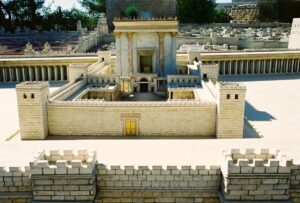
The territory of Binyamin would eventually contain the central area of the Beit HaMikdash, including the location of the Mizbe’ach upon which the korbanot were offered.
And the Temple service was deeply connected to joy.
The korbanot were accompanied by music and song, and those serving in the Beit HaMikdash were expected to approach their duties with simcha.
The Zohar describes how a Kohen who arrived in a depressed or unhappy state was instructed to return home rather than perform the service in that condition.
The atmosphere of the Beit HaMikdash was meant to be one of holiness, blessing and joy.
This is connected to Shabbat.
The thirty-nine categories of prohibited labor on Shabbat are derived from the activities involved in constructing the Mishkan, the predecessor of the Beit HaMikdash.
Yet the Temple itself was a place where activities and service were performed amid an atmosphere of joy and holiness.
This reflects Rebbe Nachman’s teaching about drawing the sanctity of Shabbat into the weekdays.
On Shabbat, a person experiences rest, serenity and freedom from the ordinary pressures of work.
The goal is to extend that spiritual atmosphere into the rest of the week, even while engaging in necessary activities.
Binyamin, whose territory contained the heart of the Temple service, therefore represents the joy and holiness of Shabbat illuminating the weekdays.
With Yosef and Binyamin, the twelve stages are complete.
The children of Leah reflect the initial foundation of prayer and thanksgiving, while Rachel’s children represent the culminating achievements of perfect holy speech and the extension of Shabbat’s holiness throughout the week.
Both foundations, Todah and Halachah, are necessary to bring the process to completion.
Yaakov’s Flocks and the Revelation of Hashem’s Unity
After the birth of the twelve tribes, the Torah describes Yaakov receiving his wages from Lavan.
His reward consisted of sheep and goats with various markings, including spotted, speckled and striped animals, as well as reddish sheep.
These unusual appearances reflect the final two results of Rebbe Nachman’s teaching.
The first is the revelation of Hashem’s simple unity from within the multitude of creation.
The animals bore contrasting colors, with white spots and stripes appearing against darker backgrounds.
The white represents unity, while the dark background symbolizes the combination of many different elements.
The white markings emerging from the darkness therefore represent the revelation of Hashem’s unity from within the countless variations of creation.
The Torah describes different patterns, including akudim, nekudim, berudim and telu’im.
These varied markings all express the same underlying idea: the revelation of oneness within multiplicity.
This is the culmination of the spiritual process that began with giving thanks and learning Halachah.
Through the rectification of the twelve stages, a person becomes capable of recognizing the One Hashem within the seemingly separate activities of the world.
The second result is the restoration of the proper flow of blood.
This is represented by the reddish animals.
The Torah uses the term chum, which Rashi explains as a reddish color, adom.
Red is associated with blood, and Rebbe Nachman teaches that the final result of these spiritual rectifications is the restoration of tahaluchot hadamim, the healthy and tranquil flow of blood.
The person who was previously experiencing danger, constriction or distress now emerges into a state of relief.
The pressure that accompanied the process of birth has been resolved.
Thus, the two kinds of animals Yaakov received reflect the two final accomplishments: revealing Hashem’s unity from within the multitude of creation and restoring the proper flow of blood after difficulty.
What appeared to be an unusual arrangement of wages between Yaakov and Lavan becomes a hint to the culmination of the spiritual process represented by the twelve tribes.
Bringing Todah and Halachah Into Our Lives
The story of Leah and Rachel teaches that thanksgiving and learning Halachah must work together.
Yaakov originally intended to begin with Rachel, representing the clarification of Halachah, and afterward attain the prayer and thanksgiving represented by Leah.
But Hashem arranged that Leah should come first, teaching that gratitude must form the foundation of our relationship with Torah.
A person who is struggling spiritually should not abandon Torah study because he feels unworthy. He should first thank Hashem for giving him the opportunity to learn, even if he can presently accomplish only a little.
That appreciation enables the light of Torah to remain connected to him and helps him move forward.
At the same time, thanksgiving must be accompanied by Halachah, which reveals Hashem’s will and guides us in fulfilling the mitzvot.
Together, these two practices initiate the entire process of spiritual rectification: salvation from difficulties, truth in prayer, Torah and marriage, the refinement of speech, the perfection of Lashon HaKodesh and the extension of Shabbat’s joy into the weekdays.
Ultimately, they enable us to recognize Hashem’s unity within all the different circumstances of creation and emerge from our difficulties with greater peace and tranquility.
May we be zocheh to appreciate the tremendous power of Todah and Halachah, to learn Halachah every day and to continually thank Hashem for the kindnesses He has done, is doing and will yet do for us.
Through these two essential practices, may we merit to participate in the complete tikkun of creation.
Shabbat Shalom u’Mevorach.
Meir Elkabas
- 0 comment