- Joy ⬦ Leaders ⬦ Read ⬦ Shabbat ⬦ Weekly Torah Portion
Remembering the 12 Tribes
Remembering the Twelve Tribes
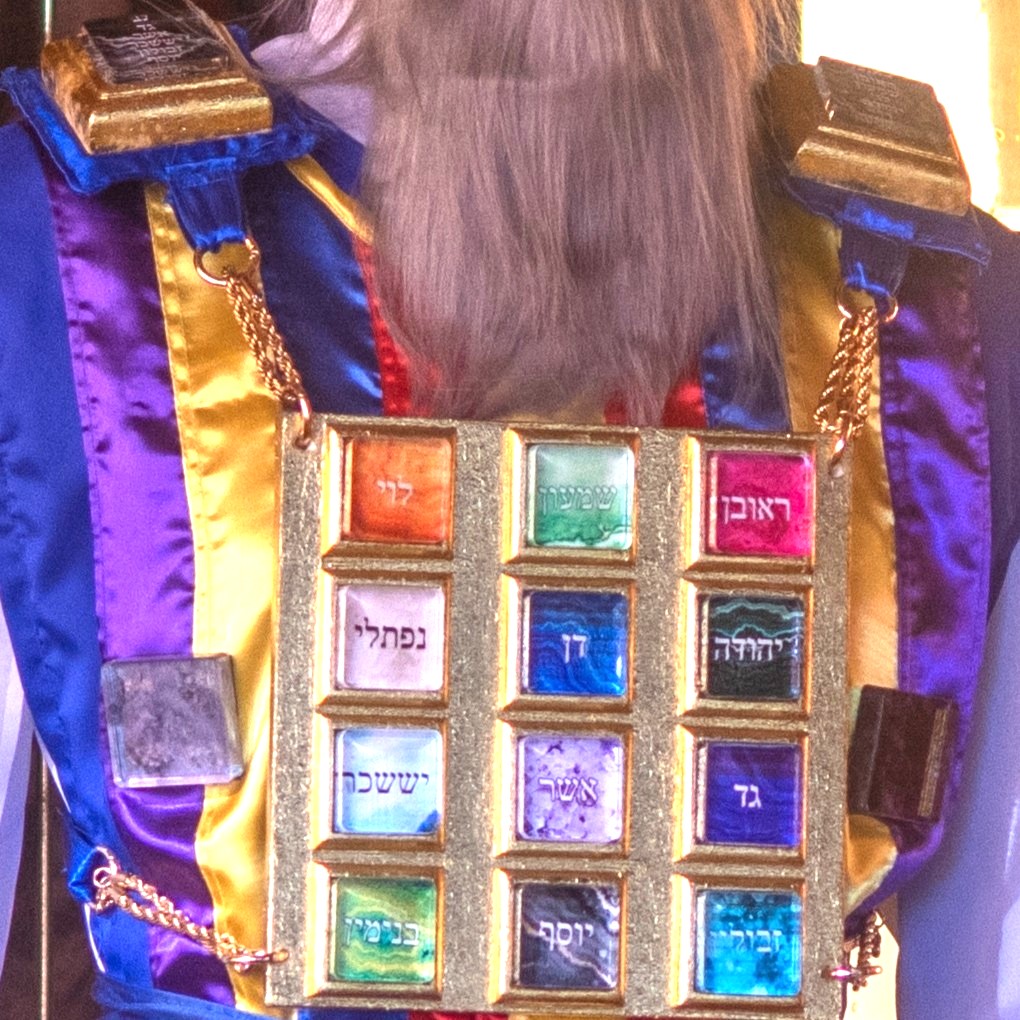
Parshat Tetzaveh falls together with Shabbat Zachor, just before Purim—a powerful and heavy Shabbat. The Parashah describes, among other things, the vestments of Aharon the Kohen Gadol. Within those garments, two features stand out: the Avnei Shoham on the shoulders of the ephod, and the Choshen Mishpat, the breastplate worn over the heart.
Both contain the names of the twelve tribes.
On the shoulders were two identical stones. On one were engraved six tribes, and on the other the remaining six. Then on the Choshen were twelve separate stones, each bearing a tribal name. In addition, the names Avraham, Yitzchak, and Yaakov were included, and even additional letters so that every letter of the alphabet was present. Through these letters, when guidance was sought—such as whether to wage war—the letters of the response would illuminate.
The question is obvious: why the redundancy? Why inscribe the names of the twelve tribes twice—once on the shoulders and again on the heart?
The Names of the Tzaddikim as Remembrance
The Torah states regarding the shoulder stones (Shemot 28:12) that they are “stones of remembrance for Bnei Yisrael,” and Aharon carries their names before Hashem on his two shoulders.
Rashi explains that the remembrance is for Hashem—to recall the righteousness of the tribes and arouse compassion.
The Midrash draws from here an astonishing principle: this is the source for the power of reciting names of Tzaddikim. Rebbe Nachman writes in the Aleph-Bet book that merely mentioning the names of Tzaddikim can activate their merit and even bring miracles above nature. Their holiness transcends natural law, and invoking their names arouses their merit.
This is learned from the engraved names of the twelve tribes. Even after their passing, their names retain—and even intensify—their spiritual power. Hashem “sees” their names and remembers their righteousness. That remembrance brings compassion and salvation.
So the Avnei Shoham serve as a reminder of the merit of the tribes.
But then the Torah describes the Choshen (28:29): “And Aharon shall carry the names of Bnei Yisrael on the Choshen of judgment upon his heart when he enters the holy place, as a remembrance before Hashem tamid—always.”
Here the key word appears: tamid.
Tamid — Always
The Midrash explains that the power of the names engraved on the Choshen is so great that even when the Kohen Gadol is not wearing the garment, their merit remains active. Specifically, when he enters the Holy of Holies on Yom Kippur wearing only four white garments—without the Choshen—the merit of those names still enables him to enter and achieve atonement. Without that merit, he could not succeed.
This introduces the difference between the two inscriptions. The shoulder stones are “for remembrance.” The Choshen is remembrance tamid—always.
What does tamid mean in this context?
Rebbe Nachman, in Likutey Moharan Lesson 24, teaches that a person must learn how to serve Hashem in a state called mateh v’lo mateh—reaching and not reaching. One advances toward light and then is pushed back. One ascends and then falls. The test is whether one can hold on in both states.
A person striving for closeness to Hashem inevitably experiences pushback. In Kabbalistic language, this pushback comes from the keter—the crown. The keter acts as a barrier so that a person does not dissolve in overwhelming light. When someone sincerely strives for spiritual growth, Heaven may “pull the carpet” from beneath him. The setback feels shocking and disorienting. Yet it is not punishment. It is preparation—forming vessels capable of receiving greater light.
The secret is to continue.
Even when a person falls, he gets back up and begins again. That is tamid.
Simcha Tamidit
Rebbe Nachman famously teaches: mitzvah gedolah lihiyot b’simcha tamid—it is a great mitzvah to be happy always.
How can that be? Life contains pain, loss, mourning, setbacks.
The answer is subtle. When a person makes simcha his steady orientation—when he works consistently to choose positivity and gratitude—then even when he falls into sadness, that simcha remains present in potential form. It does not disappear. It waits beneath the surface and provides the strength to rise again.
The continual effort to live with joy creates an internal reservoir. When the person crashes, that reservoir whispers: don’t give up. Try again. Start small. Do what you can.
This is simcha tamidit—not constant emotional euphoria, but a continual commitment to return to joy.
The Breastplate and the Tzaddikim
Now the symbolism deepens.
The twelve stones represent the twelve tribes—the Tzaddikim. The shoulder stones activate their merit as remembrance. But the Choshen, worn on the heart, represents something greater: the capacity to maintain merit tamid, always.
The Tzaddikim embody this quality. Whether ascending or descending, whether advancing or pushed back, they do not interpret setbacks as failure. They see them as part of the growth process. For them, even the descent is an ascent in disguise.
It is as if they are always wearing the Choshen. Even when the garment is removed, the merit remains active.
So too, the one who trains himself in simcha tamidit carries that light whether in clarity or confusion, ascent or setback. The remembrance does not turn off.
And this, the Midrash teaches, is what empowers the Kohen Gadol even when entering the Holy of Holies on Yom Kippur without the Choshen. The merit is not dependent on the visible garment. It has become internalized.
The same applies to spiritual growth. When joy and trust are internalized, they remain operative even when not visibly present.
In Parshat Tetzaveh, remembering the twelve tribes is not only about historical remembrance. It is about activating the quality of tamid—the ability to endure pushback without despair, to hold joy even in potential form, and to continue serving Hashem whether advancing or retreating.
That is the remembrance that never ceases.
We are descendants of Avraham, Yitzchak, Yaakov, and the twelve tribes. Even if the Torah feels heavy, we are upheld by the light of the Choshen
The Descent That Is Really an Ascent
Reb Noson illustrates this idea through the Avodah of the Kohen Gadol on Yom Kippur.
On that day, the Kohen Gadol immerses in the mikveh five times. When he moves from a lower level of service to a higher one—such as entering the Holy of Holies—it makes sense that he must immerse. He is ascending. He requires spiritual preparation.
But the Torah requires immersion even when he exits the Holy of Holies to return to the outer service—the daily korbanot—and dons the full eight garments again. Why immerse when going down? He is leaving the highest level and returning to what appears to be a lesser one.
Reb Noson explains: it is a descent that is truly an ascent.
Even when leaving the Holy of Holies, the Kohen Gadol is not “going down.” He is continuing forward. What appears externally as a step down is part of the upward process. Therefore, each transition—whether entering or exiting—requires immersion. Every movement is growth.
This is the light of the Choshen.
The twelve stones on the breastplate—together with the names of Avraham, Yitzchak, and Yaakov—represent all the Tzaddikim throughout the generations. Their defining quality is that whether “in” or “out,” whether ascending or descending, they remain connected. They do not interpret setbacks as failure. They know every pushback is preparation.
Rebbe Nachman once described this level about himself. When returning from Eretz Yisrael, he endured tremendous danger. He said that even if he were sold as a slave and cast to the most distant place without access to Torah, tefillin, or a Jewish community, he would still be able to serve Hashem with whatever means were available. Like Yaakov Avinu, who, according to the Zohar, “put on tefillin” symbolically through the peeling of branches. Even in exile, service is possible.
That is tamid.
Just as the Choshen activates remembrance even when not physically worn, so too the Tzaddikim maintain simcha and connection even when externally removed from clarity or elevation. Even the “out” is part of the “in.”
The Shoulder Stones — The Burden of Torah
The two shoulder stones of the ephod represent something different.
The Baal HaTurim and others explain that the two stones correspond to the two tablets of the Torah. The twelve tribes engraved six and six reflect the division at Har Gerizim and Har Eival—blessings and curses. Six tribes stood for blessing, six for curse. The Torah presents reward and consequence.
This represents the ordinary Jew (descendants of the 12 tribes inscribed therein) —us.
When we fulfill the Torah, we are blessed. When we fail, there are consequences. It is not always tamid. It feels conditional. It feels heavy.
(side note: The word for shoulder, katef, has the gematria of 500. Remarkably, Noson—the name of Rebbe Nachman’s primary disciple—also equals 500. It is said that HaRav David Zvi – Reb Noson’s father-in-law – chose him over greater scholars because, as he put it, he had “broad shoulders.” He could endure. He could carry responsibility-weight.)
The shoulder carries burden.
Torah is sometimes heavy. It is not always shining light like the breastplate. Often it is obligation. Discipline. Restraint. Effort. We carry the weight of the tablets on our shoulders.
The Choshen, however, is luminous. It shines. It rests over the heart.
And the Torah specifically connects the Choshen to the shoulder stones with chains and straps. The breastplate is held up by the shoulders.
This teaches that the Tzaddikim exist for the sake of Am Yisrael. Their light rests upon and is supported by the struggles of the ordinary Jew. And the ordinary Jew draws strength from attachment to the Tzaddikim.
The shoulder carries the weight.
The heart shines the light.
Together, they form one Avodah.
Purim and the Eight Garments
The Megillah describes Achashverosh’s lavish feast, and in the phrase “chur karpas,” the letter chet is written large. The Manot HaLevi explains that this hints that Achashverosh donned the eight garments of the Kohen Gadol.
Why would he do such a thing?
On the surface, to demoralize the Jews. But there are many ways to demoralize. Why specifically the eight garments?
Because the Kohen Gadol represents the pinnacle of simcha. The Zohar says that if a Kohen came to serve in the Beit HaMikdash while sad, he would be sent home. Avodah requires joy. The eight garments symbolize holy simcha, culminating in the Choshen.
Achashverosh attempted to appropriate that holiness—to seize the simcha of Am Yisrael and redirect it into impurity.
But true simcha belongs only to Am Yisrael. “Simchu baHashem v’gilu Tzaddikim.” Our joy is bound with Hashem. “Orayta, Yisrael, v’Kudsha Brich Hu kula chad.” Torah, Israel, and Hashem are one.
When evil attempts to swallow holy joy, that act becomes the beginning of its downfall. Achashverosh’s wearing of the eight garments led to his intoxication, to the episode with Vashti, to her downfall, to Esther’s rise, and ultimately to Haman’s destruction.
The theft of holy simcha cannot endure.
Remember Who We Are
On Shabbat Zachor, just before Purim, we are commanded to remember Amalek. Amalek whispers despair. “You are nothing. You will never succeed. You have every reason to be sad.”
Parshat Tetzaveh answers with remembrance of the twelve tribes.
We are descendants of Avraham, Yitzchak, Yaakov, and the twelve tribes. We are connected to the Tzaddikim. Even if we struggle beneath the burden of the shoulder stones, even if Torah feels heavy, we are upheld by the light of the Choshen.
The regular Jew carries weight.
The Tzaddik shines light.
And both are bound together.
Remembering that alone is enough to activate simcha.
If we merit to reclaim true simcha— especially on Purim – to reject Amalek’s voice of despair—then we can be zocheh to complete redemption, to the Korban Pesach, to Mashiach’s arrival bimheirah b’yameinu, amen.
Shabbat Shalom u’Mevorach and Purim Sameach
Meir Elkabas
- 0 comment