- Joy ⬦ Read ⬦ Shabbat ⬦ Weekly Torah Portion
The 11 Drapes of Izim
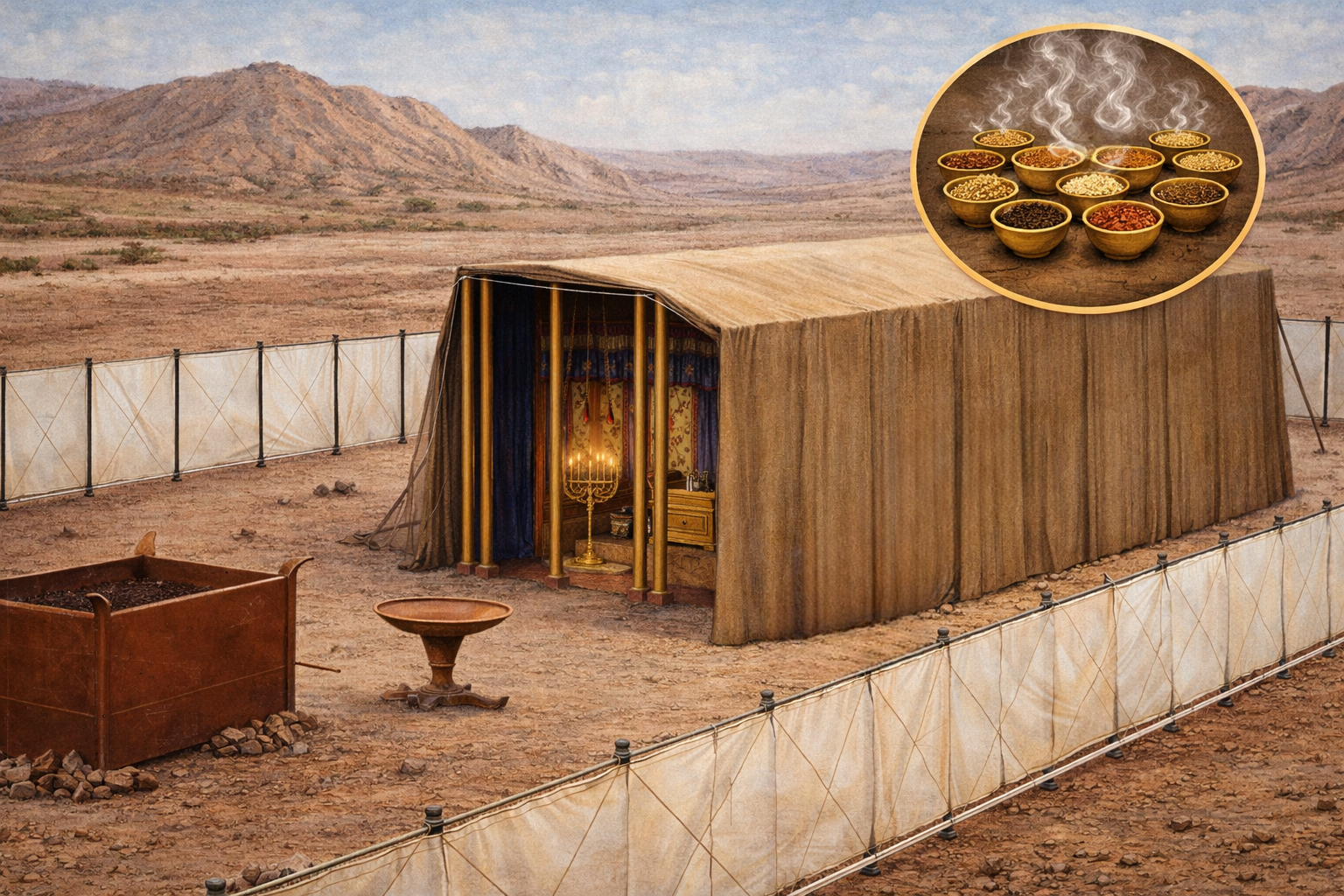
The Coverings of the Mishkan
In this Parshah the Torah again describes the construction of the Mishkan, the Tabernacle. Rashi himself notes that the details of the Mishkan were already explained earlier in Parshat Terumah and Tetzaveh, and therefore much of his commentary in Vayakhel refers back to those earlier explanations. For this reason, in examining the Mishkan’s coverings we will draw on Rashi’s commentary from Parshat Terumah as well.
The Mishkan itself had several layers of coverings. The first covering was known as the Mishkan itself—ten beautiful curtains woven from fine fabrics dyed with techelet, argaman, and crimson wool. These curtains were crafted with intricate designs and joined together in two groups of five. Each group was connected through loops and clasps so that the ten curtains formed a single covering.
This magnificent covering lay directly above the interior of the Mishkan, forming the ceiling above the Kodesh and the Kodesh HaKodashim. Beneath it stood the Ark in the Holy of Holies, and in the outer sanctuary were the Menorah, the Shulchan with the showbread, and the incense altar. Because this covering formed the immediate roof over the sanctuary, the Torah refers to it simply as the Mishkan—the dwelling place of Hashem.
The ten curtains themselves carry symbolic meaning. The commentators explain that the division into five and five corresponds to the two Tablets of the Covenant—the shtei luchot habrit—with five commandments on each tablet. The joining point of the two sets of five curtains was positioned precisely above the parochet, the curtain that separated the Kodesh from the Kodesh HaKodashim. Even in the covering above, there was a corresponding division reflecting the separation within the Mishkan itself.
The Eleven Drapes of Goat Hair
Above this first covering was a second covering known as the yeriot izim, the drapes made from goat hair. These drapes were slightly longer than the inner curtains so that they fully covered and protected the beautiful fabric below. Unlike the colorful inner covering, this upper covering was made from goat hair threads that had been braided in a remarkable way.
Rashi explains that skilled women braided the goat hair while it was still attached to the goats. Only afterward were the skins removed and the materials prepared for weaving. The Midrash records differing opinions about whether these coverings were fashioned as one large piece or assembled from multiple sections, but in any case the Torah describes them as consisting of eleven drapes.
Here the arrangement differed from the inner covering. Instead of five and five, there were two sections—one of six drapes and one of five. These were again joined together with loops and clasps positioned exactly above the parochet, just like the covering beneath them.
The obvious question is: why eleven? The inner covering had ten curtains, but this upper covering included an additional strip. What purpose did the extra curtain serve?
The Folded Curtain at the Entrance
Rashi addresses this question in his commentary to Parshat Terumah. The Torah states that the sixth curtain—the additional one—was positioned toward the entrance of the Mishkan. Half of it was folded over the entrance of the Ohel Moed, the Tent of Meeting, while the other half hung downward.
In other words, this extra curtain was deliberately doubled over the eastern entrance of the Mishkan. Rashi explains that this folding resembled the modest covering worn by a bride. Just as a kallah covers herself modestly, the Mishkan too had a kind of covering at its entrance.
This comparison raises a deeper question. Why does the Torah associate this curtain with the modesty of a bride? What is the meaning behind the distinction between the ten inner curtains and the eleven outer ones?
Ten and Eleven
To understand this symbolism, we must examine the significance of the numbers ten and eleven.
The inner covering of ten curtains represents holiness. In many areas of Torah, the number ten symbolizes completeness in holiness. We see this in the Ten Commandments, the ten sefirot, and even the quorum of ten required for a minyan. The number ten expresses a full structure of sanctity.
The outer covering, however, consisted of eleven curtains. Rav Noson, in Likutey Halachot, drawing upon teachings from Kabbalah, explains that these eleven curtains correspond to another group of eleven that appears in the Mishkan service: the eleven spices of the Ketoret, the sacred incense.
Both the incense and the goat-hair drapes share a similar role. Their purpose is to confront the forces of impurity and prevent them from drawing nourishment from holiness.
Protecting the Mishkan from the Outside
This function becomes clearer when we consider the environment in which the Mishkan stood. The Jewish people were traveling through the wilderness—a place associated in Torah with spiritual danger. The desert is described as a domain of snakes and scorpions, a barren region where holiness appears absent and forces of impurity dominate.
Because the Mishkan radiated immense holiness, it required protection from these outside influences. The inner coverings sheltered the sanctity within, but the outer layer—the yeriot izim—faced the outside world.
The word izim, goats, is related to the root azut, which can mean brazenness or boldness. There is azut d’kedushah, boldness in holiness, and there is negative brazenness as well. In this context the goat-hair coverings represent a form of spiritual boldness that stands guard against the forces of impurity surrounding the Mishkan.
Eleven and the Forces of Impurity
Kabbalistic sources explain that evil also mirrors the structure of holiness. Just as holiness is structured through ten levels, the forces of impurity have their own distorted parallel known as the asarah kitrin d’mesavuta, the ten crowns of impurity.
How, then, do those forces draw nourishment from holiness? Through an eleventh channel.
The number eleven represents a gateway through which impurity attempts to draw energy from holiness. This concept appears elsewhere in Torah as well. For example, the descendants of Esav were organized into eleven chiefs—the alufim of Esav. The number eleven thus became associated with the structure of impurity.
To counter this, the Mishkan employed its own structure of eleven. The eleven drapes of goat hair and the eleven spices of the Ketoret served to confront that negative force and prevent it from drawing sustenance from holiness.
The Eleven Spices of the Ketoret
The Ketoret itself contained eleven spices. Ten of them were fragrant and pleasant, but the eleventh—chelbenah, galbanum—had a foul smell. Yet when the eleven were blended together, even the unpleasant scent became part of the sacred incense.
The sages explain that this mixture possessed extraordinary spiritual power. Through the eleven spices the incense could penetrate the domain of impurity, extract holiness trapped there, and elevate it back to its proper place.
The Zohar describes this process through a vivid metaphor. The Ketoret is like a chain lowered into the depths of impurity. Once it reaches the trapped sparks of holiness, it gathers them and pulls them upward again. The Aramaic word katar, from which Ketoret derives, itself carries the meaning of connection or binding together—like links of a chain.
In the same way, the eleven drapes of goat hair functioned as a protective barrier around the Mishkan. Facing the outside world, they guarded the sanctuary from the negative forces of the wilderness while simultaneously enabling holiness to reclaim what had fallen into impurity.
Together, the coverings of ten and eleven reveal a profound spiritual structure: the inner perfection of holiness and the outer system designed to confront and overcome the forces that oppose it.
Through the power of the Ketoret, holiness continually reclaims what has been taken from it
The Inner Ten Curtains — The Essence of Holiness
If the outer covering consisted of eleven drapes, what about the lower covering—the one actually called the Mishkan? There we find the number ten. The Mishkan itself was covered by ten curtains, and these ten represent the essence of holiness.
Unlike the outer covering, these ten curtains were completely hidden. From the outside, no one could see them at all. The only covering visible to someone standing outside the Mishkan was the layer of the yeriot izim. The ten inner curtains remained concealed within.
The commentators explain that this hidden layer corresponds to a deeper level of holiness—the very essence of holiness itself. In spiritual terms, this refers to the essence of the Jewish soul. There are situations in which holiness becomes trapped through ordinary misdeeds, where sparks of holiness fall into the domain of impurity and must later be elevated. But there is a deeper and more serious form of damage connected to pegam habrit, blemishes in sexual purity.
In such cases, the damage does not merely affect external sparks of holiness. Rather, it involves the very essence of the soul. Just as misused seed results in spiritual energy becoming trapped in the domain of evil, the holiness contained within that energy must eventually be rescued before it becomes absorbed into impurity. This is why transgressions in this area are considered especially severe: they affect the root of holiness itself.
The Limits of the Ketoret
Rabbi Yonatan Eibeschutz discusses this concept in connection with an episode later in the Torah. When Korach and his followers caused strife among the Jewish people, a deadly plague broke out. Moshe Rabbeinu instructed Aharon to quickly bring the Ketoret, the incense, and stand between the living and the dead. The Torah relates that Aharon did so and the plague stopped immediately.
The Ketoret possesses the power to repair damage caused by conflict and wrongdoing among Jews. Through its eleven ingredients it can penetrate the domain of impurity, extract trapped sparks of holiness, and restore balance.
However, Rabbi Yonatan Eibeschutz explains that this power has limits. When the tribe of Shimon later fell into immorality through the actions of Zimri ben Salu and Kozbi, the Ketoret was not used to stop the situation. Instead, Pinchas had to intervene directly.
Why was the Ketoret not sufficient in that case? Because the Ketoret functions like a chain that connects holiness to the fallen sparks. As long as the chain remains intact, the incense can reach downward and retrieve what has fallen. But when the damage reaches the deepest level—when the very root of holiness is affected—the chain is considered broken. At that point the Ketoret alone cannot repair the damage.
A deeper force is required.
The Ten Types of Melody
This deeper force corresponds to the number ten—the hidden layer of the Mishkan. Rebbe Nachman, drawing from the Zohar, teaches that the root of holiness is expressed through the asarah minei neginah, the ten types of melody. These correspond to the ten utterances through which the world was created and to the ten sefirot that structure the flow of Divine energy.
King David expressed these ten types of melody through the Psalms. Rebbe Nachman revealed that ten specific Psalms correspond to these ten spiritual melodies, forming the basis of the Tikkun HaKlali. These melodies reach the deepest level of the soul and have the power to rectify even the most profound spiritual damage.
For this reason, the ten inner curtains of the Mishkan were concealed and protected. They represent a level of holiness that must remain guarded, accessed only when absolutely necessary.
The Protective Role of the Eleven Drapes
With this understanding we can see the relationship between the two coverings of the Mishkan. The eleven outer drapes—the yeriot izim—serve as a protective barrier. Their role parallels that of the Ketoret, which confronts impurity directly and prevents holiness from falling deeper into its grasp.
When the protection provided by the Ketoret is functioning properly, the deeper level represented by the ten types of melody does not need to be activated. The outer layer guards the inner sanctity.
This idea is hinted to in the verse from Mishlei: Oz vehadar levushah vatischak leyom acharon—“Strength and splendor are her garment, and she laughs at the final day.” The word oz, strength, alludes to the boldness associated with the goat-hair coverings. These coverings function like a protective garment, shielding the deeper sanctity within.
Rashi compared the folded curtain of goat-hair at the entrance of the Mishkan to the modest covering worn by a bride. Just as a bride protects her beauty through modesty, the Mishkan’s inner holiness was protected by the outer covering.
Simcha as Protection
Rebbe Nachman and Reb Noson explain that the Ketoret is deeply connected to simcha, joy. When joy is present, holiness flourishes. Joy strengthens a person spiritually and protects him from falling into destructive behavior.
For this reason we recite the section of Ketoret in our daily prayers. The spiritual force associated with the incense continues to function, drawing holiness upward and restoring joy even when negativity attempts to overwhelm us.
The eleven drapes of goat hair therefore symbolize the protective power of simcha. They guard the deeper holiness represented by the ten inner curtains, preventing a person from falling to the point where the deeper remedy would be required.
The Mishkan and the Tzaddikim
Rebbe Nachman teaches in Likutey Moharan (Lesson 70) that the tzaddikim themselves are called a Mishkan. The word Mishkan is related to moshech, the power of drawing. The tzaddik has the ability to draw the Divine Presence into the world and to draw souls back to Hashem.
The ten inner curtains correspond to this deeper power of the tzaddikim—the ability to rescue souls that have fallen far from holiness. Surrounding them are the eleven drapes, which correspond to the disciples and followers who work to maintain joy and holiness among the people.
Rebbe Nachman notes that the number eleven is associated with Yosef HaTzaddik, the eleventh son of Yaakov Avinu. From Yosef descended Yehoshua bin Nun, the faithful disciple of Moshe Rabbeinu. In this way the number eleven represents the students and followers who support and protect the work of the tzaddikim.
Their task is to strengthen joy among the Jewish people, constantly extracting holiness from the forces that oppose it. By doing so they protect the deeper sanctity represented by the tzaddikim themselves.
The Final Victory of Simcha
The verse declares that “she laughs at the final day.” Evil may appear to mock and attack holiness throughout history, claiming victory over the Jewish people. But in the end, holiness has the final laugh.
Through the power of the Ketoret, holiness continually reclaims what has been taken from it. Sparks of holiness trapped within impurity are brought back to their rightful place, restoring joy to Am Yisrael.
Thus the eleven drapes of goat hair symbolize the protective force of simcha, while the ten inner curtains represent the deepest power of holiness that restores and redeems.
These ideas are profound, but they teach us something practical as well: by strengthening simcha and holiness in our lives, we participate in this process of restoring the sparks and protecting the sanctity of the Jewish soul.
May we merit to internalize these teachings and live them in our own lives.
Shabbat Shalom and Chodesh Tov.
Meir Elkabas
- 0 comment