The 4+1 Cups of Joy
The Four (Plus One) Cups of Joy
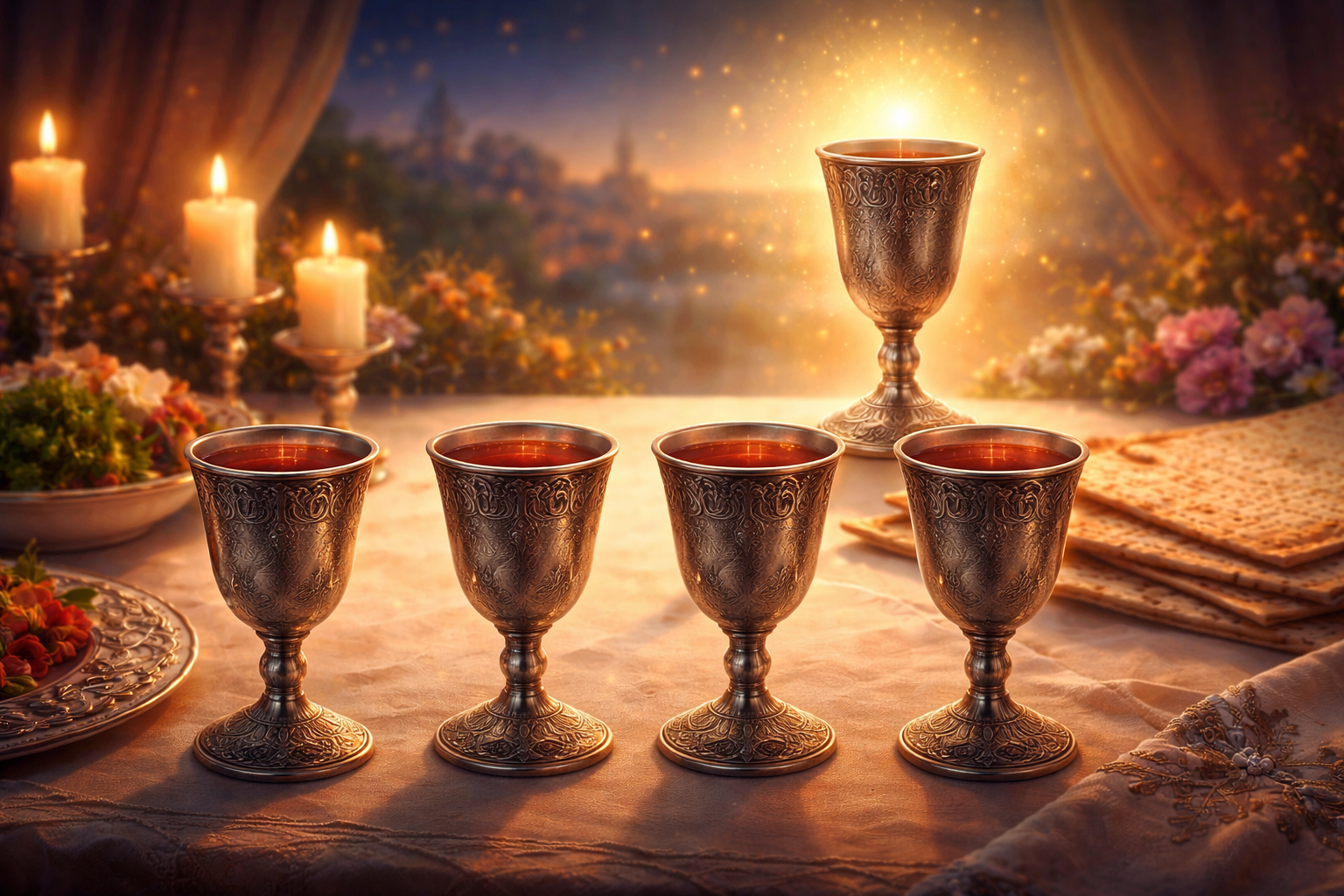
Pesach night revolves around the ארבע כוסות (arba kosot – four cups of wine), each corresponding to a language of redemption mentioned in Parshat Va’era. The Torah describes five expressions: “Vehotzeiti, Vehitzalti, Vega’alti, Velakachti, Veheiveiti”—“I will take you out, I will rescue you, I will redeem you, I will take you, and I will bring you.”
Chazal (our sages) established four cups corresponding to the first four expressions, each aligned with a stage in the Seder:
- Kadesh → Vehotzeiti (I will take you out)
- Maggid → Vehitzalti (I will rescue you)
- Barech → Vega’alti (I will redeem you)
- Hallel → Velakachti (I will take you as a nation)
The fifth expression, Veheiveiti (I will bring you to the Land), corresponds to the cup of Eliyahu HaNavi (Elijah the Prophet)—poured but not drunk. It represents a redemption not yet fully realized, dependent on the coming of Mashiach (Messiah).
This creates a structure of four plus one—four active stages, and a fifth that hovers just beyond our current grasp.
From Redemption to Simcha (Joy)
There is a striking parallel: these four plus one expressions correspond to five pathways to simcha (joy). Pesach is not only about historical redemption—it is a practical toolkit for emotional and spiritual renewal.
Each cup becomes not just a remembrance, but an activation of joy.
1. Mili d’Shtuta — Breaking In Through Joy
The first pathway is מילי דשטותא (mili d’shtuta – lighthearted silliness)—telling jokes, acting a bit foolish.
This may seem trivial, but Rebbe Nachman teaches that in a world weighed down by heaviness and depression, most of the time the only way out and in is through something simple and even “silly.” It breaks the rigidity, opens the heart, and creates a first נקודת אור (nekudat or – point of light).
This is the entry point for many people into real simcha.
2. Hoda’ah — Gratitude as Elevation
The second pathway is הודאה (hoda’ah – gratitude and acknowledgment).
Hoda’ah means both to thank and to admit—to recognize and appreciate the good that already exists. Even the smallest טובה (tovah – good) can become a מקור שמחה (mekor simcha – source of joy) when it is acknowledged.
Especially when a person feels low, everything—even something tiny—can be seen as above him. By expressing gratitude even for the tiniest things, he lifts himself upward toward it.
3. Nekudot Tovot — Finding Your Good Points
The third pathway is identifying נקודות טובות (nekudot tovot – good points within oneself).
This is an internal battle. The negative voice insists: “You’re nothing, you’ve accomplished nothing.” Rebbe Nachman teaches to actively counter this by finding even the smallest genuine good.
Even a tiny נקודה טובה (nekudah tovah – good point) has value. Holding onto it creates momentum toward real simcha.
4. Movement — Joy Through Song and Dance
The fourth pathway is physical movement—singing, clapping, dancing.
Simcha is not only intellectual or emotional; it is embodied. Movement generates energy, breaks stagnation, and allows joy to emerge through action.
Even when a person doesn’t feel happy, moving as if he is can awaken real simcha.
5. Simchat Ha’Atid — Borrowing Joy from the Future
The fifth and highest pathway is שמחת העתיד (simchat ha’atid – joy of the future).
This is the ability to connect to the certainty that everything will ultimately be resolved—that nothing is lost, that every effort has value, and that redemption will come.
By attaching the mind to that future reality, a person can “borrow” joy and bring it into the present moment.
This corresponds to the fifth cup—the one we cannot yet drink, but can still relate to.
A Pesach filled with simcha is not only more meaningful—it is the gateway to real redemption
The Structure of a Life of Joy
The four cups we drink represent accessible, actionable levels of simcha. The fifth represents a higher level that we are still growing toward.
Together, they form a complete system:
- Start with even artificial or external joy
- Recognize and express gratitude
- Find inner good points
- Activate joy through movement
- Anchor everything in future redemption
Pesach night encodes this entire process into a lived experience.
The Seder is not just a remembrance of redemption—it is a training in how to become a person who lives with simcha.
The Structure of the Seder: Four Stages and One Beyond
The structure of the Seder now becomes clearer. The four cups align with four stages of the Haggadah—Kadesh, Maggid, Barech, and Hallel—while the fifth level corresponds to Nirtzah, the stage that is not our doing, but Hashem’s acceptance.
Everything we do throughout the Seder is פעולה (pe’ulah – human action). But Nirtzah represents רצון (ratzon – Divine favor and acceptance). It is the moment where we step back and say: we’ve done our part—now it’s in Your hands.
This is the fifth cup, the cup of Eliyahu HaNavi (Elijah the Prophet), corresponding to Veheiveiti—a redemption still in progress.
Mapping the Five Paths of Joy onto the Seder
Each stage of the Seder activates one of Rebbe Nachman’s five pathways to simcha.
1. Kadesh — Joy Through Breaking the Barrier
Kadesh, the sanctification, corresponds to mili d’shtuta (lighthearted silliness).
At first glance, this seems counterintuitive. Sanctity is usually associated with seriousness, not silliness. But precisely because people can become stuck in heaviness, the only way to “sanctify” them—meaning to lift them out—is mainly through something unexpected, even undignified.
Rebbe Nachman connects this to the verse “ki b’simcha tetze’u” (“with joy you will go out”). The יציאה (yetzi’ah – exit) from darkness often begins with breaking rigidity. That is Vehotzeiti—the first step out.
2. Maggid — Joy Through Gratitude
Maggid corresponds to hoda’ah (gratitude and acknowledgment).
The entire section of Maggid is about telling the story of Yetziat Mitzrayim (the Exodus from Egypt), recognizing the miracles, and expressing thanks. This act of verbalizing gratitude is itself the beginning of rescue.
Rebbe Nachman teaches that when a person gives thanks—even for small things—he is already being lifted. This is Vehitzalti—the process of being rescued begins with recognition.
3. Barech — Joy Through Inner Good
Barech, the third cup during Birkat HaMazon (Grace after Meals), corresponds to nekudot tovot (good points within oneself).
Food becomes part of the person. When one eats with awareness and blessing, the nourishment is not just physical—it becomes spiritual content within him. The act of benching (Birkat HaMazon) is recognizing that goodness has been internalized.
This mirrors the עבודה (avodah – inner work) of finding good within oneself—extracting and identifying value even when it is hidden. This is Vega’alti—redemption, the reclaiming of what was concealed.
4. Hallel — Joy Through Expression
Hallel corresponds to movement—singing, clapping, and expressing joy physically.
This is where the Seder shifts into full emotional expression. Song, rhythm, and praise activate simcha in a tangible way. It is no longer conceptual—it is lived.
Here, Velakachti is fulfilled: Hashem “takes” us through our own expression, through our hands, our voices, our movement.
5. Nirtzah — Joy of the Future
The final stage, Nirtzah, corresponds to simchat ha’atid (joy of the future).
This is the highest level—and the most difficult. It is not something we can fully access yet. We can only long for it, hope for it, and orient ourselves toward it.
That is why the fifth cup is not drunk. It belongs to a future reality, one that will be fully revealed with the coming of Mashiach.
Living the Seder Beyond the Night
The goal of the Seder is not confined to one night. It is a template for life.
These five pathways of simcha are meant to be carried forward:
- Break heaviness with simple and silly joy
- Practice gratitude consistently
- Identify and hold onto inner good
- Use movement and expression to awaken joy
- Anchor everything in the certainty of future redemption
Together, they form a complete system for sustaining simcha even in difficult circumstances.
Simcha First, Then Kosher
Rebbe Nachman adds a powerful practical insight: the key to a kosher Pesach is simcha.
People often approach Pesach with stress and pressure, focusing on technical perfection. But true success comes from joy. Simcha opens the pathway for everything else to fall into place.
This is why, in Yiddish, the blessing is phrased: “a freilichen un kosher’n Pesach”—a happy and kosher Pesach, in that order. Joy comes first, and from it flows everything else.
A Pesach filled with simcha is not only more meaningful—it is the gateway to real redemption.
May we carry these pathways of simcha beyond the Seder night, living with joy that lifts us through every stage of life. With that, we can truly experience a freilichen un koshern Pesach—a joyful and kosher Pesach.
Meir Elkabas
- 0 comment