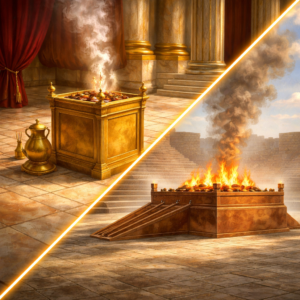
The Ascent of the Korban Tamid
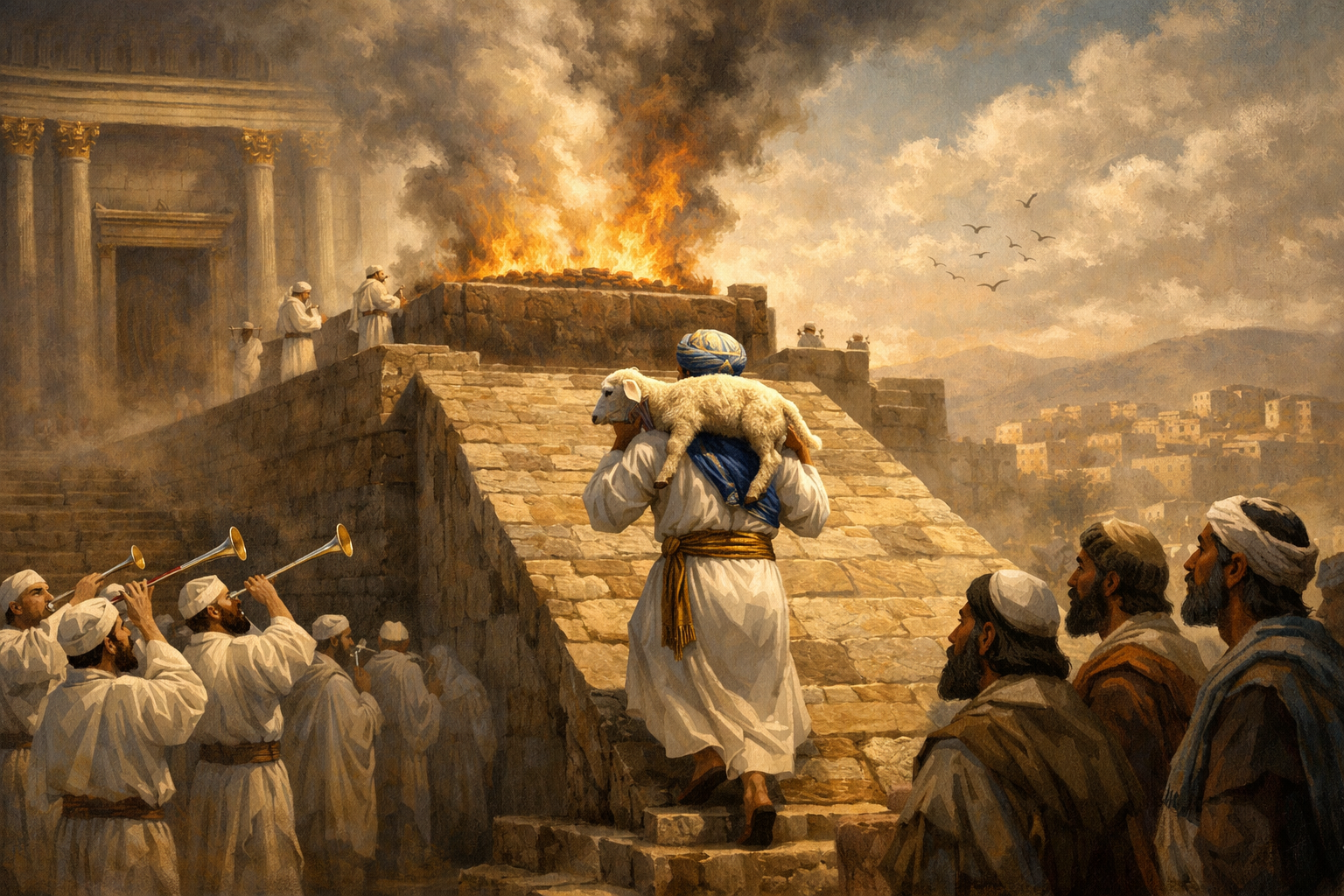
The Order of Ascent Begins from Above
Parshat Tzav opens with a detailed discussion of the Korban Tamid, the daily burnt offering brought in the morning and afternoon. Unlike other offerings, the olah is entirely consumed on the altar—nothing is eaten. Its very name, olah, signifies ascent, something that rises completely upward to Hashem.
The Torah emphasizes this with a seemingly redundant phrase: “Zot torat ha’olah, hi ha’olah”—this is the law of the burnt offering, it is the burnt offering. The repetition hints to its deeper function: the Korban Tamid is not just another offering, but the mechanism of elevation itself. It gathers everything that came before it—all the sacrifices of the day—and lifts them upward.
Rashi notes that the afternoon Korban Tamid concludes the day’s offerings, sealing and elevating them. In this sense, it functions as a spiritual culmination, drawing all prior avodah upward toward its source.
Yet immediately after this ascent comes something that appears to move in the opposite direction: the Ketoret, the incense offering.
A Fundamental Contradiction
The Ketoret, as explained in Kabbalistic sources and developed by Rebbe Nachman and Reb Noson, operates in reverse. Instead of ascending, it descends—penetrating into the depths of impurity to extract trapped holiness.
This creates a striking contradiction:
- The Korban Tamid elevates upward
- The Ketoret descends downward
Logically, one would expect the sequence to be reversed. First descend into impurity, retrieve the fallen sparks, and only then elevate them. But the Torah establishes the opposite order: first the Korban Tamid, then the Ketoret.
Reb Noson sharpens the question further through the physical layout of the Beit HaMikdash. The outer courtyard houses the altar of the Korban Tamid, while the Ketoret is offered inside, closer to the Kodesh HaKodashim—the holiest place.
This too seems inverted. If the Ketoret deals with the depths, shouldn’t it be outside? And if the Korban Tamid represents ascent, shouldn’t it be positioned closer to the inner sanctum?
The Impossibility of Starting from Below
Reb Noson answers with a foundational principle in avodat Hashem.
Ideally, a person should first repair everything—clean up past damage, correct mistakes, and only then begin to grow. That would be the logical, orderly progression.
But in reality, this approach is impossible.
If a person were required to fully fix their past before moving forward, they would never begin. The weight of their failures would paralyze them. The backlog is too large, the confusion too great. A person would remain stuck indefinitely.
Therefore, the Torah reveals a different order.
You do not begin by descending into the depths to fix everything. You begin by ascending.
First Elevation, Then Repair
The Korban Tamid comes first because a person must first connect upward—to Hashem, to holiness, to some point of elevation—before attempting to confront the darkness.
This initial ascent provides:
- Strength
- Orientation
- Hope
- A connection to Kedushah
Only after establishing this upward movement can a person safely descend—through the power of the Ketoret—to extract and rectify what is broken.
Without that prior elevation, entering the depths would be overwhelming and dangerous. A person would be swallowed by the very negativity they are trying to fix.
Thus, the sequence is not reversed—it is precise.
First, the Korban Tamid lifts a person upward. Then, with that strength, the Ketoret can descend and accomplish its task.
The Inner Structure of the Mishkan
This also explains the physical layout of the Mishkan and the Beit HaMikdash.
The outer altar represents the beginning point—the accessible place where a person starts their avodah, lifting themselves upward. Only afterward can one move inward, toward the deeper, more hidden work represented by the Ketoret.
The closer something is to the Kodesh HaKodashim, the more refined and delicate it is. The Ketoret, though it descends into impurity, originates from a higher, more concealed level. Its power to descend comes specifically from its inner holiness.
A Practical Framework for Growth
Reb Noson’s teaching is not theoretical—it defines how a person must approach growth.
When a person wants to improve, the instinct is often to say: “First I need to fix everything I’ve done wrong.”
But this mindset leads to stagnation.
Instead, the Torah teaches:
- Begin with what you can do right now
- Create movement toward holiness
- Build connection and simcha
- Then gradually address the past
This is the order of the Korban Tamid followed by the Ketoret.
Growth is not linear—it’s a cycle
The Beginning of True Ascent
The opening of Parshat Tzav is not merely detailing sacrificial procedures. It is laying out a blueprint for spiritual progress.
A person does not begin by descending into their failures. They begin by rising above them.
Only after that ascent can the deeper work begin.
A Taste Before the Work Begins
Reb Noson now completes the picture. If a person were left in darkness and told to fix everything before moving forward, he would never begin. What’s needed first is a taste of light—a glimpse of what it feels like to be close to Hashem.
Even if a person is undeserving, carrying a full “package” of past mistakes, Heaven grants him a temporary elevation. He feels inspired, alive, connected—like everything is finally clicking. This is not accidental. It is intentional. It is the experience of the Korban Tamid, the olah—an ascent.
But crucially, this ascent happens in the courtyard, not inside the inner sanctum. It is real, but it is only the beginning.
The Illusion of Arrival
Once a person tastes this light, something shifts. He naturally wants more. Growth is built into human nature—we are wired to move forward.
But this is where a critical misunderstanding can occur.
A person may think: I’ve arrived. I’ve reached something real.
In truth, he has only reached the courtyard.
The experience is authentic, but it is not yet the destination. It is an introduction—a necessary stage that creates desire and motivation to go further.
The Turning Point: Being Sent Back
When a person seeks to move beyond this initial elevation—to enter the bayit (house), the inner domain of holiness—he encounters resistance.
Reb Noson describes this as “guards at the entrance,” spiritual barriers that prevent further progress until a deeper עבודה (avodah – spiritual work) is done.
And what is that עבודה?
He is sent back.
Back to the very places he came from. Sometimes even deeper than before.
This is the moment where most people break.
Where Most People Fall Apart
Everything seemed to be going well. Growth, inspiration, clarity. Then suddenly:
- Confusion returns
- Motivation drops
- Old struggles resurface
- Progress feels reversed
A person looks at this and concludes: I’ve lost everything.
But Reb Noson reveals: nothing was lost. This is the next stage.
The descent is not a failure—it is the עבודה of the Ketoret.
The Work of the Ketoret
The Ketoret represents descending into the darkness to extract the hidden holiness trapped there—sparks that were left behind through a person’s past actions.
And here is the key: only that person can retrieve those sparks.
This is why he must go back.
But the only way to survive this stage is through simcha (joy).
Rebbe Nachman teaches that Ketoret and simcha are fundamentally connected—“Ketoret yesamach lev” (the incense gladdens the heart). In this phase, a person must find ways to remain positive, even with the smallest נקודות טובות (nekudot tovot – good points).
If he falls into despair, he becomes stuck. If he holds onto even minimal joy, he can extract the sparks and move forward.
Why the Order Matters
This now explains everything:
- Korban Tamid comes first → to give a person a taste of elevation
- Ketoret comes after → to send him back and complete the עבודה
Without the initial ascent, the descent would be unbearable.
Without the descent, the ascent would remain incomplete.
The order is not a contradiction—it is the structure of real growth.
From Courtyard to Home
The ultimate goal is not to remain in the courtyard, but to enter the bayit (house)—to internalize holiness in a stable, lasting way.
As the sages describe, Avraham saw Har HaMoriah (the Temple mount) as a mountain, Yitzchak as a field, but Yaakov called it a bayit Elokim—a home for Hashem. True avodah is not a temporary high, but something integrated into daily life.
But to reach that level, a person must be willing to revisit the darkness—not as a victim, but as someone sent on a mission.
The Ongoing Cycle of Growth
This is why Rebbe Nachman teaches: “Mitzvah gedolah lihyot b’simcha tamid” (it is a great mitzvah to always be in joy).
The word tamid—constant—echoes the Korban Tamid, the daily ascent. A person must continually reconnect to that נקודת אור (nekudat or – point of light), even while engaged in the difficult work of the Ketoret.
Growth is not linear. It is a cycle:
- Ascent
- Descent
- Extraction
- Deeper ascent
Recognizing this cycle changes everything. What looks like regression is often the doorway to the next level.
Shabbat Shalom and Chag Sameach.
Meir Elkabas
- 0 comment