The Two Prophecies of Moshe
Parshat Matot opens with the laws of nedarim (vows). A person can take something that the Torah ordinarily permits and, through his own words, make it forbidden to himself. Once he expresses a valid neder, he may not simply disregard it. His commitment has acquired the force of Torah law.
There are, however, specific ways in which a vow can be removed. A person who regrets his neder and realizes that he cannot maintain it may approach a qualified chacham (Torah sage), or in certain circumstances a panel of three, for hatarat nedarim (annulment of vows). The sage searches for a petach (opening)—a circumstance the person had not properly considered when he made the vow. If he can honestly say that he would never have taken the vow had he understood what it would involve, the vow can be released.
The Torah also discusses hafarah (revocation), which is different from hatarah. Under the Torah’s prescribed conditions, a father may revoke certain vows made by his daughter while she remains in his domain. Once she is betrothed, her father and future husband act together, and after marriage her husband may revoke certain vows. This power is limited to the day on which the vow is heard.
Moshe Rabbeinu introduces these laws with a striking expression:
“Zeh hadavar asher tzivah Hashem” – “This is the matter that Hashem commanded.”
Rashi explains that these words reveal the exceptional clarity of Moshe Rabbeinu’s prophecy.
“Thus Said Hashem” and “This Is the Matter”
The other prophets generally introduced their prophecies with the expression:
“Ko amar Hashem” – “Thus said Hashem.”
Moshe Rabbeinu also used this expression. Before the plague of the firstborn in Egypt, he declared:
“Ko amar Hashem: Kachatzot halaylah…” – “Thus said Hashem: At approximately midnight…”
But Moshe possessed an additional prophetic level that the other prophets did not have. He could also say:
“Zeh hadavar” – “This is the matter.”
“Ko” means “thus,” “something like this,” or “in this manner.” It conveys a degree of approximation. “Zeh,” by contrast, means “this”—clear, direct and precise. Moshe could point, as it were, to the prophecy itself and say, “This is exactly what Hashem commanded.”
Rashi therefore praises Moshe for two forms of prophecy. He prophesied with “ko amar Hashem,” as did the other prophets, but he also reached the unique clarity of “zeh hadavar.”
The Maharal raises an important question. Once Moshe had attained the higher level of “zeh hadavar,” what praise is there in saying that he also possessed the less precise level of “ko”? If someone can communicate Hashem’s word with perfect clarity, why mention that he could also communicate it approximately?
We might have expected the Torah simply to say that other prophets prophesied with “ko,” whereas Moshe prophesied with “zeh.”
Yet the Torah deliberately associates both expressions with Moshe Rabbeinu.
Different Prophecies Require Different Levels
The Maharal explains that even Moshe’s prophecy did not operate in exactly the same way in every area.
When Moshe transmitted the Torah and the laws required by Am Yisrael, his prophecy was perfectly clear. In these matters, he could say “zeh hadavar”—“This is precisely what Hashem said.”
But other matters remained in the category of “ko,” even for Moshe. There were areas in which the revelation came through an element of approximation, concealment or uncertainty.
This is not a flaw in Moshe Rabbeinu. On the contrary, it expresses a fundamental principle: no human being, even the greatest Tzaddik, becomes identical with Hashem.
A Tzaddik may reach levels of closeness that are incomprehensible to ordinary people. He may perceive Hashem with extraordinary clarity and devote every aspect of his life to Him. But he remains a human being and a servant of Hashem. He is never Hashem Himself.
To erase that distinction would be idolatry.
Even the highest Tzaddik must therefore retain some boundary, some area beyond his grasp, and some experience of moving between revelation and concealment. Rebbe Nachman teaches that the Tzaddikim also experience spiritual “ins and outs,” although at levels far beyond our understanding.
The two expressions of Moshe’s prophecy reflect those two movements.
“Zeh hadavar” represents clarity.
“Ko amar Hashem” represents the necessary area of concealment.
Why “Zeh Hadavar” Appears by Vows
It is significant that the Torah reveals Moshe’s clearest prophetic expression specifically in connection with nedarim.
What is so profound about a vow?
Reb Noson explains in Likutey Halachot that a neder demonstrates the astonishing power of a Jew’s speech. Through his words, a person can create a new personal Torah obligation.
Suppose a kosher bottle of soda is sitting before him. The Torah permits him to drink it after making the appropriate berachah (blessing). But if he makes a valid neder forbidding that drink to himself, it now becomes prohibited.
The original Torah has not changed. The drink remains permitted to everyone else. Yet for this person, a new Torah restriction has been created.
In a sense, he previously had 613 mitzvot, and now he has created an additional personal obligation. Violating the neder is not merely breaking a casual promise. His words have produced a real prohibition.
This is why one must be extremely careful with commitments. A Jew should commonly say “bli neder”—“without making a vow”—when accepting a future practice or promising to do something. Words possess tremendous power, and a person should not casually create obligations that he may later be unable to fulfill.
Nun Dar – Residing at the Fiftieth Level
The Zohar and Kabbalah explain that the word neder can be divided into “nun dar.”
Nun has the numerical value of fifty, while dar means “dwells” or “resides.” A neder draws from the concept of dwelling at the fiftieth level.
The fiftieth level is an extraordinarily elevated spiritual root. It is associated with the Keter, the level beyond the ordinary structure of understanding. Through the power of speech, a Jew can reach toward that root and draw down a new personal Torah obligation.
This explains the severity of a neder. It is not simply a strong promise. Its spiritual source is extremely high.
It also explains why Moshe Rabbeinu’s prophecy of “zeh hadavar” is revealed here. Moshe was connected to the fiftieth level with a clarity no other prophet attained.
Chazal teach that during his lifetime Moshe reached forty-nine levels of understanding, and at his passing he fully accessed the fiftieth. He was buried at Har Nevo (Mount Nevo), a name that can be read as “nun bo”—“the fifty is within him.”
Neder is “nun dar”—dwelling at fifty.
Nevo is “nun bo”—fifty within him.
Moshe Rabbeinu was uniquely connected to this level. Therefore, when he taught the laws of nedarim, he could say “zeh hadavar.” His prophecy came with complete clarity from the root of the Torah.
The Sage Who Can Release the Vow
The power of a chacham to annul a neder makes this teaching even more remarkable.
The person’s speech has reached the spiritual root of “nun dar,” the fiftieth level, and created a real Torah prohibition. One might assume that nothing can now undo it. The vow came from such an elevated source that it must remain forever.
Yet the Torah gives the chacham power to find a petach and release it.
The sage asks the person questions such as: “Had you known how difficult this would become, would you have made the vow?” or “Had you understood the consequences, would you have accepted this obligation?”
If the person can truthfully respond that he would not have made the vow, the sage can uproot it through hatarah.
The chacham is not dismissing the neder or pretending it never mattered. He is reaching to its root and showing that the commitment was formed without a full understanding of the circumstances.
This power ultimately comes through the Torah transmitted by Moshe Rabbeinu. Moshe, connected to the fiftieth level, teaches that a true chacham can release even an obligation that drew its force from that very level.
This is the clarity of “zeh hadavar.”
A person should not stop striving for clarity. But when clarity is taken away, he should not give up.
Why Moshe Still Needed “Ko”
But Moshe could not live only with “zeh.”
No Tzaddik, however great, can experience uninterrupted clarity. There must also be an area of “ko”—an experience in which the light is not fully grasped.
Rebbe Nachman teaches that spiritual life always requires both movement forward and movement backward. A person advances toward Hashem, receives light and gains understanding. Then he is pushed back and enters a state where the earlier clarity is gone.
The Tzaddikim experience this as well, on their own exalted level.
If Moshe possessed only “zeh hadavar,” without any experience of “ko,” his perception would appear unlimited. The Torah therefore shows that even he had a prophetic expression connected to approximation and concealment.
The primary example is midnight.
“At Approximately Midnight”
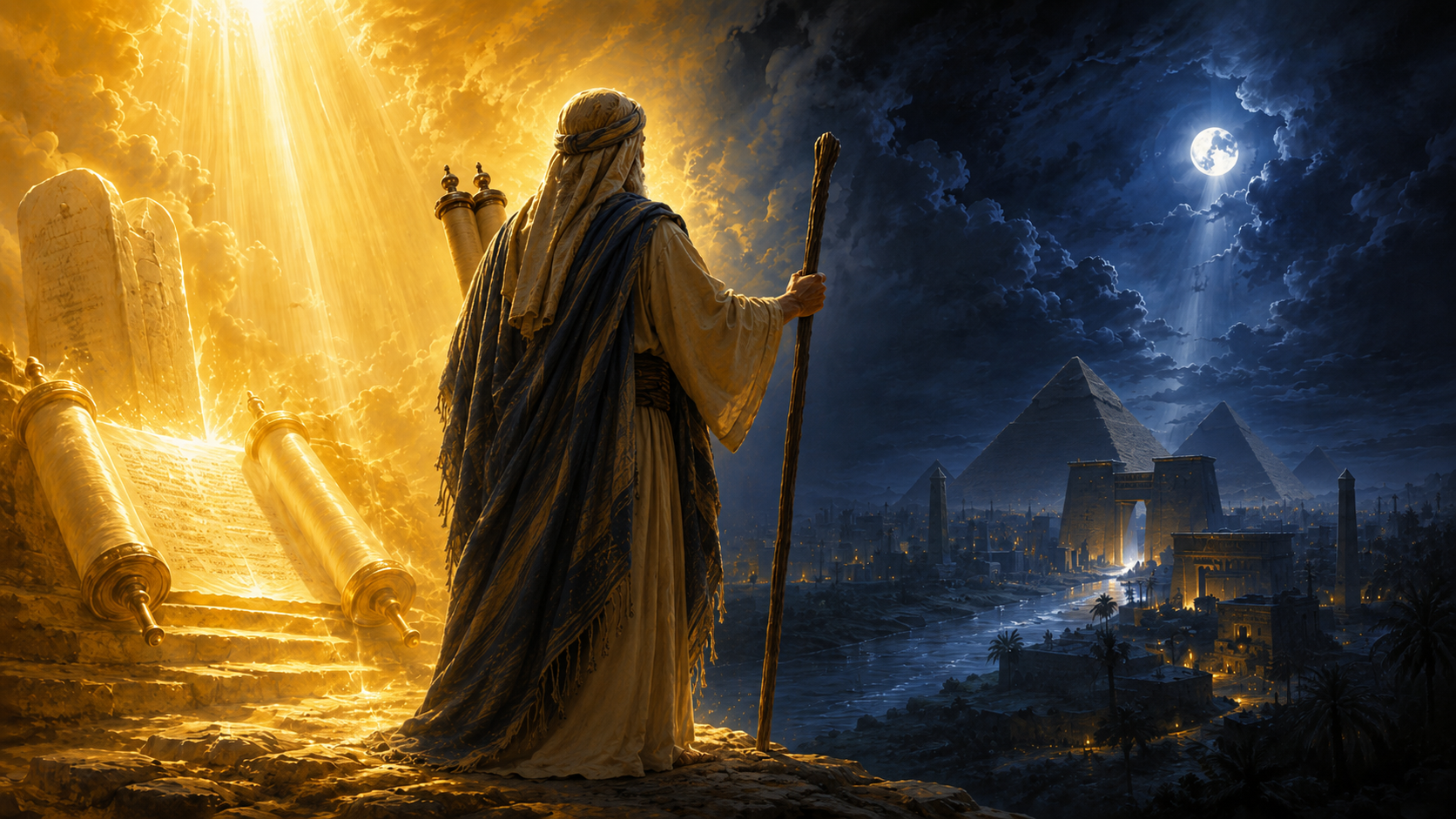
Before the final plague in Egypt, Moshe told Pharaoh:
“Ko amar Hashem: Kachatzot halaylah ani yotzei betoch Mitzrayim” – “Thus said Hashem: At approximately midnight, I will go out in the midst of Egypt.”
Why did Moshe say “at approximately midnight”? Why not simply say “at midnight”?
Rashi explains that Pharaoh’s astrologers would be carefully monitoring the prediction. If Moshe announced an exact midnight but their calculation differed by even a small amount, they might claim that Moshe’s prophecy had failed.
(Halachic midnight is not necessarily midnight according to an ordinary clock. It depends on the division of the night, and there are different calculations and opinions regarding its exact time. Rebbe Nachman follows the calculation of six full hours after the beginning of the night, but the practical time changes according to sunset and the season).
To prevent the Egyptians from using their own mistaken calculation to attack Moshe’s credibility, he said “kachatzot”—“at approximately midnight.”
However,other interpretations suggest that Moshe himself did not know the exact moment and therefore spoke approximately. In either case, this prophecy was expressed through “ko” and “kachatzot,” rather than through the absolute clarity of “zeh.”
Why is the concealed side of Moshe’s prophecy revealed specifically regarding midnight?
Midnight and the Union of Opposites
Reb Noson explores the mystery of midnight in Likutey Halachot, in the fourth discourse on Nefilat Apayim (falling on one’s face).
Midnight represents the joining of two opposites.
It is the meeting point of the sun and the moon.
At first, that sounds impossible. Midnight is dark. The sun is not visible. The sun appears during the day, while the moon rules the night. How can midnight represent their union?
The moon has no independent light. Whatever light it possesses is reflected from the sun. Its appearance changes as it waxes and wanes according to the positioning of the earth, sun and moon.
The sun represents light, knowledge, perception and understanding. It corresponds to the times when a person can see what Hashem is doing and perceive something of His wisdom.
The moon represents diminished light. It corresponds to concealment, uncertainty and the lack of understanding. A person cannot see clearly. His knowledge has contracted, just as the moon’s light diminishes.
Yet the moon’s light still comes from the sun.
Even within the darkness, hidden sunlight is present.
At midnight, the sun and moon perform their roles together in a manner the human mind cannot fully comprehend. The darkness itself contains reflected light. The absence of direct perception becomes the place through which another form of light can appear.
Knowledge and the Lack of Knowledge
Rebbe Nachman teaches that a person needs both knowledge and the lack of knowledge.
He must pursue Torah, understanding and closeness to Hashem. He must use his mind, develop his perception and advance toward greater spiritual clarity.
But he must also experience the pushback.
At certain points, the clarity disappears. The person no longer understands what is happening. His plans fail, his earlier inspiration fades and his mind cannot make sense of his circumstances.
This pushback is called a betishah (spiritual striking or repulsion). It comes through the Keter, the barrier surrounding the Infinite Light.
A person moves toward the light, but the Keter pushes him backward. That setback creates the vessels through which he will later be able to receive a greater light safely.
The person needs both movements. He cannot remain permanently pushed backward, but neither can he move forward without interruption.
He needs the thrust toward Hashem and the setback from Hashem.
He needs knowledge and the lack of knowledge.
He needs the sun and the moon.
The Light Hidden in Darkness
The deepest Divine light can enter a person specifically when his ordinary mind is no longer in control.
When everything is clear, the person receives according to the limits of his understanding. But the Infinite Light is beyond the mind’s grasp.
Therefore, there are times when Hashem allows the person’s intellectual control to collapse. He does not understand. He cannot calculate what comes next. He feels as if he is in darkness.
Yet precisely then, vessels are being created for a light beyond his comprehension.
This does not mean that confusion is automatically holy or that a person should seek to abandon understanding. Rather, when Hashem brings him to a place beyond his understanding, he must respond with emunah (faith).
He says: “I do not understand what is happening, but I believe Hashem is here. I will continue moving forward even without clarity.”
That is the secret of midnight.
It is completely dark, yet the hidden power of the sun is present. The moon shines only because of the sun, even when the sun itself cannot be seen.
A person may feel that he is in darkness while, in reality, the light is operating in a hidden form.
The Breakthrough at Midnight
The final plague in Egypt occurred precisely at midnight.
The plague of the firstborn was the decisive blow. After nine earlier plagues, Pharaoh continued refusing to release Am Yisrael. But when the firstborn died—including Pharaoh’s own son—everything changed.
Pharaoh himself was a firstborn and feared that he would die as well. In the middle of the night, he ran through Egypt searching for Moshe and Aharon, desperate for the Jewish people to leave.
(The Midrash describes Pharaoh rushing out in his nightclothes, giving rise to the well-known children’s song about Pharaoh in pajamas in the middle of the night).
When he finally reached Moshe and Aharon, he ordered them to leave. The final barrier had collapsed.
The greatest breakthrough occurred at midnight.
This is not incidental. Midnight represents the moment when visible light and hidden light join, when understanding and the lack of understanding work together. It is the point at which darkness itself becomes the setting for redemption.
The person cannot explain how the breakthrough will occur. It emerges from beyond his ordinary perception.
The Kaf of “Kachatzot”
The word “kachatzot”—“at approximately midnight”—begins with the letter kaf.
Kaf is also the first letter of Keter.
The Keter is the force that pushes a person back from the Infinite Light. It creates the “approximately,” the area in which he cannot say “this is exactly what is happening.” He can only say “ko”—“something like this.”
That lack of total clarity is necessary.
Even Moshe Rabbeinu, at his exalted level, needed this aspect of Keter. He needed a prophecy connected to “ko amar Hashem – kachatzot halaylah.” He too required an area where the revelation was not expressed as complete human certainty.
The Maharal’s question is therefore answered.
Moshe’s greatness was not only that he possessed “zeh hadavar.” His greatness also included the ability to remain connected to Hashem within “ko.”
He could receive perfect clarity where Hashem gave clarity, and he could accept concealment where Hashem withheld it.
The Two Sides of Moshe’s Prophecy
Moshe Rabbeinu’s two prophetic expressions correspond to two essential spiritual powers.
“Zeh hadavar” appears with the laws of nedarim. It represents clarity, the fiftieth level and the power to reach the root of Torah. Moshe can teach how human speech creates a new personal Torah and how a chacham can release that obligation from its root.
“Ko amar Hashem” appears by midnight and the plague of the firstborn. It represents concealment, approximation, the Keter’s pushback and the merging of knowledge with the lack of knowledge.
One leads to the power of Torah.
The other leads to the breakthrough from exile.
Both are necessary.
A person needs times of clear Torah and firm direction. He must know what Hashem asks from him and follow that truth without ambiguity.
But he also needs the strength to survive the midnight periods, when nothing is clear and he cannot understand what Hashem is doing.
Finding Tzaddikim Who Can Illuminate Both
The practical lesson begins with the need to find true Tzaddikim.
We need Tzaddikim who can illuminate both sides of the path. They can teach us the clarity of Torah—the “zeh hadavar”—while also helping us endure the concealment of “ko amar Hashem.”
They understand how to direct a person when the road is clear, and they know how to strengthen him when he is in darkness.
Their own experience of spiritual movement enables them to guide others through the same process. They shine into our advances and our setbacks, our knowledge and our confusion.
We must seek such Tzaddikim, attach ourselves to their teachings and allow their guidance to help us navigate our own spiritual “ins and outs.”
Do Not Give Up During the “Out”
There is also a deeply personal message.
People often become discouraged because their spiritual lives are inconsistent. One day they feel inspired, close to Hashem and ready to change everything. Another day they feel completely disconnected.
At times, a person feels as if he is “on cloud nine.” He understands, prays with feeling and experiences genuine desire.
At other times, he feels entirely off the grid. He may wonder why he is here at all or whether any of his earlier progress was real.
Parshat Matot teaches that these movements do not necessarily mean the person has failed. Even the greatest Tzaddikim experienced spiritual “ins and outs,” each according to his level.
Moshe Rabbeinu himself had “zeh hadavar” and “ko amar Hashem.”
There were revelations of perfect clarity, and there were revelations expressed through approximation.
There was the light of the fiftieth level, and there was the darkness of midnight.
The work is not to remain permanently at the highest point. The work is to hold on through both movements.
Holding On Through Midnight
When a person reaches his personal midnight, he should remember that the darkness may contain the hidden beginning of his breakthrough.
The sun is present even when it cannot be seen. The moon’s light comes from it. The lack of understanding may be preparing vessels for a light beyond understanding.
A person should not stop striving for clarity. But when clarity is taken away, he should not give up.
He must respond with emunah:
“Hashem, I do not understand, but I still want You. I cannot see the way forward, but I will continue. I believe that this darkness is also part of the process.”
That response joins the sun and the moon.
It joins knowledge with faith beyond knowledge.
It turns midnight into redemption.
May we be zocheh to connect to the true Tzaddikim who can illuminate both the clarity and concealment in our lives. May we learn from Moshe Rabbeinu to receive “zeh hadavar” when Hashem grants us clarity and to remain faithful within “ko amar Hashem” when the path is hidden and “iffy”. Through all our spiritual advances and setbacks, may we hold on until the darkness of midnight becomes the beginning of our greatest breakthrough.
Shabbat Shalom.
Meir Elkabas
- 0 comment