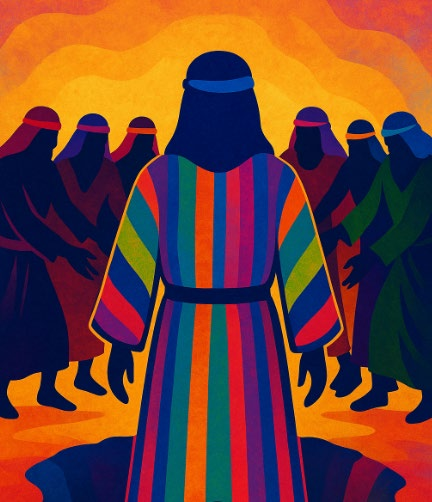
Yosef HaTzaddik and his Brothers
FROM THE RECENTLY PUBLISHED ‘REBBE NACHMAN’S SOUL’, ADAPTED FROM HIS AUDIO SHIURIM ON SICHOS HARAN 80 AND SICHOS HARAN 262
SICHAH 80 – REUVEN’S MERCY
We see in the Chumash that the brothers of Yosef HaTzaddik wanted to kill him. This, of course, was a pitiful act, brothers wanting to kill their own brother. For whatever reason it was, it was a tragedy. However, the Torah says, “Vayishma Reuven” (Bereishis 37:21), the oldest one, Reuven, decided to rescue Yosef HaTzaddik from the hands of his brothers. How do you rescue Yosef HaTzaddik? Was he going to do battle against them? What chance would he stand?
He had to use his wits. He said to the brothers, “Why should we kill him with a sword? Why should we spill his blood? Here we have a pit that is more than twenty feet deep. He cannot escape from this pit. It is filled with poisonous snakes and scorpions. One sting of a scorpion, one bite of a snake, will kill him instantly. Drop him into this pit; he’ll step on one of the many snakes there and he’s finished. Let’s do it that way.”
The brothers agreed. Yosef HaTzaddik was dropped into the pit and with this, it says, Reuven did his best and rescued his brother. Is that a nice thing to do to a younger brother, to take him and throw him into a pit of poisonous snakes that are just waiting for the chance to pounce and kill? How is this called a rescue, and one that the Torah lauds, and commends to no end?
Throughout the Torah, we find again and again the great quality of mercy of Reuven – his wonderful, humanitarian act in saving the life of Yosef HaTzaddik. He threw him into a pit of poisonous snakes and scorpions!
We add the word scorpions because the Gemara says that many times, a poisonous snake will not harm a person unless it is attacked. If the person stands perfectly still, it is most probable that the snake will not attack him. However, a scorpion is so vicious and has such a rotten character, it will sting and kill a person without being attacked, without any provocation at all (See Berakhos 33a).
This pit was a real bargain basement: it had both, snakes and scorpions! It was very narrow, so there was no way for Yosef HaTzaddik to escape them. What then was so heroic about what Reuven did? The answer is that Reuven said to himself, “I know what is written in Sichos HaRan. I know what Rabbeinu zal said, that the worst enemy of a person is another human being. Therefore, if I rescue Yosef HaTzaddik from his brothers, no matter where I put him, he’ll be better off, because an angel is less destructive than a person. An angel is surely more powerful than snakes and scorpions. A person could be saved from an angel, and Yosef HaTzaddik could be saved through his goodness, through his purity, through his holiness as a tzaddik. He could be saved by a miracle from snakes and scorpions, but nothing can save him from these humans, his brothers, who are out to destroy him!
“Therefore,” he said, “I would rather risk his life in a pit of snakes than leave him to the mercy of his brothers who are intent on killing him.”
This demonstrates the point. Rabbeinu zal says that a person should be extremely wary of the damaging effects of conversing with people whose minds are steeped in philosophy, and those who have atheistic inclinations, because there is very little you can do to affect their minds and bring them back to faith. They can much more easily spoil your faith, whatever you have of it.
Therefore, a person should avoid any type of contact with philosophers or Reform rabbis. Rabbeinu zal says that their speech is poison. Just as a snake gives forth poison from his fangs, so too, the tongues of these Reform leaders spread poison. Just by speaking to them, a person’s faith could be marred. A person should stay away from them, completely avoiding any contact whatsoever. They should be considered as though they are in cherem, as they very much deserve to be.
SICHAH 262 – THE TZADDIK SEES THE FUTURE
Rabbeinu zal says that there is a special kind of chein, charm, that gives a person the power to foretell the future. This chein causes the person’s dreams to be much more realistic.
The vast majority of dreams are false and meaningless. They are devarim beteilim, nonsense and contain no truth whatsoever regarding the future. A tzaddik, however, can see the future in his dreams. If he has this chein, his dreams become purer and they enable him to foretell the future. Not only that, but he can even interpret another person’s dreams, to see the future through them. He can pick out the few grains of truth that are present in those dreams, which are completely hidden from others.
This is the chein of Yosef HaTzaddik. Yosef was “ben poras” (Bereishis 49:22). Poras means beauty, chein. He had a type of charm that enabled him to understand and interpret the dreams of others, as well as his own. Dreams are a routine matter, and it would not seem that stories about dreams would warrant being mentioned in the Torah. Yet, the dreams of Yosef HaTzaddik and his interpretations are so important that the Torah dedicates numerous words to them. The Torah gives more space to Yosef’s dreams than it does to many mitzvos, which shows how far-reaching they are.
Yosef HaTzaddik’s power comes from his being “ben poras Yosef.” Poras is the power of the tzaddik emes to unite, to sew together. The word PORaS contains the same letters as TOFeR, to sew. There are seven Names which add up in gematria to PORaS. The tzaddik emes sews together the yichud of Yod‑Heh-Vav-Heh and Ehyeh in all their forms. He is able to sew them together because he is the tzaddik emes. Therefore, he has also the power of POSeR, interpreting dreams, by virtue of having this PORaS, this chein.
- 0 comment