The Light of the Crowns
From the Joy of Purim to the Golden Calf
At first glance the Parshah seems to move in the opposite direction. Right after the great joy and miracle of Purim, we encounter the story of the Golden Calf. It appears as if we are moving backwards—from redemption to collapse. How can it be that after such a powerful revelation of salvation we read about the Jewish people falling to one of the lowest levels imaginable?
Yet in truth, the episode of the Golden Calf brought about the revelation of a higher level of compassion. As a result of that sin, Hashem revealed to Moshe Rabbeinu the Thirteen Attributes of Mercy. This revelation represents a deeper level of Divine compassion that had not previously been revealed. In that sense, the miracle of Purim and the events of Parshat Ki Tissa are closely connected. Both emerge from a hidden level of redemption and compassion that becomes revealed specifically through crisis.
To understand this more deeply, we must examine several details in the Parshah—how Moshe Rabbeinu spoke with Hashem in order to calm the Divine anger, what Hashem said in response, and what spiritual damage was caused by the Golden Calf.
Moshe Rabbeinu’s Argument
After the sin, Moshe Rabbeinu pleaded with Hashem not to destroy the Jewish people. He presented a powerful argument: if Hashem would forgive the people, then all would be well. But if not—“v’im ayin, mecheini na misifrecha”—then blot me out from Your book. Moshe declared that he did not want to become the founder of a new nation if the current people would be destroyed.
Moshe explained his reasoning with a striking analogy. If a table with three legs cannot stand, how could a table with only one leg stand? The Jewish people stood upon the merit of the three forefathers—Avraham, Yitzchak, and Yaakov. If their descendants could not endure even with the merit of those three pillars, how could Moshe expect his own descendants alone to succeed? Through this argument Moshe Rabbeinu succeeded in persuading Hashem not to destroy the Jewish people entirely.
Nevertheless, the situation was still extremely serious. Hashem declared that those who sinned would still be punished. In addition, He announced that His Divine Presence would no longer accompany the Jewish people in the same way.
The Removal of the Divine Presence
In chapter 33 the Torah describes Hashem telling Moshe that His Presence – the Shekhinah – would no longer travel directly among the Jewish people. Instead, He would send an angel to accompany them. Paradoxically, this was actually for their benefit. The holiness of the Divine Presence is so intense that even a slight blemish among the people could provoke severe judgment. If the people were not able to maintain the necessary level of holiness, that closeness itself could bring destruction. Therefore Hashem said He would send an angel instead.
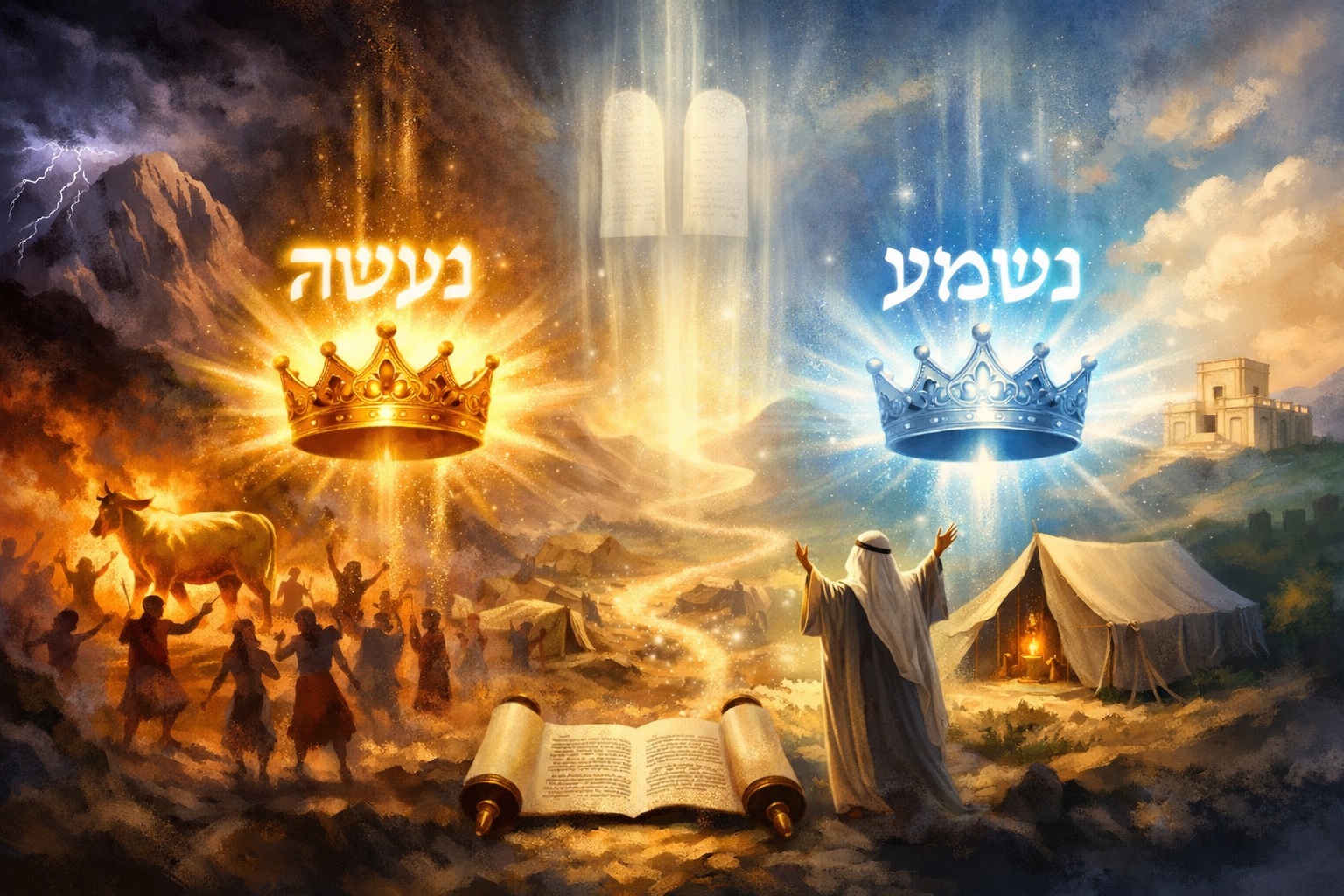
When the Jewish people heard this announcement, they mourned deeply. The verse says that no man placed his edyo—his crown—upon his head. What crown is this referring to? The Gemara in Masechet Shabbat teaches that when the Jewish people declared at Mount Sinai, “Naaseh v’Nishma”—“We will do and we will listen”—six hundred thousand angels descended and placed two crowns upon every Jew: one crown for “Naaseh” and one crown for “Nishma.”
Yet the verse describing their mourning mentions only a single crown. The people did not place “the crown” upon their heads. Immediately afterward, Hashem tells Moshe to instruct the people to remove the crown from their heads. Then the next verse states that the Jewish people removed their crowns—now in the plural. The commentaries ask the obvious question: if they had already removed the crown, why does Hashem command them to remove it again?
The Two Crowns of Naaseh and Nishma
The Midrash and the commentators explain that every Jew received two crowns—one for Naaseh and one for Nishma. The crown of Naaseh represents action, the commitment to perform Hashem’s commandments. The crown of Nishma represents something deeper—the inner desire and yearning to fulfill Hashem’s will.
Because of the sin of the Golden Calf, the crown of Naaseh was already blemished. The Jewish people themselves removed that crown. But Hashem then instructed them to remove the second crown as well. Even the crown of Nishma, the crown of desire, had to be taken away. This is why the verses first mention the crown in the singular and then in the plural: first the crown they removed themselves, and then the second crown that Hashem required them to remove.
Reb Noson explains that the crown of Nishma represents the deeper level of ratzon, the yearning to serve Hashem even when one is unable to act. Action is one level, but desire is far deeper. The tragedy of the Golden Calf was not only a failure of action—it was also a failure of inner desire.
The Meaning of the Crown — The Keter
Reb Noson explains that these crowns correspond to the concept of Keter, the “crown” described in Kabbalah. The Keter represents the gateway through which a person receives and perceives the Infinite Light of Hashem. That light is constantly flowing, sending vitality and abundance—chiyut v’shefa—to every person.
Yet the Keter functions in a surprising way. According to Likutey Moharan lesson 24, the Keter actually pushes a person back. When someone advances toward spiritual light, he experiences setbacks and obstacles. This pushback is not a punishment; it is part of the mechanism through which the Infinite Light enters his life.
The Zohar describes this dynamic as “reaching and not reaching.” A person moves forward and then is pushed back. He advances and then retreats. Through this process he develops the vessels necessary to receive greater light. Without setbacks, a person cannot grow. If someone imagines that spiritual life consists only of continuous advancement without difficulties, he fundamentally misunderstands how spiritual growth works.
Rebbe Nachman teaches in Sichot HaRan that if a person cannot accept setbacks with faith and patience, he can never advance. The ability to endure those setbacks is precisely what allows the Infinite Light to enter.
The Two Levels of Keter
The two crowns correspond to two aspects of the Keter. The crown of Naaseh represents the Keter associated with action—when a person is actively doing mitzvot and advancing spiritually. The crown of Nishma represents the deeper level—the Keter associated with desire. When a person cannot act, when he experiences setbacks or obstacles, his yearning to come close to Hashem grows stronger.
Rebbe Nachman explains that desire becomes stronger precisely when something is withheld. When a person is prevented from attaining something, his longing intensifies. Thus the setbacks themselves create the deeper crown—the crown of desire.
Both crowns together enable a person to receive the Infinite Light.
The Despair of the Golden Calf
The tragedy of the Golden Calf was that the Jewish people fell into despair. Satan deliberately created confusion while Moshe Rabbeinu was on Mount Sinai. Through deception, he caused the people to miscalculate the time of Moshe’s return and even showed them an illusion of Moshe’s body suspended in the air, as if Moshe had died.
Under that pressure the people panicked. The Erev Rav, the mixed multitude, urged them to create a new leader. Hur attempted to stop them and was killed. Aharon tried to delay the process as much as possible, hoping Moshe would return before the situation spiraled further. Nevertheless, the pressure and confusion led many people to participate in creating the Golden Calf.
This represents a failure of patience. When a person faces pressure and uncertainty, he may make impulsive decisions rather than waiting with faith. Instead of enduring the setback and trusting that Moshe would return, the people rushed to create their own solution.
That despair blemished the crowns. The Keter is meant to function through setbacks: a person falls, but then he rises again. When someone experiences a setback and still cries out, “Hashem, I want to come close to You,” that desire itself draws the Infinite Light. But when a person falls and declares that everything is finished—that is the opposite of the Keter.
Those who maintain their desire will eventually rise again. But those who surrender to despair fall completely. That is what happened with the Golden Calf. Under pressure and confusion, many people abandoned patience and hope, and in doing so they lost the crowns that once connected them to the Infinite Light.
Because we failed to use the crowns properly—and in the absence of the Beit HaMikdash—their light must now be accessed through the true Tzaddikim
The Keter and the Settling of the Mind
Rebbe Nachman explains that the Keter also serves another purpose: it settles and organizes the mind. When a person is advancing and absorbing spiritual light, the experience can become overwhelming. The influx of light comes so quickly that the mind has no opportunity to absorb and integrate it.
Therefore the Keter introduces a pushback. The brakes are applied, so to speak, and the person is pushed away temporarily. This pause allows the mind to settle and become organized. Only then can the person properly receive and contain the light that he is being given.
In the episode of the Golden Calf, however, the Jewish people blemished both aspects of the Keter. They damaged the crown of Naaseh through their actions in creating the Golden Calf. But they also blemished the crown of Nishma, the crown of desire. When they concluded that Moshe Rabbeinu was gone and declared, “This is your god, Israel,” they demonstrated that they had lost patience with the process entirely.
Such a reaction occurs when a person cannot tolerate a setback. Instead of enduring the pushback and waiting for clarity, he panics and searches for an immediate replacement. The Keter, which requires patience and trust, becomes impossible to sustain.
For this reason Hashem commanded that the crowns be removed. The system of Keter was no longer functioning properly among the people. In truth, this removal was not a punishment but a necessary adjustment, because the people were not yet capable of using the crowns correctly.
The Tent Outside the Camp
If the crowns were removed, however, a difficult question arises. Without access to the Keter, how could an ordinary Jew continue to advance spiritually?
The answer appears immediately in the next verse. After the crowns were removed, the Torah states: “U’Moshe yikach et ha’ohel”—Moshe Rabbeinu took his tent and placed it outside the camp, far from the encampment of the Jewish people. He called it the Ohel Moed, the Tent of Meeting.
The Torah then explains that anyone who sought Hashem—“v’haya kol mevakesh Hashem”—would go out to the Tent of Meeting outside the camp.
This movement outward carried deep significance. A person who truly wished to seek Hashem had to leave the familiar environment of the camp and travel outward to Moshe Rabbeinu. That journey itself demonstrated how much he desired to connect to Hashem.
The Light Given to Moshe Rabbeinu
The Zohar teaches that the word ohel—tent—can also refer to a halo or surrounding light. The verse in Iyov says, “b’hilo nero alei roshi,” describing a light shining above one’s head. The Zohar connects this idea with the crowns that were removed from the Jewish people.
The light of those crowns did not disappear entirely. Instead, it was transferred to Moshe Rabbeinu. Moshe received the spiritual light that had once been distributed among the entire nation.
From that point onward, anyone who wished to access the Infinite Light could no longer do so independently. The crowns of Naaseh and Nishma had been blemished. Therefore the only path was through Moshe Rabbeinu.
Anyone seeking the Divine Presence had to approach Moshe’s Tent of Meeting. There, the Shechinah rested with Moshe Rabbeinu, and through him the Jewish people could once again access the light that had previously been available to them through the crowns.
This arrangement remained in place until the Mishkan was erected on Rosh Chodesh Nisan. Once the Mishkan was established, the Divine Presence rested there, and the various vessels of the Mishkan—the Aron, the Menorah, the Showbread, and the altar of Ketoret—became channels through which the Jewish people could once again receive spiritual light.
Leaving the Comfort Zone to Seek the Tzaddik
There is an important message here for every generation. When a person pushes himself too aggressively in spiritual growth and cannot tolerate the inevitable setbacks, he may lose his connection to the Keter. When he insists that things must happen immediately, according to his expectations, he loses the patience required to allow the mind to settle.
At that point the only path forward is through the Tzaddikim—the spiritual leaders who possess access to the light of the crowns.
Yet even this path contains a test. Moshe Rabbeinu’s tent was deliberately placed outside the camp. Anyone seeking Hashem had to leave the familiar surroundings of the community and travel outward in order to find the source of light.
This pattern appears again in the story of Purim.
The Example of Mordechai
At the end of Megillat Esther we read that Mordechai became second to King Achashverosh and that his influence spread throughout the entire empire. The nations feared the Jews because of the miraculous reversal of events—v’nahafoch hu—in which the Jewish people, who had been destined for destruction, were instead empowered to defeat their enemies.
Yet the Megillah concludes with a surprising detail: Mordechai was accepted by the majority of his brethren, but not by all of them. Some members of the Sanhedrin distanced themselves from him.
Rashi explains that since Mordechai became involved with the government, he was able to devote less time to Torah study. Because of this, some scholars questioned his role.
This situation reveals the same pattern we saw with Moshe Rabbeinu. The Tzaddik who holds the light is not always fully accepted by the establishment. Sometimes his position appears unusual or controversial. This creates a test for those who are truly seeking Hashem.
The Test of the Mevakesh Hashem
A person who is genuinely a mevakesh Hashem, someone seeking Hashem, must sometimes step beyond the familiar structures of religious life. This does not mean abandoning Torah or Halacha. Rather, it means being willing to search for the deeper truth, even when it lies outside the comfortable framework of convention.
The Torah hints to this idea through Moshe Rabbeinu’s tent outside the camp and through the partial acceptance of Mordechai among his peers.
Throughout history, those who have sought the deepest spiritual light have often faced opposition or misunderstanding. This pattern is well known in the history of the Breslov movement itself. From its earliest days there were debates, opposition, and doubts about following Rebbe Nachman. Yet such opposition is part of the test faced by anyone who sincerely seeks Hashem.
The question becomes: are we willing to leave the comfort of the status quo in order to pursue truth?
Restoring the Crowns
Because the Jewish people once failed to use the crowns properly, the light of those crowns must now be accessed through the Tzaddikim of every generation. In the absence of the Beit HaMikdash, the spiritual light that once radiated from the Temple is found through the true Tzaddikim who guide the generation.
This situation continues until the coming of Mashiach. At that time the crowns will be restored to the Jewish people. The Gemara in Shabbat teaches that the ornaments that were removed—the two crowns of Naaseh and Nishma—will once again return.
The verse promises: “v’simchat olam al rosham”—an eternal joy will rest upon their heads. The crowns that once rested upon the heads of the Jewish people will return, restoring the full light of Divine connection.
May we merit to find the true Tzaddikim who illuminate our path with the light of Naaseh and Nishma, and may we soon witness the restoration of those crowns with the coming of Mashiach.
Shabbat Shalom, and may we merit the purification of the Parah Adumah as preparation for Pesach, b’ezrat Hashem.
Meir Elkabas
- 0 comment