- Joy ⬦ Read ⬦ Shabbat ⬦ Weekly Torah Portion
The Joy in Ritual Slaughter
As Parshat Re’eh approaches, the excitement of Rosh Hashanah can already be felt. In Breslov, this means an intensified longing to join Rebbe Nachman in Uman for Rosh Hashanah.
Parshat Re’eh also marks a transition in Moshe Rabbeinu’s final teachings. After the largely moral and spiritual guidance of the preceding Parshiyot, Moshe begins reviewing many of the Torah’s practical laws in preparation for Am Yisrael’s entrance into Eretz Yisrael.
Among the subjects discussed are the korbanot (offerings) and the laws governing ordinary meat. Once the nation enters the Land and many Jews live far from the Beit HaMikdash, they will be permitted to slaughter animals locally for personal consumption rather than bringing every animal as an offering.
This permission comes with an important qualification. Rashi teaches that a person should not accustom himself to eating meat constantly. Meat is more appropriate for special occasions, particularly those associated with simcha (joy): Shabbat, Yom Tov, Rosh Chodesh and seudot mitzvah such as a wedding, Brit Milah or Siyum Masechet.
Chazal express this connection through the teaching:
“Ein simcha ela b’basar v’yayin” – “There is no joy except with meat and wine.”
This does not mean that consuming meat automatically produces genuine happiness. Rather, meat is spiritually suited to occasions on which a heightened simcha is already present.
The reason is that eating meat involves an immense spiritual responsibility.
Elevating the Sparks Within the Animal
Kabbalah teaches that holy sparks and reincarnated souls can be trapped within animals. Rebbe Nachman discusses this in Likutey Moharan Lesson 37, explaining that a Shochet (ritual slaughterer) requires proper intentions to release and elevate what is trapped within the animal.
Shechitah (ritual slaughter) is therefore not merely a technical means of making meat kosher. It begins a process of tikkun (rectification).
The person who later eats the meat must also participate in that elevation. This requires an appropriate spiritual state. When meat is eaten during a mitzvah and with simcha, a person is better able to elevate its hidden sparks.
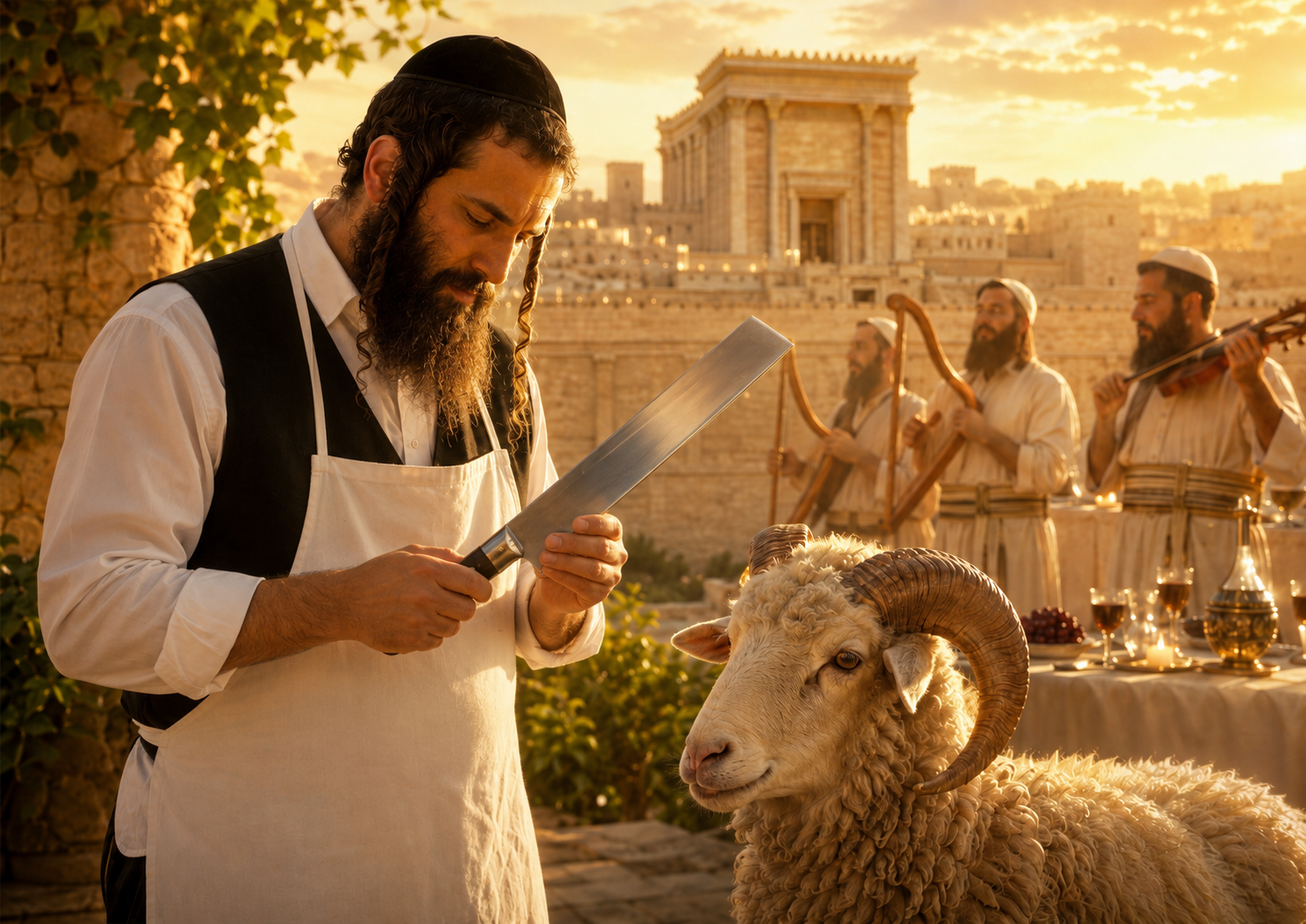
This helps explain why the Kohanim ate meat regularly in the Beit HaMikdash. Their service demanded a consistently elevated state of joy. The Levi’im played music during the offerings to create an atmosphere of simcha, while the Kohanim performed the avodah and ate their portions of the korbanot.
Meat was appropriate there because the entire environment was directed toward holiness, joy and rectification.
Outside that setting, meat is best reserved for times when a person can approach it with similar purpose. It should not become a mindless habit.
There is also a practical dimension. Rashi notes that frequent meat consumption can impoverish a person because meat is expensive. Kosher meat in particular can cost far more than ordinary meat. The Torah therefore teaches restraint alongside spiritual responsibility.
“As I Have Commanded You”
The Torah says:
“When the place that Hashem your God will choose to place His Name is far from you, you may slaughter from your cattle and sheep that Hashem has given you, as I have commanded you.”
Rashi asks an obvious question: Where did Hashem previously command us how to perform Shechitah?
No detailed procedure appears in the Written Torah.
Quoting the Gemara in Chullin, Rashi explains that the words “as I have commanded you” refer to the laws of Shechitah transmitted orally to Moshe Rabbeinu at Har Sinai.
This passage is therefore a clear source for Torah Shebe’al Peh, the Oral Torah. The Written Torah alludes to an earlier command, but the actual details were entrusted to the oral tradition.
Those details are extensive and exacting. Some people have been so concerned about modern standards of Shechitah—the condition of the animals, the examination of the lungs and the quality of the knives and Shochtim—that they refrain from eating meat entirely.
The complexity of the laws reinforces the lesson that meat is not a casual food. Its preparation involves a delicate spiritual and halachic process.
The Shulchan Aruch organizes the principal disqualifications of Shechitah into five categories:
- Shehiyah
- Derasah
- Chaladah
- Hagramah
- Ikur.
Each contains many practical extensions, but these five form the basic structure.
Reb Noson teaches that there are also five preliminary pathways through which a person can awaken genuine simcha. Seen through the perspective of Likutey Moharan Lesson 24, the five laws of Shechitah can be understood as corresponding to these five forms of joy.
The connection between meat and good tidings leads to the ultimate besorah: the coming of Mashiach
Five Pathways Toward Simcha
Rebbe Nachman teaches several practical ways to lift oneself from sadness and reach genuine joy.
- lightheartedness: telling jokes or acting silly to break the weight of depression.
- music, dancing and clapping, using physical movement to awaken the heart.
- Azamra, the practice of finding one’s good points even within apparent failure.
- hoda’ah, giving thanks to Hashem for every kindness.
- simchat ha’atid, drawing joy from the future redemption into the present.
These methods may initially feel external or incomplete. A joke is not the same as deep inner happiness, and dancing does not mean that all one’s problems have disappeared. But they are stepping-stones. They help a person reach the genuine simcha through which trapped holiness can be released.
The five central laws of Shechitah reflect the same process.
Shehiyah: Maintaining the Movement of Joy
Shehiyah means pausing.
When the Shochet begins passing the knife across the animal’s neck, he may not stop in the middle. The cut must continue with controlled momentum. It should not be rushed recklessly, but neither may it be interrupted.
Reb Noson compares Shechitah to playing a violin. The knife resembles the bow, while the kaneh and veshet—the windpipe and esophagus—resemble the strings. The motion of the knife becomes a form of music.
This image is appropriate because both Shechitah and the later eating of the meat are connected to joy.
Shehiyah corresponds to the pathway of music, dancing and clapping. All three depend on movement and momentum. A person who is weighed down by sadness often becomes physically stagnant. He sits still, withdraws and loses the desire to act.
Movement begins to break that state.
By playing music, dancing or clapping, a person gives simcha momentum even before he fully feels it. The external motion can awaken an inner response.
The prohibition against pausing during Shechitah therefore hints that the movement toward joy should not be unnecessarily interrupted. Once a person begins pulling himself upward, he should continue with steady momentum.
Derasah: Do Not Crush Lightheartedness
Derasah means pressing or chopping.
The Shochet may not cut by pushing the knife downward like a chopping blade. Shechitah must be performed through a smooth drawing motion rather than by forcefully severing the windpipe and esophagus.
This can be connected to the use of jokes and silliness in the service of simcha.
Some people believe that serving Hashem always requires a grave and solemn expression. They assume that seriousness means constant sadness, regret and heaviness. They cannot tolerate jokes or lighthearted behavior, especially in a spiritual setting.
Rebbe Nachman strongly rejected this attitude.
There is a time for brokenheartedness, confession and honest self-examination. Breslov teachings assign these matters a defined place, particularly during one’s daily Hitbodedut. One can treat that hour like a personal Yom Kippur.
The rest of the day, however, should be lived with joy.
When genuine happiness is inaccessible, a person may need to tell a joke or act silly. The joy may initially be artificial, but that does not make it worthless. The external laughter can break the grip of sadness and eventually lead to something authentic.
Derasah represents the impulse to crush this possibility – to chop it off completely and insist that there is no room for lightheartedness.
The smooth motion of proper Shechitah teaches the opposite. Do not attack sadness only through force and severity. Sometimes a joke or moment of silliness can open the heart more effectively.
Chaladah: Revealing the Joy of the Future
Chaladah occurs when the knife becomes concealed during the cut.
An animal’s neck may be covered by skin, fat or other tissue. The Shochet must position the animal so that the knife remains visibly exposed as it passes across the neck. The cut may not be performed while the blade is hidden.
The word chaladah is related to concealment, just as chaludah (rust) covers metal.
This corresponds to simchat ha’atid, the joy of the future.
A person may believe that one day everything will be good. Mashiach will come, the world will be repaired and all suffering will end. But he leaves that joy buried in the future.
He says, “Yes, one day we will be happy. At present, however, I have nothing to rejoice about.”
Rebbe Nachman teaches that future joy must be brought into the present.
When a person cannot find happiness in his current circumstances, he can borrow from the joy that will ultimately be revealed. He believes that Hashem’s plan will reach its completion and that a time of true simcha is coming.
This is not an empty fantasy or meaningless daydream. It is an act of emunah.
The future joy already exists in potential. A person’s work is to uncover it rather than allowing it to remain concealed.
Chaladah disqualifies Shechitah because the knife must remain revealed. In the same way, the joy of the future must not be hidden beneath present pain. It must be exposed and allowed to enter life now.
Hagramah: Finding the Good Where You Are
Hagramah means cutting outside the prescribed area.
There is a specific region of the animal’s neck in which Shechitah must be performed. A cut above, below or outside that area is invalid.
This law corresponds to Rebbe Nachman’s teaching of Azamra: finding the good point within the place where one presently stands.
A person facing difficulty often wants to escape his circumstances. He thinks that happiness exists somewhere else – in another community, another job, another marriage or another version of himself.
Rebbe Nachman teaches him to look for the good point within his present situation.
This does not mean pretending that the difficulty is pleasant. Nor does it mean that a harmful situation should never be changed. The point is that even before escape or improvement becomes possible, there is some good that can be found now.
Within the failure, there is a sincere desire.
Within the darkness, there is one mitzvah.
Within the confusion, there is one moment of honesty.
Within the person who appears entirely bad, there is at least one point that is not bad.
Hagramah teaches that the work must be performed in the proper place. Do not look outside the area in which Hashem has placed you as though no tikkun can occur there.
The good point is hidden within the very situation that appears so difficult.
Finding it is not easy, but it is one of the most powerful paths to simcha.
Ikur: Gratitude Without Force
Ikur means uprooting.
If the knife does not cut properly and the Shochet forces it forward, it may pull or tear the windpipe and esophagus rather than cutting them cleanly. This invalidates the Shechitah.
Ikur corresponds to hoda’ah, sincere gratitude.
Giving thanks cannot be forced.
A person can say “thank You” mechanically or impatiently, but genuine gratitude requires that he stop and recognize the kindness he has received.
“Modeh ani lefanecha” – “I thank You, Hashem, that I woke up.”
The person reflects on what those words mean. His soul was returned. He can breathe, see, hear, move and begin another day.
Hoda’ah is not saying, “Fine, Hashem, thank You – now let me continue forcing my plans forward.”
It is an attitude of appreciation and calm acceptance.
Ikur represents impatience: the knife is not moving correctly, so the Shochet forces the process and tears what should have been cut gently.
A person often treats life the same way. He feels that circumstances are not moving quickly enough and attempts to force the outcome.
Gratitude slows him down. It allows him to notice what Hashem has already given instead of tearing at reality in frustration.
Through sincere hoda’ah, he stops trying to uproot the situation and begins receiving it with a more peaceful heart.
Shechitah as a Process of Joy
These five laws show that Shechitah requires far more than technical precision.
The Shochet must perform the mitzvah with the correct intentions. His knife must be perfectly prepared, his movements controlled and his mind directed toward the holiness of the act.
The five disqualifications can be read as warnings against attitudes that obstruct simcha:
- Do not stop the movement toward joy.
- Do not crush lightheartedness through excessive severity.
- Do not conceal the joy of the future.
- Do not run away from the place where your good point can be found.
- Do not force life instead of responding with gratitude.
Together, these pathways prepare the meat for its spiritual elevation.
Basar and Besorah
The Hebrew word basar (meat) is connected to besorah, meaning good news or glad tidings.
“Mevaser besorot tovot” means one who announces good news.
Meat therefore carries within its name an association with joy and hopeful news. It belongs most naturally at moments when there is something to celebrate: Shabbat, Yom Tov, Rosh Chodesh or a seudat mitzvah.
At those times, a person can approach eating not merely as physical consumption but as part of a mitzvah and an opportunity for tikkun.
This explains once again why the Kohanim ate meat so frequently. Their lives in the Beit HaMikdash were devoted to holiness and rectification. Surrounded by the music of the Levi’im and the avodah of the korbanot, they possessed the joy necessary to elevate the meat properly.
When we eat meat, we should aspire to do so in a similar spirit.
Preparing to Receive the Light of Mashiach
The connection between meat and good tidings leads to the ultimate besorah: the coming of Mashiach.
We pray that the basar we eat should be transformed into a vessel through which Hashem will “levaser lanu besorot tovot” – bring us good tidings.
But receiving the light of Mashiach also requires preparation.
Rebbe Nachman teaches that when Mashiach comes, many people will experience tremendous excitement together with fear and instability. They will not have prepared vessels for such an overwhelming revelation.
Those who regularly practice Hitbodedut and work on simcha will be better able to receive that light. By speaking honestly with Hashem and learning to remain joyful through life’s challenges, they build the inner capacity to encounter redemption without being knocked over by its intensity.
The five pathways of simcha are therefore not merely techniques for feeling better. They prepare the soul for the greatest possible revelation.
By telling a joke when sadness becomes overwhelming, moving through music and dance, finding the good point, thanking Hashem sincerely and drawing the joy of the future into the present, a person begins living with a Mashiach consciousness even before Mashiach arrives.
May we be zocheh to approach Shechitah and eat meat with the holiness, care and simcha they require. May the basar we eat bring true besorot tovot, and may we prepare ourselves through Hitbodedut and joy to receive the light of Mashiach very soon.
Shabbat Shalom u’Mevorach.
Meir Elkabas
- 0 comment