Escaping the Chamber of Exchanges
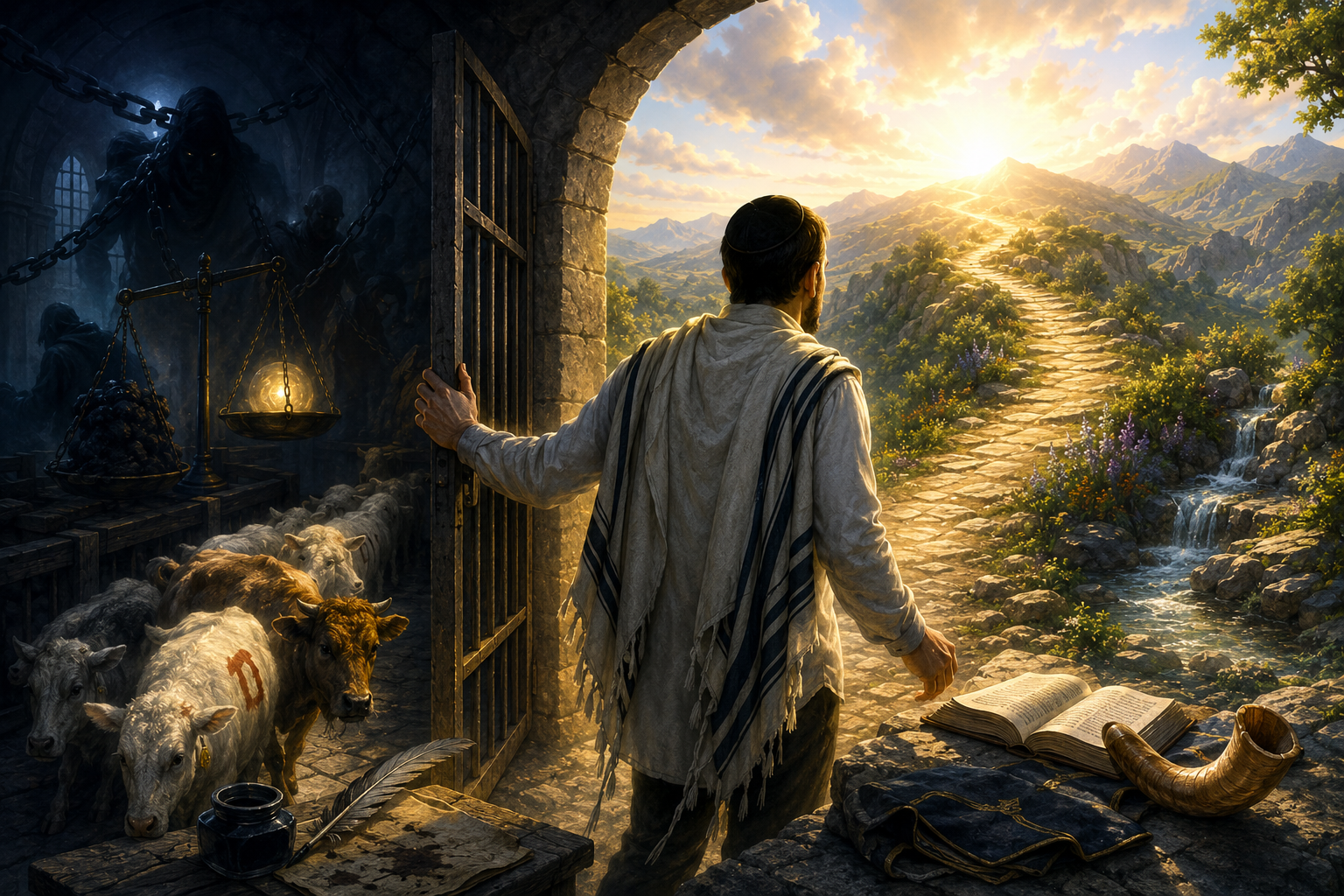
At the end of Parshat Bechukotai, the Torah discusses the laws of exchanging consecrated animals—temurah. A person designates every tenth animal from his flock or herd as ma’aser behemah, an animal tithe dedicated to the Beit HaMikdash. The animals pass one by one through a narrow gate, and the tenth is marked and consecrated.
If the animal is unblemished, it is offered as a sacrifice. If it has a blemish, it is still used for the needs of the Temple.
But what happens if the owner wants to exchange the designated animal for another?
The Torah says that if he attempts an exchange—whether because he prefers a healthier animal or because he wants the original one back—both animals become consecrated. He loses them both.
Rebbe Nachman sees in these verses a deep spiritual secret connected to what the Kabbalah calls the “Chamber of Exchanges.”
The Chamber of Exchanges
The Hebrew words hamer yemirenu (“he shall exchange it”) share the same root as temurah—exchange. Rebbe Nachman connects this to a frightening spiritual concept: a domain where holiness becomes swapped and trapped within evil.
A person comes into this world with holiness, clarity, and spiritual potential. But through sins, confusion, or spiritual falls, that holiness can become “exchanged.” Instead of holding onto his true spiritual identity, a person becomes entangled in darkness and impurity.
His mission is then to retrieve what was taken from him.
But there is a danger.
When a person goes back into the “Chamber of Exchanges” to recover the holiness trapped there, he himself can become trapped.
This is hinted in the Torah’s warning about exchange: the one trying to retrieve what was lost can himself become caught in the process.
The Power of Speech
How does a person escape?
Reb Noson explains that the key is speech.
The word hamarah (exchange) is connected to amirah (speech).
When a person feels spiritually stuck, confused, or trapped in darkness, the way out begins through verbal confession—vidui.
By articulating his mistakes before Hashem, a person releases the impurity holding him captive.
Speech has the power to extract holiness.
This is why confession is such a central part of Jewish life. Reb Noson explains that the vidui recited after the Amidah prayer is not merely an admission of guilt—it is a spiritual extraction process.
Just as the moon renews, and just as the festivals elevate, there is always a path back
Climbing Through Prayer
Reb Noson describes the structure of the daily prayers as a gradual ascent.
The morning prayers move upward through stages:
- Korbanot
- Pesukei DeZimra
- Kriyat Shema and its blessings
- The Amidah
The climax is the final blessing of the Amidah, Sim Shalom, where a spiritual unification is achieved. But the process is not complete until afterward, when we recite vidui and Nefilat Apayim.
Why?
Because after ascending spiritually, a person must return into the lower realms to retrieve the holiness still trapped there.
The confession is what enables that extraction.
When a Jew says, “Hashem, I did this wrong,” he is not merely recounting sins. He is loosening the grip of impurity by bringing hidden darkness into speech and awareness.
From Confession to Joy
Rebbe Nachman and Reb Noson emphasize that confession is not meant to leave a person broken.
Its purpose is to bring relief and joy.
After admitting wrongdoing, a Jew is supposed to open his heart and say:
“Yes, I failed. But all I truly want is to be close to You.”
That desire itself is precious.
The Yetzer Hara wants a person to remain trapped in fear, guilt, and despair. Many people fall away from Judaism because they are taught only fear and punishment, without being shown the path back.
But Breslov teaches something different.
Confession is meant to free a person—not crush him.
Once the burden is spoken out and released, joy begins to emerge.
And joy itself becomes the escape route from darkness.
The Joy of Escape
This is why Reb Noson connects confession directly to simcha.
When a person confesses honestly and then expresses his true desire to serve Hashem, he begins to feel lighter. The spiritual blockage weakens.
The verse says:
“Ki v’simcha tetze’u” (“For with joy you shall go out”).
Joy is not the reward after escaping darkness.
Joy is the mechanism that helps a person leave it.
Returning What Was Lost
Every person experiences moments where parts of himself feel lost—clarity, holiness, motivation, hope.
The Torah’s laws of exchange hint that spiritual life is a constant struggle to reclaim what belongs to us.
But the path back is never through despair.
It begins with honesty.
It continues through prayer.
And it culminates in joy.
May we merit to escape every “Chamber of Exchanges,” reclaim the holiness that belongs to us, and serve Hashem with renewed simcha and clarity.
Shabbat Shalom.
Meir Elkabas