The 3 Difficulties of Moshe
The Three Difficulties of Moshe
Parshat Terumah opens the preparations for the Mishkan, and this year it falls at the beginning of Adar—just as we begin turning our attention toward Purim. In Breslov teachings, Purim is called the beginning. Rebbe Nachman teaches that Purim is an opening, a gateway to start again. Rav Noson, in Likutey Tefillot (Prayer 37, part 2), writes that we should pray to delve deeply into the miracle of Purim—to uncover the hidden light within Megillat Esther, to reveal what is concealed within creation itself. The entire story is about revealing what was hidden—legalot me’hester—and accessing a dimension beyond surface reality.
With that in mind, Parshat Terumah presents us with something striking: Moshe Rabbeinu had difficulty understanding the menorah.
“See and Do”—Why Only by the Menorah?
At the end of the section describing the menorah (Shemot 25:40), the Torah states: “See and do according to the form that you were shown on the mountain.” Rashi notes that this language appears only regarding the menorah. It is not said about the Aron, the Shulchan, or the Mizbeach.
Why here?
Rashi explains that Moshe Rabbeinu had difficulty grasping how to construct the menorah until Hashem showed him a menorah of fire. The menorah had to be carved from one solid block of gold. No attaching parts. One mass, shaped from within. The word miksha—usually translated as “hammered from one solid piece”—also hints to something kasha, difficult.
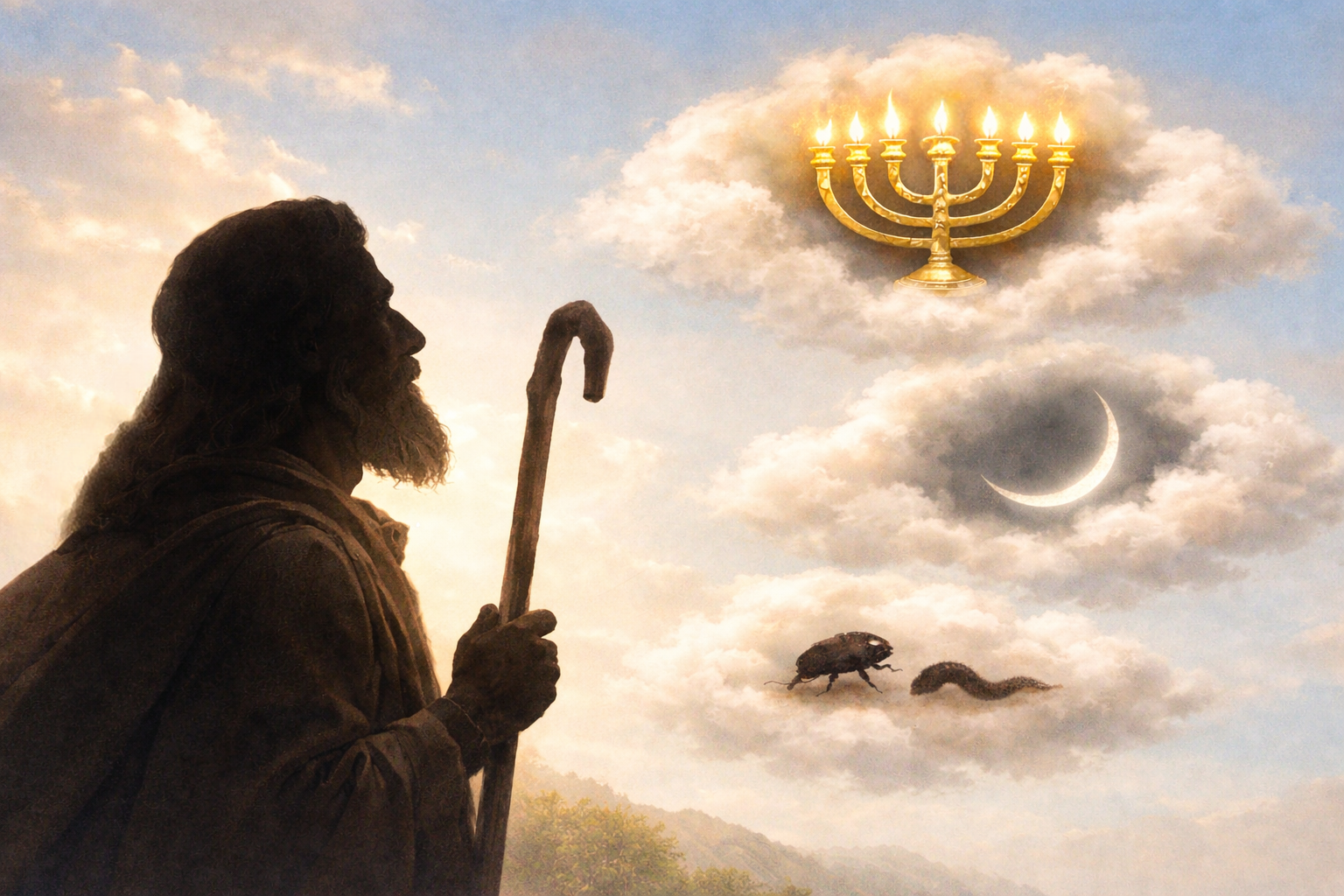
The Gemara in Menachot (29a) states that Moshe had difficulty with three areas, and some say four:
- The menorah
- The laws of creeping creatures (shkatzim and remasim)
- The renewal of the moon (chidush ha’levanah)
- Some add the laws of shechitah
The Maharal of Prague, in his Gur Aryeh commentary, explains what lay behind these difficulties. All of Moshe’s teachings came through prophecy. Yet each of these areas touches something beyond the framework of prophecy itself.
The Menorah—Light Above Existence
The Maharal explains that the menorah represents the Infinite Light shining into existence. Its light is not ordinary illumination. It symbolizes a light that is above existence, drawn into physical reality.
Prophecy works within existence. Moshe received Divine revelation and transmitted it to the Jewish people through a system grounded in creation. But the menorah represented something higher—a light beyond metziut, beyond defined existence, now being drawn into a physical vessel.
How can something physical contain a light that is beyond prophecy itself?
That was Moshe’s difficulty. It required Hashem to show him an image of fire—a glimpse of a supernal reality translated into form.
The Creeping Creatures—Below Existence
On the opposite extreme were the laws of shkatzim and remasim—creeping insects and creatures.
The Maharal explains that these represent a level below what we consider meaningful existence. Animals have some relationship to human beings. But worms, insects, and crawling creatures appear to serve no visible purpose. They are often repulsive and irritating. Why do they exist at all? And why are there detailed halachot concerning them?
For Moshe, this too was difficult. Prophecy deals with structured, meaningful existence. But here the Torah enters a realm that seems beneath existence, beneath significance. And yet even there, Divine law operates.
Moshe needed Divine assistance to understand that even the lowest realms are governed by Torah.
The Renewal of the Moon—Beyond Continuity
The third difficulty was chidush ha’levanah, the renewal of the moon.
Creation generally functions through continuity. One moment leads to the next. One state evolves into another. But the sanctification of the new moon is called chidush—renewal. It is treated as something new, not merely a continuation.
The Beit Din must see the initial, tiny crescent of moonlight and declare, “Mekudash, Mekudash.” A new month begins.
This concept of renewal—of something genuinely new emerging—was also beyond the framework of prophecy. Prophecy works within the continuity of creation. But renewal represents an interruption of continuity, a new beginning not strictly bound to what preceded it.
Again, Moshe required Divine demonstration.
A Pattern Emerging
We now see the pattern:
- The menorah represents light above existence.
- The creeping creatures represent reality below existence.
- The renewal of the moon represents new existence, beyond continuity.
Each one lies outside the ordinary prophetic framework.
Moshe Rabbeinu, the greatest of prophets, transmitted Torah within the structure of existence. Yet here he confronted realities that stretch beyond that structure—above it, beneath it, and beyond its continuity.
In each case, Hashem intervened and showed him.
The menorah of fire.
The forms of the creatures.
The shape of the new moon.
Moshe’s difficulty was not lack of knowledge. It was that these areas touch the Keter—the root beyond structured reality.
Even Moshe Rabbeinu encountered difficulty at the edges of existence, yet precisely there lies our greatest hope
The Menorah – Perceiving the Infinite Within the Finite
With these three areas of difficulty—the menorah, the shkatzim, and the renewal of the moon—we now view them through the lens of Likutey Moharan, Lesson 24.
Rebbe Nachman speaks there about something that is inherently impossible: perceiving the Infinite Light while living within physical existence. A finite being cannot grasp the Infinite. That tension itself is the core of existence.
This is exactly what the menorah represented.
The menorah was a physical object—gold, shaped by hammer and chisel—and yet when the Kohen lit it, it shone the Infinite Light into this world. How can a physical vessel channel something that transcends all physical limitation? That was Moshe Rabbeinu’s difficulty.
The seven branches of the menorah correspond to the seven middot, the seven lower Sefirot – chesed, gevurah, tiferet, netzach, hod, yesod and malchut. A person’s entire inner world is structured around these seven traits. Anger, humility, restraint, purity, perseverance, gratitude, joy – all are rooted in these attributes. When a person refines them, he becomes a vessel.
The daily lighting of the menorah sustained the world with a light beyond comprehension. It brought simcha into creation. As the verse says, “Shemen u’ketoret yesamach lev.” The oil of the menorah and the ketoret brought joy to the heart – the heart of the Shechinah and the heart of every Jew. Simcha is what allows the Infinite to dwell within the finite.
Moshe Rabbeinu struggled because prophecy operates within existence. The menorah represents something beyond prophecy – Infinite Light drawn downward. Even the greatest tzaddik needed Hashem to show him how such a paradox could exist.
The Shkatzim – Hope from Beneath Existence
The second difficulty was the laws of shkatzim and remasim – creeping creatures, worms, insects. These are beings associated with decay, filth, and repulsion. They inhabit rotten fruit and carcasses. They seem beneath dignified existence.
The Maharal explains that this represents a domain below metziut. It is not just low – it is beneath what we normally define as meaningful existence.
On a deeper level, this reflects the spiritual condition of a person who has fallen extremely low – into the chamber of exchanges. A person whose actions have distanced him so far that he feels outside the category of humanity. The language we sometimes hear—shegetz—comes from sheketz. It reflects this fallen state.
And yet there are halachot there. The Torah legislates even in that realm.
Rebbe Nachman teaches that precisely from the lowest place, a person can awaken and return. The fall itself can become the catalyst for ascent. But this too lies beyond ordinary prophecy. There is a limit to what structured revelation can reach. To retrieve souls from such depths requires access to a higher level of Divine compassion.
That is why Moshe Rabbeinu needed assistance here as well. Not because he despaired, but because helping those who have fallen beneath existence requires drawing from above existence.
Chidush HaLevanah – Sanctifying the Beginning
The third difficulty was the renewal of the moon.
At the end of the month, the moon disappears entirely. Complete darkness. Then a thin sliver appears – barely visible. That first faint ray is when the Beit Din declares, “Mekudash.”
Not at the full moon. Not at its glory. At its beginning.
This reflects the deepest teaching of renewal. A person may feel pitch black – spiritually depleted, ashamed, broken. Yet the moment he makes the first movement back toward Hashem, he is already sanctified. Even before real growth. Even before visible success.
We would think holiness belongs to completion. The Torah says holiness begins at the first spark.
This too transcends prophecy. Creation usually follows continuity. One stage leads into another. But renewal represents something genuinely new. Not merely continuation, but chidush – new light emerging from total darkness.
Moshe Rabbeinu needed Hashem to show him this as well. Because sanctifying the first ray of light requires a perspective rooted beyond structured existence.
The Underlying Theme
The pattern is clear:
The menorah – light above existence.
The shkatzim – hope beneath existence.
The moon – renewal beyond continuity.
All three touch the Keter – the dimension beyond structure.
Moshe Rabbeinu did not fail in these areas. He encountered their depth. And through that encounter, he accessed higher Divine assistance.
The Zohar teaches, “Itpashtuta d’Moshe bechol dara v’dara.” The spark of Moshe Rabbeinu exists in every generation. There are tzaddikim in every era who access this level – who can draw Infinite Light into finite reality, who can retrieve souls from beneath existence, who can sanctify the first step of return.
The Midrash states that Mordechai was the Moshe Rabbeinu of his generation. As we enter Adar and approach Purim—the beginning—this teaching becomes especially relevant. Purim reveals hidden light. It teaches that even in concealment, Infinite compassion is present.
Parshat Terumah shows us that even Moshe Rabbeinu encountered difficulty at the edges of existence. And precisely there—above, below, and at the threshold of renewal—lies our greatest hope.
May we merit to connect to the tzaddikim who illuminate even the most difficult places, and may we learn to recognize that even the smallest beginning is already Mekudash.
Shabbat Shalom and Chodesh Tov.
Meir Elkabas
- 0 comment