The 40 Days of Waiting
The 40 Days of Waiting
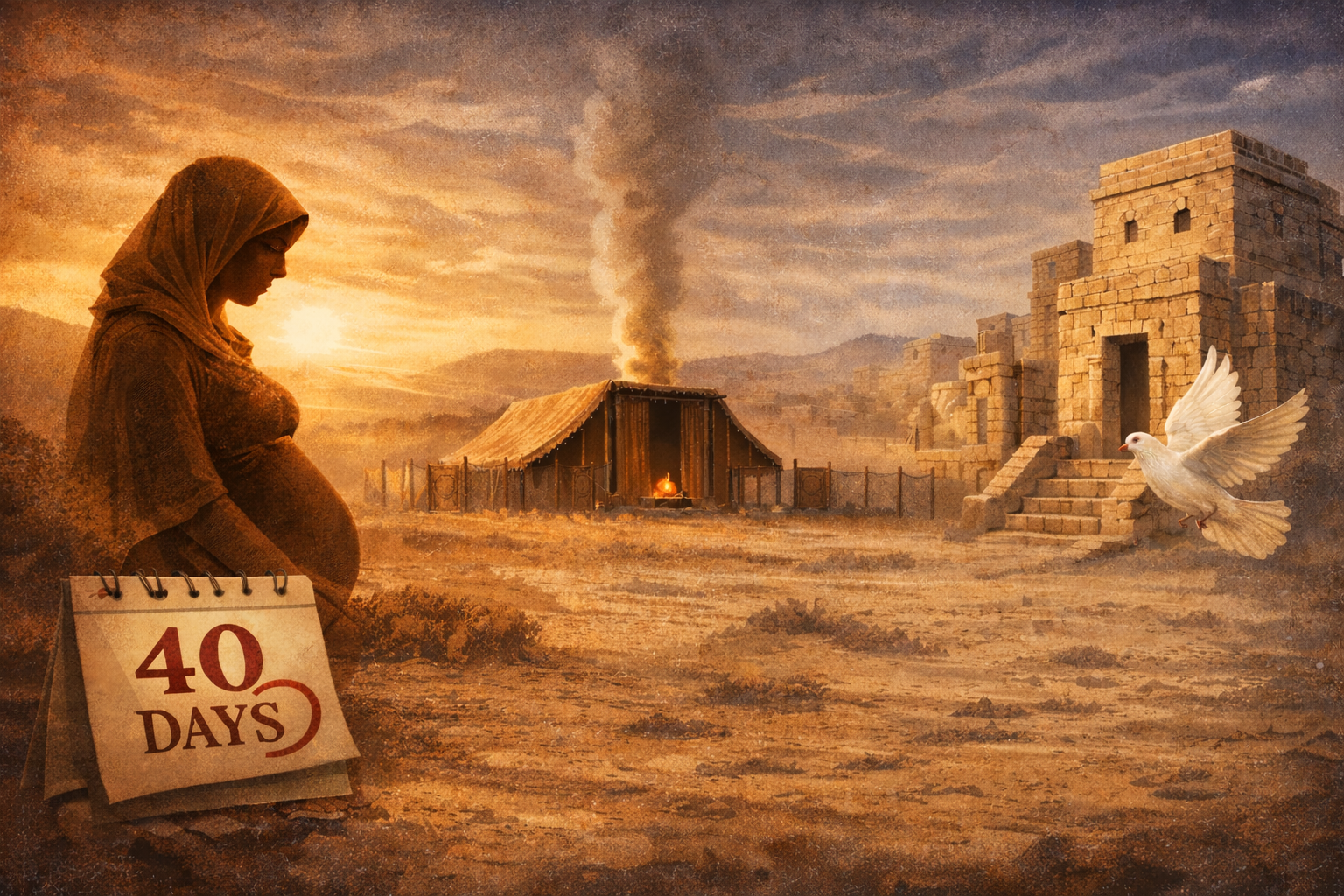
Parshat Tazria introduces the laws of a woman after childbirth, which, while not applicable today in practice, reveal deep spiritual structures. When a woman gives birth to a boy, she undergoes a process totaling 40 days before she can fully return to interacting with the קדשים (kodashim – holy offerings). For a girl, this process is doubled to 80 days.
At first glance, these numbers seem technical. But the deeper teachings show that they reflect something fundamental about creation, the soul, and a person’s connection to the Infinite.
The Structure of Creation: 40 and 10
The Kabbalistic explanation begins with two core numbers:
- 40 → representing the woman, through the womb (rechem), described as two “doors” (dlatot), forming the letter מ (mem), whose numerical value is 40. This also relates to the 40 Gates of Binah (understanding) which is the feminine input in conception.
- 10 → representing the man, whose seed contains the structure of the עשר ספירות (eser sefirot – ten Divine attributes), rooted in creation itself
When these come together—40 and 10—they form 50, corresponding to the level of Keter (crown), the gateway to the Infinite Light.
This means that bringing a child into the world is not just biological—it is the creation of a being with the potential to access something beyond the finite world.
Why the Mother Waits
After birth, the child has emerged from the realm of the 40—the womb. But the mother must now re-enter a process connected to that same structure.
The 40-day waiting period reflects a return to that foundational level of formation. It is a rebalancing, a resetting, and a preparation for continued spiritual function.
Even though she may already be technically pure in other respects, there remains a restriction in accessing higher קדושה (kedushah – holiness), such as eating from the sacrifices. This indicates that something deeper is still in process.
Doubling for a Girl: 80 Days
When a girl is born, the process doubles—from 40 to 80.
On a simple level, this reflects an intensified connection to the same faculty of creation. The daughter will, Be’ezrat Hashem, carry the same capacity of the 40—of the womb, of formation, of binah (understanding). The doubling reflects a deeper layering of that capacity.
The Centrality of the Jewish Soul
The Torah’s focus on these processes highlights a broader principle: the creation of a Jewish soul is not incidental—it is central.
Chazal (our sages) teach that the world itself was created for this purpose. That is why Jewish existence carries such weight, and why there is so much resistance and turmoil surrounding it.
The birth of a Jewish child is not just another event—it is the continuation of that central purpose of creation.
From Formation to Access
The key idea emerging here is that every person is born with the structure needed to connect to the Infinite Light—but that connection requires process, patience, and stages.
The 40 days are not a limitation—they are preparation.
They reflect a deeper truth: access to higher levels of holiness is never immediate. It requires זמן (zman – time), structure, and development.
This sets the stage for understanding how waiting, delay, and process are not obstacles—but essential parts of spiritual growth.
Simcha is not just an emotion – it is a spiritual force that allows a person to reconnect to the deeper reality of who he is
The Power of Waiting
Rashi explains that the word “teshev” (she shall sit) also means to wait. The woman is not just in a technical waiting period—she is in a מצב (matzav – state) of preparation.
She is waiting for two things:
- The completion of her process of purity
- The ability to once again partake of the קדשים (kodashim – holy offerings)
But on a deeper level, this waiting reflects a fundamental principle taught by Rebbe Nachman in Likutey Moharan Lesson 24: true spiritual light is received דווקא (davka – specifically) through waiting, delay, and pushback.
Waiting as a Vessel for Light
Rebbe Nachman connects the concept of Keter (crown) with the idea of “katar” (to wait)—as in the verse “Katar li ze’er” (wait a little for me).
This teaches that waiting is not passive. It is the mechanism through which a person becomes capable of receiving the Infinite Light.
The mother, having already participated in bringing a child into the world through the union of 40 and 10—forming 50, the level of Keter—must now undergo a bounce-back phase.
This waiting period creates the vessels needed to receive and internalize that light in a stable way.
The Role of the Korbanot
In the time of the Beit HaMikdash, eating from the sacrifices was not just ritual—it was an encounter with something beyond this world.
Partaking of korbanot allowed a person to experience a taste of the Infinite Light within the boundaries of physical existence.
Today, without the Beit HaMikdash, tefillah (prayer) serves as our closest equivalent.
The mother’s inability to partake in these offerings during the 40 days is therefore not a restriction—it is part of the process of building toward that renewed connection.
Why 80 Days for a Girl
The doubling—from 40 to 80—when a girl is born reflects an expanded dimension of this same structure.
The commentaries explain:
- The first 40 days correspond to the child herself
- The second 40 days correspond to her future capacity—her own womb, her own potential to carry life
This is not a penalty. It is an expression of added depth and responsibility within the same system of creation.
The Greatness of Creation
The act of bringing a Jewish child into the world is described as one of the highest moments of connection to the Infinite Light.
At the moment of conception, the union of the man’s 10 and the woman’s 40 activates the level of 50—Keter. This is why the experience carries such intensity and significance.
It is not merely physical—it is a moment of deep spiritual alignment with the purpose of creation.
Rectification Through Creation
Reb Noson teaches a powerful idea: even someone who has stumbled in areas of holiness can begin rectification through building the future.
Bringing Jewish children into the world is itself a profound תיקון (tikkun – rectification), because it reactivates the same structure of holiness that may have been damaged.
Creation itself becomes the תיקון.
Simcha as the Ultimate כלי
From all of this emerges a central conclusion: the ultimate כלי (kli – vessel) for reconnecting to the Infinite Light is simcha (joy).
Simcha is not just an emotion—it is a spiritual force that allows a person to reconnect to the deeper reality of who he is.
In a world filled with confusion, opposition, and negativity, simcha becomes the primary כלי for redemption.
Through simcha, a person reconnects to the Infinite Light—and through that connection, we move closer to the final redemption, Be’ezrat Hashem.
Shabbat Shalom and Chodesh Tov
Meir Elkabas
- 0 comment