- Joy ⬦ Read ⬦ Shabbat ⬦ Weekly Torah Portion
The Missing Alef and the Lack of Joy
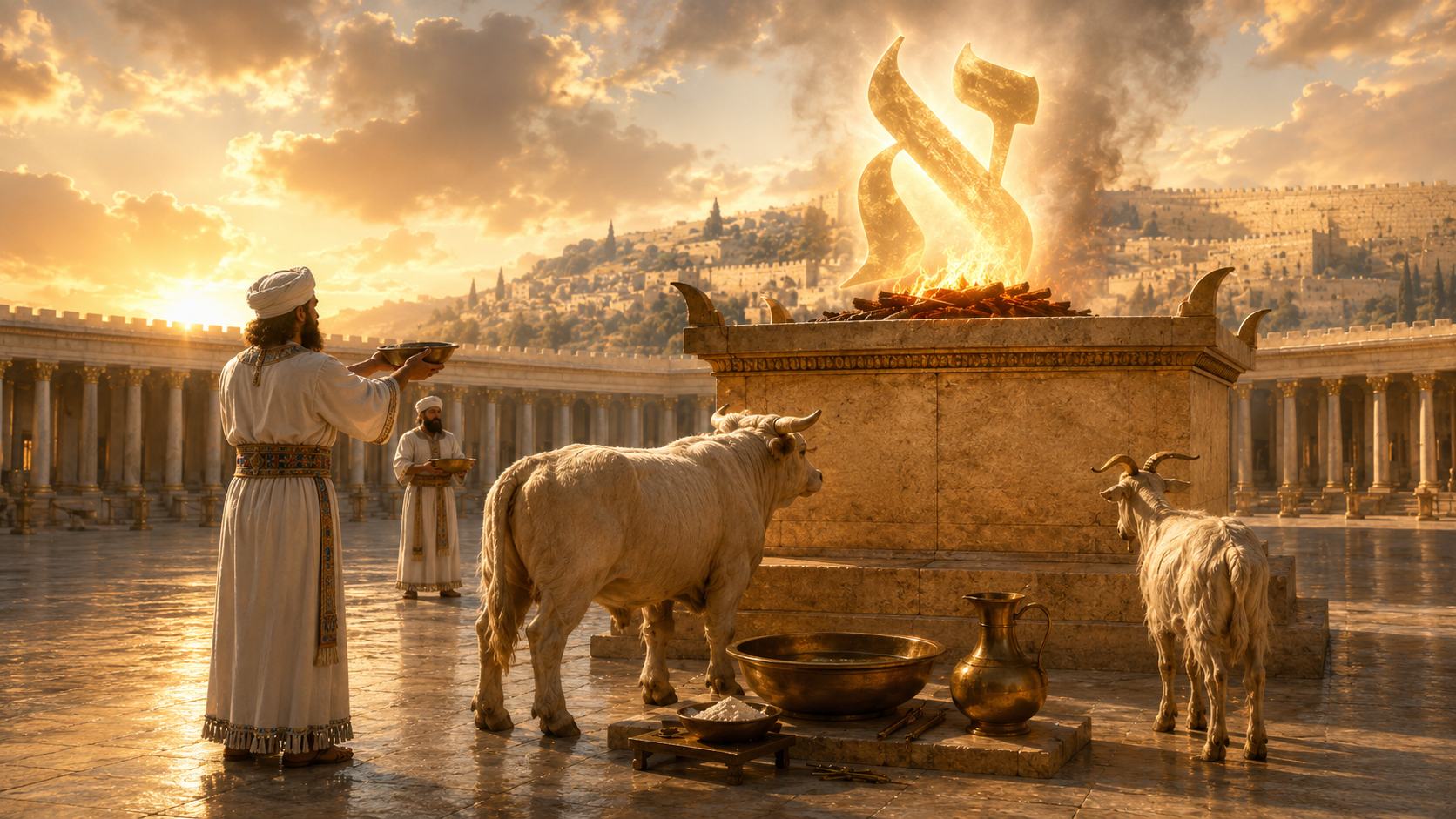
Parshat Shelach is best known for the tragic story of the spies, but the second half of the Parshah contains another striking section with a powerful message for life. After the episode of the spies, the Torah discusses a unique case of unintentional idolatry and the special korbanot (offerings) that must be brought when such a mistake takes place.
The case is unusual. The Sanhedrin, the High Court, rules mistakenly that a certain form of idolatrous service is permitted. The people rely on that ruling and act accordingly. Later, it becomes clear that this form of service was forbidden and that the nation, following the mistaken ruling of the court, had committed idolatry unintentionally.
For such a case, the Torah prescribes two korbanot: an olah (burnt offering) and a chatat (sin offering). But the order is surprising.
Normally, a chatat comes before an olah. The sin offering comes first because it serves as atonement. A person did something wrong, even unintentionally, and now he must admit the mistake, regret it and seek forgiveness from Hashem. Only afterward does he bring an olah, which is considered a doron (gift). First comes the praklit (advocate), the offering that pleads the case and seeks atonement. Only after the acceptance of that atonement does one bring the gift.
Here, however, the order is reversed. The Torah first mentions the olah and only afterward the chatat.
This reversal itself demands explanation.
The Severity of Idolatry
The Torah introduces this section with the words:
“Vechi tishgu velo ta’asu et kol hamitzvot ha’eleh” — “If you unintentionally stray and do not perform all these mitzvot.”
Rashi asks: How can one sin be described as failing to perform all the mitzvot? He explains that this refers to idolatry. One who serves an idol is considered as if he has transgressed the entire Torah.
Idolatry is not merely one isolated transgression. It represents a total break in faith. It means turning away from Hashem and looking elsewhere for hope, salvation, meaning or power. Because of that, even when done unintentionally, it carries a unique severity.
This is why the korbanot in this section do not follow the usual order.
Usually, when a Jew has a bad thought but does not act on it, Hashem does not treat the thought as a deed. “HaKadosh Baruch Hu eino metzaref machshavah l’ma’aseh” — the Holy One, blessed be He, does not combine a bad thought with an action. A person may think about doing something wrong, but if he does not actually do it, he is not judged as though he committed the act.
The olah can atone for hirhur halev (improper thoughts of the heart), but it is primarily a gift entirely offered to Hashem. Unlike a chatat, from which the Kohanim may eat certain portions, the olah is completely burned on the Mizbeach (altar). It is wholly given to Hashem.
But idolatry is different. In the realm of idolatry, even the thought itself is deeply damaging. The Maharal and the Malbim explain that here, the thought to serve idolatry is in some sense even more severe than the action. Since idolatry begins with turning one’s mind, faith and hope away from Hashem, the machshavah (thought) itself requires rectification first.
Therefore, the olah comes first. It repairs the thought. Only afterward does the chatat come to atone for the action.
The Missing Alef
The Torah says:
“U’se’ir izim echad l’chatat” — “And one goat as a sin offering.”
But the word l’chatat (as a sin offering) is written without the letter alef. The Gemara explains that the missing alef teaches that this chatat is not like a normal chatat. In a regular case, the chatat comes first. Here, because of the severity of idolatry and the need to repair the thought first, the olah precedes it.
But why is this shown specifically through the missing alef?
To understand this, we need to look deeper into the nature of idolatry, and especially into the teachings of Rebbe Nachman in Likutey Moharan Lessons 23 and 24.
The Idolatry of Money
In Likutey Moharan Lesson 23, Rebbe Nachman teaches that there is one form of idolatry that contains within it all other forms of idolatry: ta’avat mamon (the desire for money).
This is a difficult teaching because money is necessary. A person needs money for Shabbat, kosher food, tuition, rent, clothing, tzedakah and basic life. A Jew cannot function in this world without money.
The problem is not money itself. The problem is worshiping money.
Ta’avat mamon means that money becomes the focus of a person’s hope, trust and emotional security. Instead of turning to Hashem, the person begins to believe that salvation comes through money. He feels that everything depends on income, business, opportunity, investment and financial maneuvering. Money becomes the power that promises safety.
That is why Rebbe Nachman calls it idolatry. It is not necessarily bowing to an idol. It is placing one’s faith in something other than Hashem.
This is also why money is such a subtle test. With most forms of idolatry, a Jew immediately understands that they are forbidden. But with money, a person can justify almost anything.
“It’s for parnassah (livelihood).”
“It’s business.”
“I have to make hishtadlut (practical effort).”
“For money, it’s different.”
This attitude can lead a person to bend standards in Yiddishkeit, compromise yirat Shamayim (fear of Heaven), loosen boundaries in holiness, leave what he knows is right and excuse it all under the label of parnassah.
Of course, a person must make hishtadlut. But the question is: where is his heart? Is his effort rooted in faith and simcha, or in panic, pressure and the feeling that Hashem is not really in the picture?
When Simcha Is Missing
In Likutey Moharan Lesson 24, Rebbe Nachman teaches that simcha (joy) is the key to accessing the Keter, the spiritual crown that serves as the gateway to Hashem’s Infinite Light.
When a person serves Hashem with simcha, he opens the channel to blessing, clarity and Divine light. Simcha gives him a settled mind. It allows him to see things properly. It keeps him connected to Hashem even when life is difficult.
But when a person lacks simcha, his mind becomes clouded. His thinking goes into exile. He begins to see his life through bitterness, pressure, guilt and fear.
This is especially dangerous for Torah leaders and halachic authorities. A rav or dayan needs simcha in order to rule clearly. If a person is constantly negative, harsh, embittered and depressed, his judgment can become distorted. Even a great mind needs inner clarity. Without simcha, the mind is unsettled.
This helps us understand the case in the Parshah.
How could the Sanhedrin ever mistakenly permit a form of idolatry? How could the highest court reach such an error?
On a deeper level, the Torah is hinting to a state in which even the leaders and the people have lost simcha. The nation is burdened with parnassah issues, pressures and worries. The lack of simcha creates confusion. That confusion especially expresses itself in monetary matters, because money is the most subtle and widespread form of idolatry.
A person becomes unhappy with his portion. He is not happy with his davening (prayer), his tefillin, his tzitzit, his berachot (blessings), his mitzvot or his small good points. He looks only at what is wrong: “Look where I am. Look where I wanted to be. I am not advancing. I am a failure.”
From there, sadness grows. And sadness opens the door to ta’avat mamon. If a person is not happy with what Hashem has given him, he begins to run after money as his answer. He believes that if he only had more, things would be better. That is how the idolatry of money takes hold.
Pirkei Avot teaches: “Eizehu ashir? Hasameach b’chelko” — “Who is wealthy? One who is happy with his portion.”
The truly wealthy person is not the one who has the most money. It is the one who lives with simcha in what Hashem has given him. This applies not only to physical possessions but also to spiritual points. A person must learn to be happy with his mitzvot, his efforts, his prayers and whatever good he does have.
Without that simcha, the person feels poor no matter how much he owns. Then money becomes his idol.
When simcha returns, the mind is redeemed!
Thought Comes First
This also explains why the olah must come before the chatat in this case.
A person must guard his thoughts first. The mind is like the center of a wheel. If the center is aligned, the spokes can extend properly and the wheel turns correctly. But if the center is warped, everything that extends from it becomes distorted.
The same is true in avodat Hashem (service of Hashem). If a person’s machshavah is healthy, if his mind is connected to Hashem with simcha, faith and clarity, then his actions can follow properly. But when the mind is confused, bitter and disconnected, the actions become damaged as well.
Idolatry begins in the mind. Before a person turns to another power in action, he has already turned there internally. He has already believed that Hashem cannot help him. He has already looked elsewhere for hope.
That is the deepest blemish.
Therefore, in this case, the olah comes first. The olah repairs the thought. Only afterward does the chatat repair the deed.
The Alef and the Keter
Now we can understand why the alef is missing from the word l’chatat.
The letter alef is connected to peleh (wonder). The word alef, when its letters are rearranged, forms peleh. In Kabbalah, peleh is associated with the level of the Keter, the wondrous level above normal grasp.
The Keter is the gateway to Hashem’s Infinite Light. Rebbe Nachman teaches that the way to access this gateway is through simcha. When a person is truly b’simcha in serving Hashem, when he experiences joy in his connection to Hashem and in the good points that Hashem has given him, he opens himself to endless light, blessing and sustenance.
But when a person lacks simcha, he blemishes his access to the Keter. He blocks the peleh. He loses the alef.
That is why the chatat here is written without the alef. The missing alef reveals the root of the entire problem. The mistake came from a lack of simcha, which caused a blockage in the Keter. The mind became exiled. The thought became damaged. That damaged thought then led to damaged action.
So the order must be reversed. First the olah repairs the thought and the mind. Then the chatat repairs the action.
The Danger of “Just Hishtadlut”
This teaching is extremely practical.
A person says, “I have to make hishtadlut. I have to do. I have to run. I have to take care of business.”
Yes, hishtadlut is necessary. But one must ask: why am I running so quickly to action? Did I first turn to Hashem? Did I strengthen myself in simcha? Did I remind myself that Hashem is the One who gives parnassah?
Or am I running because I do not really believe that Hashem is taking care of me?
When a person is not happy with what Hashem has given him, he feels forced to chase. He says, “There is no time. I have to act.” But often this frantic action is not true hishtadlut. It is a symptom of anxiety and lack of faith. It comes from the feeling that Hashem is absent.
That is already the beginning of idolatry.
Idolatry means turning to something else for hope and salvation. A person may not bow to a statue, but if he believes that money, business or human strategy will save him while Hashem is pushed out of the picture, he has entered the idolatry of money.
The correction is simcha.
A person must say: “Hashem gives me what I need. Hashem sustains me. Whatever I have is from Him. I will do my effort, but I will not worship the effort. I will not worship the money. I will not lose my joy, holiness or faith because of parnassah.”
Simcha Restores the Mind
The missing alef teaches that when simcha is missing, the peleh is missing. The Keter is blocked. The mind is unsettled, and a person begins to make mistakes in thought and action.
But when simcha returns, the mind is redeemed.
A person begins to see clearly again. He stops thinking that everything depends on money. He stops justifying compromises because “it’s for business.” He remembers that Hashem is the source of all blessings.
This does not mean a person stops working. It means he works differently. He makes hishtadlut with faith, calmness and simcha. He uses money as a tool for holiness instead of worshiping it as a source of salvation.
That is the difference between parnassah with emunah (faith) and the idolatry of money.
Repairing the Missing Alef
The Torah’s unusual order in this section is not technical. It reveals the structure of spiritual repair.
First, the mind must be repaired. The person must return to simcha, to emunah and to clarity that Hashem alone is the source of salvation. That is the olah, the offering that rises entirely to Hashem and repairs the thoughts of the heart.
Only afterward can the action be repaired. That is the chatat, the sin offering. But in this case, the chatat is missing its alef to show that the original blemish was the loss of peleh, the blockage from the Keter caused by a lack of simcha.
The problem began not merely with the deed, but with the inner turn away from Hashem.
And the deepest modern expression of that turn is often money.
Living With Hashem in the Picture
Parshat Shelach teaches us that idolatry is not only an ancient problem. It can appear in subtle, respectable forms. It can appear as the obsession with money, the belief that business overrides everything, the constant pressure of parnassah and the willingness to bend holiness because “this is how the world works.”
Rebbe Nachman teaches that the root of this is a lack of simcha. When a person is truly happy with his portion, he is wealthy. When he is not, no amount of money can satisfy him.
The correction is to return to simcha in Hashem. To be happy with every good point. To be happy with one’s mitzvot. To be happy with the fact that Hashem gives life, sustenance and opportunity. To make hishtadlut without worshiping hishtadlut. To use money without serving money.
May we be zocheh never to fall into idolatry, especially the subtle idolatry of money. May we strengthen ourselves in simcha, trust that Hashem provides everything we truly need and live with the clarity that He is always in the picture.
Shabbat Shalom u’Mevorach.
Meir Elkabas
- 0 comment