We Can Bring Mashiach!
ADAPTED FROM HIS AUDIO SHIUR ON EIN YAAKOV LESSON 117B – SANHEDRIN 56
A goy that strikes a Jew
The Gemara teaches that a goy who strikes a Jew is chayav misah. Here, “striking” does not mean killing; it refers even to a slap. If a goy strikes a Jew, even lightly, the penalty is death. We find this principle expressed in the Torah when Moshe Rabbeinu went out to see the suffering of his brothers, the Jewish people. He saw an Egyptian striking a Jew. Let us examine the pasuk carefully: “Vayifen koh vachoh” – He turned this way and that way. “Vayar ki ein ish” – He saw that there was no man. “Vayach es haMitzri” – He struck the Egyptian, meaning he killed him. “Vayitmen’eihu bachol” – He hid him in the sand. The straightforward understanding is that Moshe Rabbeinu saw an Egyptian—a goy—striking a Jew. Since the Torah law is that a goy who strikes a Jew is liable to death, Moshe Rabbeinu carried out that law and killed him. From this pasuk we see clearly that Moshe Rabbeinu acted in full accordance with the law. His killing of the Egyptian serves as proof that the penalty for a goy striking a Jew is indeed death.
“Shema Yisroel” used as the weapon
We do not find the weapon that was used. What did Moshe Rabbeinu use in killing the Egyptian? So, we have two statements. One the Zohar Hakadosh says. The pasuk says, “vayifen koh vachoh,” he turned here and there and he struck the Egyptian. The Zohar Hakadosh says that it means he struck the Egyptian with this weapon koh vachoh. Koh is 25, vachoh and again 25. This refers to the letters of Shema Yisrael, 25 letters in Shema Yisrael. The mitzvah of Kriyas Shema is so potent, so powerful, that a person, by saying Kriyas Shema with kavanah can actually destroy his enemies. We say that a person who has enemies, what should he do about them? “Yashkim adam l’beis hamidrash.” Get up early and go to shul. How is that going to kill your enemies? The answer is where do you find hashkamah? Where do you find that there’s a requirement to get up early? For what? For z’man Kriyas Shema. The time of Kriyas Shema requires that it be said before a certain time, meaning it be said early. Kriyas Shema is 25 letters. Shema Yisrael in the morning, 25 letters for the Kriyas Shema shel Arvis, pa’amayim b’ahavah is said – this is what’s meant with the ko’ach of the Kriyas Shema. “Vayifen koh vachoh,” with this ko’ach he killed the Egyptian, just by saying the Kriyas Shema alone.
Moshe Rabbeinu used Shem Hashem
Now to go a step further, the Arizal says that there is a special Shem Kadosh known as the Shem Ayin-Beis. This is discussed in the Gemara in Sukkah, and Rashi and Tosafos bring it there. Rashi explains that the Shem Ayin-Beis refers to a set of 72 Divine Names, each composed of three letters, for a total of216 letters. The number 72 is gematria chesed, and 216 is gematria gevurah. Rashi in the Gemara teaches that these 72 Names have tremendous potency. One of them—the eighth Name—is a three-letter Name associated with the letters ת–כ–ה (Taf–Chaf–Hei). Each of these Names has a unique function, and when used by a great enough tzaddik, it can effect supernatural outcomes. The Arizal says that by uttering this Name, a tzaddik can even bring down an enemy. Accordingly, the Arizal explains that this is the “weapon” Moshe Rabbeinu used. When Moshe saw the Egyptian striking a Jew, he did not strike him with a physical weapon. Rather, he pronounced this Name, Taf– Chaf–Hei, and the Egyptian fell dead through the power of the Shem. The Arizal then points to a hint in the very next scene: the following day Moshe goes out and sees two Jews arguing—commonly identified as Dasan and Aviram. One raises his hand to strike the other, and Moshe says to him, “Rasha—lama sakeh (תַּכֶּה) rei’echa?” (“Wicked one—why will you strike your fellow?”). The Arizal reads the wording that follows as subtly supporting the idea that Moshe’s “killing” of the Egyptian was accomplished through speech, not through a conventional weapon.
Just Raising Your Hand Against Another Jew
The Gemara teaches—based on this very sentence—that if a Jew merely raises his hand to strike another Jew, even before any blow is delivered, he is already branded by the Torah as a rasha. The word “sakeh” means “why will you strike”, not “why did you strike.” The act has not yet occurred, yet the intent and gesture alone already define the person as wicked. Accordingly, raising a hand against a fellow Jew is considered a sin as though the blow were actually struck, as though damage had already been done. For this reason, even striking someone lightly, playfully, or “as a joke” is forbidden. Toward a fellow Jew, a friend, it is absolutely wrong. A Jew must restrain his hand and his anger. Among Jews there must be respect and care, not violence—not even in gesture.
The Goal of Unity and Harmony
One need only recall the message that Rabbi Shimon bar Yochai ז״ל taught his students: we are different from the students of Rabbi Akiva. They did not maintain harmony among themselves; there was a lack of true mutual respect. Rabbi Shimon bar Yochai taught that no improper action should exist within a group—not even in words, not even in gesture. Even raising one’s hand in jest is inappropriate. There must be only ahavah and achvah among chaveirim. Only then can a group stand on a firm foundation and ensure a lasting future. The nitzchiyus, the endurance of a group, depends entirely on its unity—on being truly bound together as one. This was the ultimate goal Rabbi Shimon bar Yochai instilled in his תלמידים: unity and harmony in their truest form. Whenever they came to him with questions or difficulties, he would receive them as beloved children— not only beloved to him, but beloved to one another. There was genuine brotherhood among them. That was the secret of Rabbi Shimon bar Yochai’s success, and that is why he was able to reveal a Torah so powerful and enduring.
One Group Can Bring Mashiach
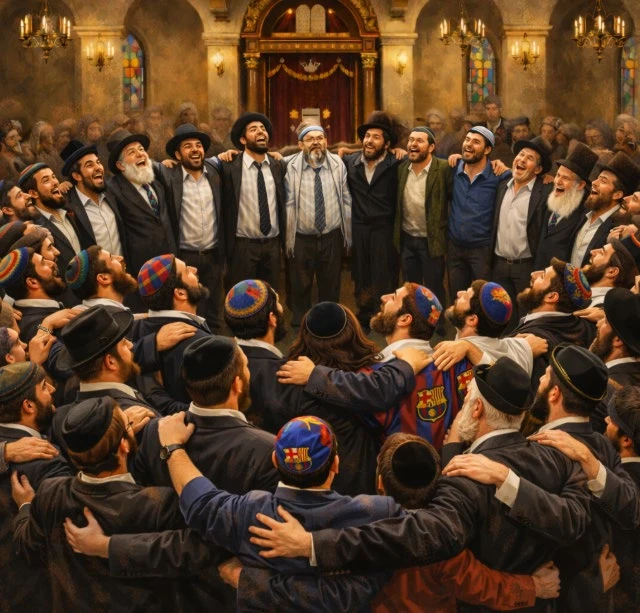
This is the lesson for us. Whether we are many or few, numbers do not impress Hashem; conduct does. There must be a strong, selfless unity. When someone needs help—physical, material, financial, or spiritual—we must give of ourselves willingly and without calculation. What we give will ultimately return to us. The Gemara teaches that when Hashem sees unity among Jews—not necessarily among the entire nation, which is nearly impossible—but even within one single group, and that unity is complete and genuine, Hashem says: the time has come for Mashiach. That group has earned the right to call upon Heaven to bring redemption for all of Am Yisrael. In the merit of one united group, all Jews can be redeemed. Therefore, let us strive—each of us personally and together—that our group be built on true ahavah, achvah, and achdus. In the zechus of Rabbeinu zal, may we merit to witness the coming of Mashiach, the rebuilding of the Beis HaMikdash, and the arrival of the Go’el Tzedek, with complete joy—amen v’amen.
- 0 comment