- Joy ⬦ Read ⬦ Shabbat ⬦ Weekly Torah Portion
The 5 Connected Mitzvot
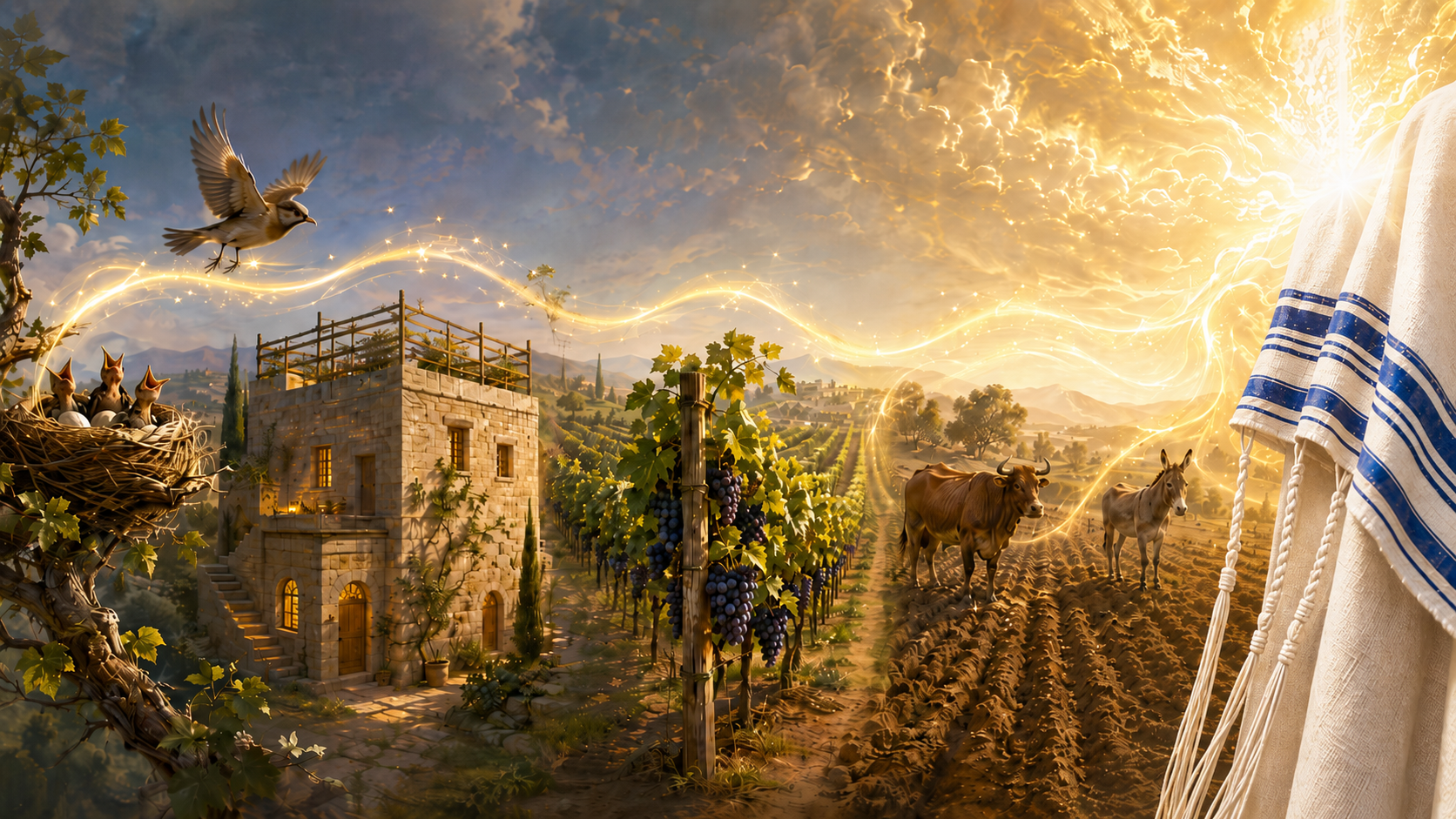
Parshat Ki Tetze contains an extraordinary number of mitzvot. Among them, the Torah places five seemingly unrelated commandments directly alongside one another: shiluach haken (sending away the mother bird), ma’akeh (building a protective fence around a roof), kilay ha-kerem (forbidden mixtures in a vineyard), the prohibition against plowing with an ox and donkey together and the laws of sha’atnez and Tzitzit.
Rashi explains that their sequence is deliberate. One mitzvah leads to another.
But why does the Torah choose these particular mitzvot to illustrate that principle?
Through Rebbe Nachman’s teaching in Likutey Moharan Lesson 24, they reveal an entire spiritual progression – from extracting holiness trapped in darkness all the way to receiving Hashem’s Infinite Light.
Five Mitzvot, One After Another
The sequence begins with shiluach haken:
“Ki yikarei kan tzipor lefanecha” – “If a bird’s nest happens to be before you.”
If a person encounters a nest containing chicks or eggs, with the mother bird resting upon them, he may not take the mother together with her young. He must first send the mother away:
“Shaleach teshaleach et ha’em” – “You shall surely send away the mother.”
He may then take the young, and the Torah promises:
“Lema’an yitav lach v’ha’arachta yamim” – “So that it will be good for you and you will lengthen your days.”
Immediately afterward comes the mitzvah of ma’akeh. When a person builds a new house, he must place a protective fence around a usable roof so that no one falls from it.
The next mitzvah prohibits sowing a vineyard with other species of seed. A vineyard must not be planted together with grains such as wheat or oats in a manner that constitutes kilayim.
Then the Torah says:
“Lo tacharosh b’shor u’vachamor yachdav” – “Do not plow with an ox and a donkey together.”
Finally comes the prohibition of sha’atnez, wearing wool and linen together, followed immediately by:
“Gedilim ta’aseh lach” – “You shall make tassels for yourself.”
These are the Tzitzit placed upon the four corners of a garment. With techelet, Tzitzit itself involves the exceptional combination associated with wool and linen.
Rashi explains by the mitzvah of ma’akeh that if a person fulfills shiluach haken, he will merit another mitzvah: Hashem will give him the means to build a new house, allowing him to fulfill ma’akeh. From there he can merit a vineyard, fields and fine garments upon which he can fulfill the subsequent mitzvot.
“Mitzvah goreret mitzvah” – one mitzvah draws another mitzvah after it.
The Torah contains hundreds of mitzvot, however. Why does it demonstrate this principle through these five?
Extracting Holiness Through Simcha
Rebbe Nachman explains in Lesson 24 that part of a person’s mission in this world is to recover holiness trapped within the forces of impurity.
Holy sparks belonging to a person’s soul root can become trapped in the kelipot, in what Rebbe Nachman calls the Heichal HaTemurot (Chamber of Exchanges). A person may return to this world in order to retrieve and elevate what belongs to him.
How is that holiness extracted?
Through mitzvot performed with simcha (joy).
When a Jew performs a mitzvah joyfully, the simcha has the power to release holiness from the domain of evil.
But extraction is only the beginning.
Rebbe Nachman describes a progression. Once holiness is released, it activates the spiritual concept of the legs. The legs generate movement and momentum, awakening creation toward Hashem. This awakening then brings down berachah (blessing), associated with the hands. The highest form of that blessing is Birkat HaSeichel, the blessing of the intellect. A properly blessed mind then becomes capable of approaching the Keter, the gateway through which a person receives a perception of the Infinite Light.
The sequence is therefore:
Extraction.
Legs and momentum.
Blessing.
Intellect.
Keter and the Infinite Light.
The five mitzvot in Parshat Ki Tetze follow this same progression.
Shiluach HaKen: Extracting What Is Trapped
At first glance, shiluach haken can appear disturbing. The mother bird is caring for her eggs or chicks, yet the Torah tells a person to send her away and take the young.
There is tremendous depth to this mitzvah, and Reb Noson discusses it extensively in Likutey Halachot.
Within the framework of Lesson 24, it represents extraction.
Sometimes there are holy sparks within these eggs or chicks that their ordinary natural environment cannot bring to their proper tikkun. Hashem therefore arranges for a Jew to encounter the nest so that he can participate in their elevation.
This is why the Torah says “ki yikarei” – if it happens before you. The mitzvah applies to a nest that Hashem sends across a person’s path, rather than a situation he deliberately created by raising the birds himself.
The encounter is an opportunity.
The person sends away the mother and takes the chicks or eggs because their rectification now requires human involvement. By using what he takes properly, he can elevate the holiness trapped within them.
Shiluach HaKen thus corresponds to the first stage of Lesson 24: taking holiness that has become trapped and extracting it from where it does not belong.
Ma’akeh: Giving the Legs Momentum
After extraction comes the concept of the legs.
Rebbe Nachman uses the legs to represent momentum. Once a holy spark is released, it begins producing movement.
The effect is not limited to the person performing the mitzvah. Spiritual momentum spreads throughout creation. Rebbe Nachman describes an awakening encompassing the levels of domem, tzome’ach, chai and medaber – the inanimate, plant, animal and human worlds. Earth, wind, fire and water, the heavens and constellations, the angels and their various levels, nations and individuals, men and women, young and old, boys and girls – all can be stirred toward Hashem.
One mitzvah done with simcha creates movement.
The second mitzvah in the sequence, ma’akeh, specifically protects a person from falling.
A house has an important role in spreading this spiritual momentum. It may be a Jewish home, a Beit Knesset or a Beit Midrash. A home shelters a person, but a Jewish home does much more than that. It becomes the location from which Torah enters the world.
A person learns Torah there. He receives Shabbat and Yom Tov there. A husband and wife build their marriage there. Children receive a Torah education there. A synagogue becomes a house of prayer, while a Beit Midrash becomes a house of Torah study.
These buildings may be physically contained within walls, yet what happens inside them radiates outward.
The Jewish home becomes a beacon.
A person standing alone in the street can accomplish only so much. To build something lasting, he needs a bayit, a stable place from which Torah and mitzvot can spread.
The Torah therefore commands that the roof be protected so that no one falls. The legs must be guarded from slipping because their purpose is movement.
After holiness is extracted through shiluach haken, ma’akeh protects the momentum generated by that holiness so it can continue spreading outward.
Kilay HaKerem: The Blessing of the Hands
The next stage of Lesson 24 is berachah.
Blessing is associated with the hands.
The Kohanim bless Am Yisrael by raising their hands. Their fingers become conduits through which the blessing passes. A Kohen with certain visible abnormalities of the hands is unable to perform Birkat Kohanim publicly.
The same symbolism appears when a parent places his hands upon a child to give a blessing. It also appears in semichah, when authority is transmitted from one Torah scholar to another.
After the mitzvah of ma’akeh, the Torah therefore moves to the vineyard and field, places of physical blessing produced through the work of the hands.
A person sows and eventually receives produce. The seed placed into the earth multiplies into grapes or grain.
The vineyard is particularly associated with blessing through wine.
Wine accompanies some of the most significant moments in Jewish life. We inaugurate Shabbat and Yom Tov with Kiddush over wine and conclude them with Havdalah. A cup of wine accompanies a Brit Milah and can accompany Birkat HaMazon. Wine is also associated with simcha, and on Purim it helps bring hidden dimensions outward.
When wine flows in a Jewish home, Chazal associate it with blessing.
The Torah nevertheless commands that this blessing remain properly ordered:
“Lo tizra karmecha kilayim” – “Do not sow your vineyard with mixed species.”
The vineyard must not be mixed improperly with other seeds.
The hands can produce tremendous blessing, but that blessing must follow the boundaries of Torah.
Thus the third mitzvah corresponds to the third stage: the berachah that flows after spiritual momentum has been awakened.
A mitzvah performed with simcha can extract holiness from the deepest darkness
The Greatest Blessing Is the Mind
Rebbe Nachman teaches that the most important blessing is not wealth itself.
A person can receive tremendous material abundance and squander it on vanity. He can use his blessing merely for a mansion with three garages, an expensive car and other possessions that do nothing to fulfill the purpose of his life.
The greater blessing is Birkat HaSeichel – the blessing of the intellect.
A blessed mind recognizes Hashem.
It sees Divine Providence within life. It learns Torah, perceives godliness and understands how to use physical blessing for a meaningful purpose.
This brings us to the fourth mitzvah.
The Ox and Donkey: What Are You Plowing For?
The Torah commands:
“Lo tacharosh b’shor u’vachamor yachdav” – “Do not plow with an ox and donkey together.”
Plowing prepares the field to produce food. Food, in turn, sustains the human mind.
Chazal connect eating grain with the emergence of intellectual capacity in a child. Once the child begins eating dagan, the five grains, his developing Da’at becomes evident.
Food is therefore not merely fuel for the body. A Jew eats in order to have the strength and mental capacity to recognize Hashem, learn His Torah and fulfill his purpose.
The ox and donkey represent two very different orientations.
The ox is a kosher animal and can represent a higher, purified pursuit.
The donkey, chamor, is related conceptually to chomriyut, physicality. It represents a life directed toward material existence without higher thought.
A donkey simply carries its load and moves. Calling someone a “donkey” implies that he acts without thinking.
The Torah therefore warns against plowing with the ox and donkey together.
A person must decide what the goal of his field is.
Is his material success intended to sustain a life of Torah and greater perception?
Or does he work merely to generate enough money for vacations, luxuries and endless physical enjoyment?
One cannot make the primary goal both spiritual perception and unrestrained physicality simultaneously.
The field produces the food that nourishes the mind. Therefore, the Torah places a warning at the stage of plowing: determine what kind of intellect and life this produce is meant to support.
The fourth mitzvah thus parallels Birkat HaSeichel.
Tzitzit: The Garment of the Keter
The final stage is the Keter, the gateway to the Infinite Light.
Immediately after the prohibition of mixing wool and linen in sha’atnez, the Torah commands:
“Gedilim ta’aseh lach” – “You shall make tassels for yourself.”
The Tzitzit hang from the four corners of the garment.
Reb Noson marvels at the greatness of this mitzvah. A person can purchase a simple tallit katan for a relatively small amount of money, make a berachah, put it on – and connect himself to the Infinite Light.
What greater reason for joy could there be?
An ordinary physical garment becomes a gateway to an extraordinary spiritual reality.
The tallit itself represents a covering, which parallels the concept of Keter. The Keter conceals the Infinite Light while simultaneously allowing a person to approach and receive from it.
The covering is not merely an obstruction.
It makes access possible.
This idea appears when Hashem taught Moshe Rabbeinu the Thirteen Attributes of Mercy. Chazal describe Hashem, so to speak, wrapping Himself in a tallit and showing Moshe the order through which the Thirteen Attributes could be invoked.
The revelation of Divine mercy was preceded by the tallit.
The garment becomes the covering through which something far beyond ordinary human perception can be approached.
Rabbi Aryeh Kaplan explores the depth of this mitzvah beautifully in Tzitzith: A Thread of Light, showing how profound the simple act of wearing Tzitzit really is.
In the sequence of the five mitzvot, Tzitzit therefore represents the destination: the Keter and the possibility of receiving the Infinite Light.
From the Bird’s Nest to the Infinite Light
The progression is now complete.
Shiluach haken represents extracting holiness trapped in a place where it cannot reach its tikkun.
Ma’akeh represents the legs and the spiritual momentum that follows the extraction, radiating Torah from the Jewish home into the world.
Kilay ha-kerem represents berachah, associated with the hands and symbolized particularly by the blessing of wine.
Plowing with the ox and donkey corresponds to Birkat HaSeichel, directing physical sustenance toward the development of a mind that recognizes Hashem rather than toward a life consumed by physicality.
Tzitzit represents the Keter, the garment through which a Jew can approach the Infinite Light.
Rashi’s statement that one mitzvah leads to another therefore takes on a remarkable depth.
The Torah is not merely promising additional opportunities to perform commandments.
One mitzvah spiritually creates the next stage.
A mitzvah performed with simcha extracts holiness. That holiness creates momentum. Momentum brings blessing. Blessing produces a blessed mind. The blessed mind approaches the Keter and receives from the Infinite Light.
A single mitzvah can begin an ascent that reaches the highest levels.
Appreciating What a Mitzvah Really Is
This sequence teaches us to reconsider how we look at mitzvot.
A mitzvah may appear small.
One sends away a bird.
One builds a fence.
One keeps two seeds separate.
One chooses the right animal for plowing.
One puts on a garment with Tzitzit.
Yet hidden inside each physical act is an opportunity to connect to godliness.
Every mitzvah has depth and beauty. Every mitzvah can become a gateway.
That knowledge itself should produce tremendous simcha.
A Breslover elder, Reb Nachman Burstyn, of blessed memory, recalled seeing a simple Breslover in Yerushalayim many decades ago putting on his tallit in the morning.
It took him approximately five minutes simply to make the berachah and wrap himself in the tallit.
He could hardly let go.
He approached the mitzvah with such love, connection and happiness because he appreciated what he was holding.
To someone else, it was a piece of cloth.
To him, it was a connection to the Infinite Light.
The First Mitzvah in Your Hands
There is something especially significant about Tzitzit at the beginning of the day.
A Jew wakes up, says Modeh Ani, washes his hands and recites the morning berachot. Some go to the mikveh.
But one of the first moments when he physically takes a mitzvah into his hands, makes a berachah over it and wraps himself in the mitzvah itself is the tallit.
The day opens with Tzitzit.
This itself expresses the goal of the entire day: to reach the Infinite Light hidden behind the coverings of ordinary life.
The tassels may appear simple, but they represent the destination of the entire fivefold process.
A mitzvah performed with simcha can extract holiness from the deepest darkness and begin a movement that ultimately brings a person to the highest possible connection with Hashem.
May we be zocheh to appreciate the mitzvot Hashem places before us, perform them with genuine simcha and recognize the extraordinary levels hidden within even the simplest commandment. Through mitzvah after mitzvah, may we merit to recover the holiness belonging to us and become vessels for Hashem’s Infinite Light.
Shabbat Shalom, and only good for Am Yisrael as we approach the new year.
Meir Elkabas
- 0 comment